


Fourth and Six
May 29, 2024 5:13 PM
Updated May 30, 2024 3:58 PM
That it’s come to this—SCOTUS about to kick America away—is the direct result of an Obama fumble that led to a turnover.
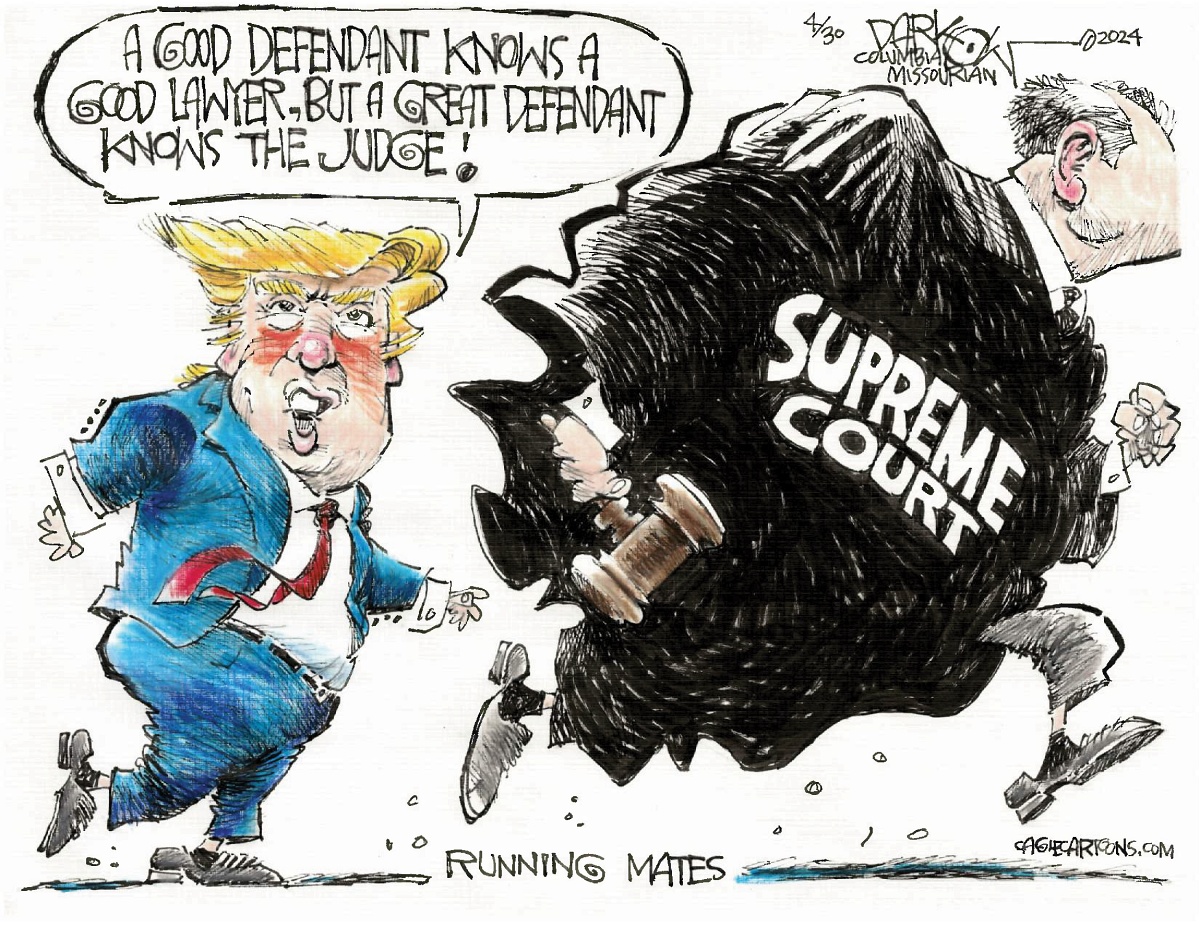
SCOTUS is about to punt. Not the ball. America. It’s fourth and six: Kavanaugh, Gorsuch, Barrett (three Trump), Roberts, Thomas, and Alito (three no Trump). All Republican appointees, all right-wing ideologues, all Catholics. This last is an intriguing data point. Given the right-wing bloc’s synchronized intolerance of abortion access, their religion is the stuff of conspiracy theories; make of it what you will. Within SCOTUS’s enervated Liberal bloc of Kagan, Jackson, and Sotomayor, the latter is also Catholic, making her seven of nine.
That it’s come to this—SCOTUS about to kick America away—is the direct result of an Obama fumble that led to a turnover: The 2016 death of far-right Justice Antonin Scalia handed Obama an opportunity to moderate a Court tilting extreme right. But where his immediate Republican predecessors had put forth the farthest right nominees they could find—Bork, Thomas, Scalia—Obama, naively hoping to glean support from Republican moderates in the Senate, nominated Merrick Garland, a centrist. The Senate Majority Leader Mitch McConnell, himself a right-wing extremist, refused to hold confirmation hearings on the grounds that, because Obama’s presidency would soon end, the SCOTUS vacancy should be filled by the next president.
This was ersatz; 11 months remained of Obama’s (second) term. McConnell calculated that replacing the intellectually dishonest Scalia, a casuistic champion of specious Constitutional doctrines—textualism and originalism—with anyone less partisan would change SCOTUS’s tilt and course. It would have made no difference had Obama nominated Karl Marx instead of Garland. For McConnell, no one even marginally to Scalia’s left would do. To prevent a change in the Court’s direction, McConnell obstructed Justice. The Garland nomination, essentially becalmed, drifted to irrelevance along with Obama’s presidency and hope of a less-extreme SCOTUS.
Obama apologists say that McConnell’s refusal to take up the nomination left Obama without recourse. That’s false. He could have chosen to fight. He could have gotten—or at least pretended to be—angry. He could have appealed to the public, held press conferences, made speeches and addresses, held McConnell’s and the Republicans’ obstructionist feet to the fire. At the least that would have heightened public awareness of the lengths to which Republicans, having exchanged principal for principle and sold out to the far-Reich—the Trump campaign recently posted a video touting the creation of a “unified Reich”—were prepared to go to gut democracy. Instead Obama did virtually nothing.
Related stories
This smacks of alternative history. It is unlikely that any such effort could have changed what happened. But it is also true that Obama didn’t try, or didn’t try very hard. And we do know that Dobbs v. Jackson Women's Health Organization, the case that overturned Roe v. Wade, is the direct consequence of Obama’s fumble. That McConnell forced that fumble makes no difference. But for the turnover, Trump would have gotten only two SCOTUS appointments, not the three that cemented the present, extremist, right-wing super-majority. Given Chief Justice John Robert’s relative moderation, his known attempt to lobby SCOTUS’s right wing to accept a compromise on Dobbs, and his reluctance to go too far too fast in overturning precedent, a Court that included the centrist Garland would not have overturned Roe v. Wade. Dobbs would have been five-four against.
So here we are, with a decision pending in the aptly named Trump v. United States (2024). It might as well be named Trump v. American Democracy.
This was not a case SCOTUS had to take. It could and should have been swatted down. Instead SCOTUS intercepted, and, simply by agreeing to consider it and its explosive question—Are ex-presidents immune from accountability for acts committed, ordered, or authorized while in office?—they lend legitimacy to a concept that on its face is counter-democratic.
In Trump (2024), the plaintiff asserts that the answer is yes, that presidents—meaning he—have blanket immunity not only while in office but after. The Constitution grants legislative immunity to Congress while in session but doesn’t mention the president. Over time, courts have granted presidents some immunity for acts taken in the course of their duties, those decisions predicated on a president’s ability to fulfill his duties free of concerns about post-presidency civil or criminal consequence. These decisions focused on the office, not the individual. Trump is attempting to establish something categorically different: residual immunity for the individual who occupied the office.
That would put ex-presidents—particularly this one—above the law, a contravention of the most fundamental democratic value: that all citizens are equal. It is one thing to carefully consider whether fulfilling the duties of the office requires that presidents should, under some limited circumstances, have some immunity. It is a different thing to grant residual, blanket immunity to those who have served as president. As a practical matter, that would confer monarchical status. Trump and his abettors believe he is already above the law—some have said so explicitly—and they want SCOTUS’s blessing. There is reason to believe, and to fear, that SCOTUS’s Reich-wing majority will provide that.
That would be the end of the American Revolution. In a democracy, there are no circumstances where any citizen should, by default, be positioned above others (which is what being above the law means). Once we establish a category of citizens who are above others, democracy ceases to be. That is aristocracy, and the two are mutually exclusive. On that ground alone, SCOTUS should have swatted the case away. And could have; it came pre-swatted, having already been heard and summarily dispatched by a federal appeals court. A Supreme Court comprised of Justices committed to democracy would have.
This Court didn’t, despite a majority of Justices who either espouse, or who flirt with, “originalism,” the sophistic legal theory that the words of the Constitution must be read and interpreted in the context of their meaning at the time they were written. One would think—one would be wrong—that Justices who claim to be swayed by that theory would refuse to hear Trump (2024) based solely on the Founders’ clearly stated intent to rid America of royalty, aristocracy, and special privilege and their explicit declaration that all men (sic) are created equal and must be considered as such by the law. In fact, nothing is more clearly stated and intended by the Constitution’s writers.
Yet by agreeing to hear arguments in Trump (2024), the majority declared that the idea of residual immunity—and thus of residual special privilege—is worthy of consideration. What’s more, by not releasing their decision immediately, they have rendered the case potentially moot: If he wins, Trump will pardon himself. That would be controversial, but when it reached the Court, as it inevitably would, the same counter-democratic majority would find that the president has the power to pardon himself.
We can look back to Y2K when a Conservative-majority Court simultaneously decided both Bush v. Gore and Bush vs. Gore by stopping the Florida recount. As justification, Justice Antonin Scalia said that allowing the recount to continue would cause "irreparable harm" to the “Bush presidency” by casting "a needless and unjustified cloud" over Bush's “legitimacy.” This ignores that the point of the recount was to decide whether there would be a Bush presidency.
In retrospect, both Bush v. Gore and Bush vs. Gore constitute a good, if arbitrary, point at which to mark the start of American democracy’s end. Justice John Paul Stevens suggested this when he dissented that "counting every legally cast vote cannot constitute irreparable harm." For a right-wing ideologue in the vanguard of a counter-revolutionary rearguard, it can.
No SCOTUS decision could be more activist than Bush v. Gore, yet Conservatives, routinely critical of judicial activism—by which they mean judicial decisions with which they disagree—were silent. The five-four per curam decision—practically speaking, per curam means that no Justice would sign his/her name to it—cited a violation of the Constitution’s Equal Protection clause, positing that because Florida lacked a formal, uniform recount procedure—It’s Florida, Jake—the process could not be equally applied and was thus unconstitutional. A judicially restrained Court would have asked: Is a uniform recount procedure needed?
Ballot-counting machines are designed to err on the side of accuracy. If an incomplete punch leaves a residual bit of ballot paper—a “hanging chad”—the machines spit out the ballots untallied so that election officials—humans—can determine a voter’s intent. In most cases, even if a chad were present, a hole punched next to a name would indicate a voter’s choice. Were a voter’s intent somehow unclear—say the voter had punched two names—an election official would reject the ballot. In deciding both Bush v. Gore and Bush vs. Gore, a partisan Court seeking a pre-determined outcome chose to gloss over the salient fact that no formal recount procedure was needed. What was needed—human judgment—was already present.
Bush vs. Gore was close, the outcome turning on Florida’s electoral votes. For a right-wing SCOTUS majority intent on a “Bush presidency,” that was a problem because a completed recount might result in enough additional votes for Gore to give him Florida’s electoral votes and thus the presidency. (Later analyses found that it would have.) That possibility necessitated halting the recount while Bush, because all votes had not yet been counted, was still slightly ahead, thus giving him the necessary electoral votes to push him over the threshold of 271. Finding more votes for Gore would have done irreparable harm to the legitimacy of the Bush presidency because there wouldn’t have been one.
“Equal Protection” was, at least for the Court’s right-wing partisans, a non-partisan-sounding hook on which to hang a partisan decision. The far-right Scalia knew the reasoning was spurious—he later called it “shit”—but it was a sufficiently Constitutional-sounding premise on which the majority could decide the case in favor of their desired “Bush presidency” while providing sufficiently Constitutional-sounding cover for dealing with the pesky matter of the will of the citizens. Scalia and his right-wing colleagues were playing pin the tail on the elephant.
Americans have been taught a sunny version of our revolutionary history, a narrative that implies that the American Revolution was a united effort by liberty-loving colonists. Oh, there was a misguided traitor or two (here’s looking at you, Benedict) but it was mostly a vast, broad consensus of American patriots—modern, enlightened men (sic) yearning to speak and breathe free—who believed that the time of monarchy, aristocracy, and privilege was over.
Poppycock. Many colonials were die-hard monarchists who opposed the revolution and democracy itself. They never left, and their progeny, whether actual or spiritual, remain. But because advocating for monarchy, aristocracy, privilege, and Christian-inspired Sharia law make for awkward conversation in an equality-touting republic, they have over time learned to appropriate, formulate, and manipulate political speech to fit a counter-democratic agenda.
Take for example, the Founders’ desire to give every man (sic) an equal voice; after Citizens United‘s finding that money distributed to influence political decisions is speech, this bedrock principle of American democracy now gives those with more money louder voices. Or Freedom of Religion, by which the Founders meant freedom from an official state religion. The far Reich has flipped this bedrock American principle so it now means freedom to impose Christianity as a state religion. Uncomfortable with having to make political—as opposed to retail—choices, the monarchists who remained after our revolution have played the long game. Over time, their heirs, both actual and spiritual, have tweaked the tropes of democracy in service of counter-democracy, craftily crafting simplistic messages that appeal to those who feel they have been denied their due.
The Founders intended—they said so clearly—a president to be a commoner on whom the people temporarily bestow authority. They intended—they said so clearly—that a president, though first among equals while in office, was at no time a king. They went to great lengths to ensure that a president was subject to the same social contract as every other citizen, was a common man (sic) before and after being president.
That SCOTUS even agreed to take up the question of residual immunity is a sign of how dire are our straits. Not only does the SCOTUS Reich-wing majority reject democracy, Thomas and Alito no longer feel the need even to feign impartiality. It’s fourth and six, and those six are counter-revolutionaries.
So are Trump and his supporters. It is naïve to treat them as though they are good-faith, fellow Americans “entitled to their points of view.” Their points of view include overthrowing the republic. They share neither our love of American democracy nor its conventions. They are not “entitled to their opinions” as if they did. They see as exploitable weakness our treating them as fellow Americans. They are ruthless, and we are in peril.
It’s fourth and six, and those six are about to kick it away.
Comments

Powered by RoundtableAn AI/DeFi-powered Enterprise Media Operating System. Learn more at Roundtable.io.© Roundtable 2026. By using this site you agree to the Terms of Use and Privacy Policy