



Mar 7, 2026 3:25 AM
Congress’s cruelly deceptive “Kids Online Safety Act” is pushed by Big Tech, the far Right, and an avalanche of junk “studies” to obscure real issues affecting teens.
It doesn’t take a clinical psychologist to see what is really troubling American teenagers. The cause leaps right out of the latest definitive survey of 20,000 adolescents by the nation’s top health agency, the Centers for Disease Control.
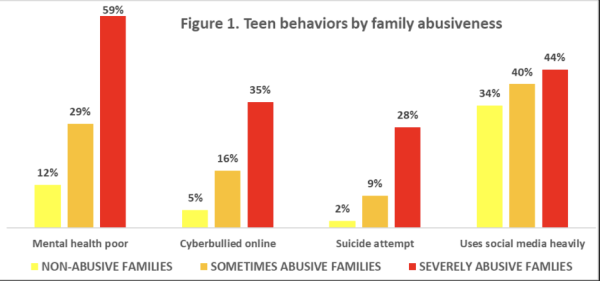
A teenager living in a family whose adults are severely troubled and abusive is five times more likely to be depressed and 15 times more likely to attempt suicide compared to a teen in a non-violent, non-abusive family.
So, you’d think severe family troubles, which a never-mentioned 2024 CDC analysis laments are “common” and associates with the vast majority of teens’ problems, would be the big topic in the raging furor over the teenage “mental health crisis.”
No. The topic is never mentioned – not by mental health professionals, not by academic researchers, not by political leaders, not in the daily barrage of news articles trumpeting that Generation Z is mentally disturbed, suicidal, lonely, neurologically damaged, bullied, and “dumb.”
Related stories
Talking about teens’ troubles without mentioning abusive, troubled families is like talking about lung cancer without mentioning cigarette smoking.
Yet, today’s discourse rigidly evades that issue
Instead, all interests fixate on what research increasingly shows is a trivial factor – social media – to catastrophically expand authoritarian governments’ and Big Tech’s growing menace to free speech, consumer privacy, and democracy itself.
Leaders should be working diligently to break up global media monsters and implement strong user privacy rules. Not happening. Rather, authorities are launching “protect children” crusades featuring “age verification” and “user I.D.” measures that will radically increase Big Tech’s power.
Bizarrely, self-styled liberals such as California Governor Gavin Newsom and U.S. Representative Ro Khanna are leading the charge.
Newsom recently endorsed legislation to restrict teens under age 16 from social media. “‘We have a generation that’s never been more anxious, less free, more stressed, and we have to address this issue,’” the press quoted Newsom, “referring to research linking social media usage with adverse mental health effects.”
But that isn’t what research shows
The only long-term survey, Monitoring the Future, shows teenagers today are no more unhappy or troubled than those of the 1970s and ‘80s. Generation Z is not uniquely unhappy, lonely, suicidal, misogynistic, or “dumb.” These are culture-war scams driven by junk research sensationalized in media splashes.
Teens’ unhappiness did rise back to its 1980’s level during the 2010s after falling to an all-time low in 2007. The 2010s increase accompanied parents’ soaring drug abuse. Drug overdose deaths and hospital emergencies soared among parent-aged adults (25-64) from 2010 to 2022, exactly when more teenagers became depressed. Students’ anxiety and depression similarly rose along with skyrocketing education loan debt.
Newsom and lawmakers could alleviate these real issues instead of succumbing to the avalanche of alarmist commentaries and worthless “studies” claiming social media and smartphones drive teenagers’ “mental health crisis,” suicide, loneliness, sleeplessness, neural damage, dumbness, and related “epidemics.” Proliferating online pay-to-publish “journals” disgorge unreviewed “studies” wildly exaggerated by advocates and reporters who fail to mention they didn’t actually find anything.
Research typically produces many “significant” but trivial factors (like eating vegetables causes teenage depression). But how important is a factor? That requires scrutiny of studies’ “effect sizes.” Effect-size reviews report social media’s near-zero harm to teens is “indistinguishable from noise,” Stetson University psychologist Christopher Ferguson sums up analyses of scores of studies.
Analyses by the Centers for Disease Control, independent researchers, and even anti-social-media psychologists Jonathan Haidt and David Stein confirm Ferguson’s skepticism: heavy social media use explains at most only tiny fractions of teens’ depression and none of their suicide attempts. Long-term research increasingly finds social media and smartphone use have no effects on teens’ mental health.
The second major problem
Studies of teenagers and social media universally omit the biggest cause by far affecting mental health and other problems – their parents’ and household adults’ abuses, violence, drug/alcohol addiction, mental disturbance, and crime.
The CDC’s analyses of its definitive 2023 survey, the only one querying teens on these issues, associated two-thirds of teens’ depression, 84% of teens’ opiate abuse, and 89% of teens’ suicide attempts with parents’ abuses and family troubles. Social media use? Practically none.
Further, five-sixths of the teens who report being cyberbullied online also report abuse by parents. A teen abused at home is 6.5 times more likely also to be cyberbullied, a compound tragedy authorities and politicians refuse to admit even exists.
Bad non-science yields bad laws
Researchers’ and politicians’ crusade to restrict teens from social media culminates in California AB 1709, which Newsom and many lawmakers champion to “protect children.”
Similarly, California Representative Khanna explains why he supports Congress’s “Kids Online Safety Act” (KOSA), which also requires “age verification” for social media use. “Kids are being preyed on… I had moms in my office [who] had lost children because of the choking challenge online, because they’re getting fentanyl online.” Among “hundreds of millions of kids on these platforms,” Khanna cites three who were allegedly raped or coerced by predators online.
However, predations, bullying, coercion, and drugs long predate the internet and are far more prevalent in thousands of documented victimizations of children and youth in churches, sports, youth organizations like Scouting, schools, and police custody. Leaders of major institutions often cover up abuses of children and youth.
In California in the last five years, Child Maltreatment researchers substantiated 30,000 children and teenagers suffered violent, sexual, and psychological abuses and 800 were murdered by parents and caretakers – only the iceberg-tip of family abuses.
Banning teens from social media endangers them
Those who see overuse of screens as a real issue should be alarmed by CDC numbers showing teens from abusive, troubled families are much more likely to use social media frequently (44%) than non-abused teens (34%) (see Figure 1). Instead, authorities ignore abuse issues and superficially blame social media for teens’ problems.
That is a huge mistake. Large majorities of teens tell Pew Research that while social media includes “drama,” it makes them feel “more accepted” and connected to “people who can help them get through tough times.” Depressed girls who use social media frequently are less likely to attempt suicide or harm themselves, CDC surveys show.
Khanna acknowledges he’s heard from advocates that “if you’re LGBTQ, you need the Internet” but dismisses that concern: "LGBTQ kids" are bullied online “three times [more] than … non-LGBTQ kids.”
Khanna’s dismissal leaves out the reality that 85% of LGBTQ teens who report being cyberbullied also report being bullied by adults in their homes. Half of LGBTQ teens report on CDC surveys having been violently abused and four-fifths psychologically abused by parents and household adults, far more than report being bullied online.
Adult-abused LGBTQ teens are considerably more likely to use social media than their non-abused counterparts. The far Right declares it will use KOSA to ban youths from LGBTQ sites, LGBTQ advocates warn, so “why do some Democrats support it”?
Big Tech and Heritage eagerly back “child protection” laws
While Representative Khanna and other advocates tout KOSA as a blow against Big Tech, tech giants like Meta, Apple, X, and Anthropic along with the far-Right Heritage Foundation spend millions of dollars supporting KOSA.
Why? Because KOSA and dangerous “protect children” measures have nothing to do with “protecting children.” They are sweeping, repressive edicts granting Big Tech, government authoritarians, and right-wing interests hugely expanded powers to censor online content, surveil users’ private data, and harm young people.
KOSA requires platforms to restrict content “inappropriate for minors" via “age verification” procedures. That radically empowers governments and tech companies to censor content they don’t like while harvesting more personal and biometric identity information for surveillance, profit, and exploitation.
UK and Australian bans on under-age-16 onliners censor young people from child abuse protection, health, pro-Palestine, LGBTQ, climate activism, and related sites government and interests disapprove of. U.S. lawmakers forced right-wing takeover of TikTok’s platform not for safety reasons, but anger at pro-Palestine content.
Authorities’ dismissal of family abuses and troubles – the proven drivers of teens’ poor mental health and related risks – while rewarding Big Tech and punishing teens (especially minorities) by banning their social media access are appalling derelictions of adult responsibilities. Why are supposedly progressive leaders on board with this?
Comments

Powered by RoundtableAn AI/DeFi-powered Enterprise Media Operating System. Learn more at Roundtable.io.© Roundtable 2026. By using this site you agree to the Terms of Use and Privacy Policy