


Parole Release System
Dec 21, 2023 11:20 PM
With grant rates among the lowest in the nation and people forced to wait up to 15 years between hearings, the Golden State's parole system is far from glittering.
In 2019, we graded parole release systems across the US. Though no state performed particularly well, the 16 states that have mostly abolished discretionary parole since 1976 received our lowest grade, an F-. California was among them. Advocates from California asked us, however, to take a closer look at California’s parole system. Unlike other states that have abolished discretionary parole, California’s discretionary parole system since 2014 has significantly expanded eligibility for a large number of incarcerated people who meet certain criteria, and more become eligible each year.
We revisited California’s existing parole system to see how it would score using criteria we reserved for states with discretionary parole. In keeping with our more recent parole research, we also examined recent trends in the state’s parole process to see how it is being (mis)used and how often parole hearings actually result in release. While California may score slightly better this time around, ultimately, it still merits a solid “F.”
What makes California different from other states that have abolished parole?
California replaced parole with determinate sentencing for most people in the state’s prison system in 1977. As in the 15 other states that have done this, discretionary parole was not entirely abolished. Almost all states that have abolished discretionary parole still retained it for small slices of their prison populations. However, California differs from other states that have abolished parole because it largely determines who is still eligible for parole based on criteria, not the date that someone was sentenced.
In the other states that abolished discretionary parole, the only people still eligible for parole are those who were “grandfathered in” — that is, who were sentenced before parole was abolished. In these states, the number of people eligible for parole shrinks every year, as people are released or die in prison. In California, people are eligible for parole if they meet certain criteria, like being convicted as a young person, being eligible for elderly parole, or being sentenced under certain laws like 2nd- or 3rd-strike laws. Every year, new people are sentenced who will eventually qualify for parole.
Related stories
What does parole look like in California?
Every state differs, though elements of California’s parole process are similar to others. In a nutshell, the Board of Parole Hearings determines when a person becomes parole-eligible and sets an initial parole suitability hearing. Like in other states, the Board considers factors such as the offense, institutional records, and the results of a comprehensive risk assessment. They often consider input from the DA and survivors of violent crimes. People have access to legal representation, though in 2021, those with state-appointed attorneys were granted parole at half the rate of those with private counsel, which many cannot afford. Unlike Alabama, which denies incarcerated people any access to the parole board, California interviews the person, generally via video. If the Board makes a decision, they either grant release or deny it, in which case the person won’t get another hearing for between 3 to 15 years. The number of times the board may see a person is bound only by the duration of their sentence, so those with lengthy or life sentences are often reviewed and denied many, many times.
How many people does this affect?
In 2022, there were 9,017 scheduled hearings, up 49% since 2019, when there were 6,061. Meanwhile, the prison population in the state dropped by around 21%. Not only did the percentage of the prison population that was eligible for parole actually increase from around 5% in 2019 to more than 9% by 2022, but it made up almost a quarter of everyone who was eligible for release from California prisons by any means that year. Because of California’s low grant rate, however, people released on parole accounted for just 4% of all people released from California prisons in 2022.
Parole grant rates 2019-2022
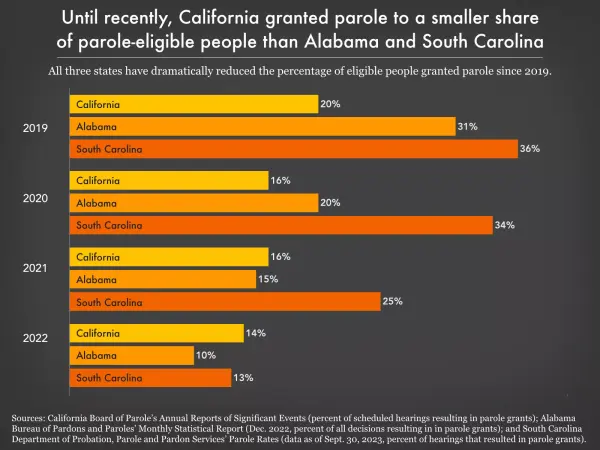
California has made several recent moves to expand parole eligibility. However, these efforts appear to have been undermined by a parole board reluctant to release anyone. California’s actual grant rate, the percentage of scheduled parole suitability hearings that resulted in parole approval, was just 14% in 2022, barely above South Carolina (13%) and Alabama (10%) for the worst among those we examined.
From 2019 to 2022, California’s actual parole grant rate fell 29%. Additionally, while hearings increased significantly, the vast majority of new hearings resulted in non-decisions, which increased by 75%, and denials, up by 41%. Ultimately, nearly 3,000 more hearings resulted in only 75 more people being released in 2022 compared to 2019, making the likeliest outcome of a parole hearing in California, by far, continued incarceration.
Grading California
Even adjusting for its limited use of discretionary parole, California’s parole system is more box office bomb than Hollywood hit. Overall, the state scored just 60 out of 120 possible points, earning only a slightly higher F than in the original report. While there were a number of issues here, three stood out as particularly egregious:
- Prosecutorial influence: Prosecutors often attend hearings and heavily influence the outcome. In 2022, prosecutors attended 60% of hearings held. The hearings attended by prosecutors resulted in about 24% fewer grants than when prosecutors did not attend.
- Extremely lengthy time between hearings after denials: Incarcerated people have to wait a minimum of three years and sometimes up to 15 years between denials.
- Unequal weighting of risk-assessment results: While California does issue a detailed annual report, there are massive deviations between the risk-assessment results, which are supposed to weigh heavily on the guidelines, and actual hearing outcomes. In 2022, people deemed “Low Risk” were paroled only 65% of the time, while folks with “Moderate Risk” were granted parole only 22% of the time, and those deemed “High Risk” were almost never paroled <1%. This suggests that negative risk assessments weighed far more against people than positive risk assessments did in their favor.
Moving forward: Ways California could improve its system
- Reduce the time between all hearings to no more than 1 year: Setting time between denials to up to 15 years fails to take into account changing policies, people, or parole board compositions. Additionally, the discrepancy in time between denials vs. time between waivers (1 to 5 years) encourages people to self-select.
- Eliminate reliance on “fixed-moment factors” and increase focus on objective factors that are better suited to measure personal growth and mitigated risk. Like many parole boards, California’s guidelines for parole consideration place heavy emphasis on “fixed-moment factors” — such as the crime of conviction, the person’s actions, and even their mental state during the commission of the crime — which are unchangeable regardless of effort on the part of the incarcerated person or the passage of time. These are ill-suited to measure things like personal growth or the risk a person might pose if released.
Conclusion
Though partially abolished almost 47 years ago, California’s discretionary parole system is alive and unwell as 2023 draws to a close. More and more people find themselves parole-eligible each year, and many are denied their chance at freedom and are forced to wait a decade or more before applying again. Ultimately, though parole does exist in some form in California, it is far from being at the head of the class.
Comments

Powered by RoundtableAn AI/DeFi-powered Enterprise Media Operating System. Learn more at Roundtable.io.© Roundtable 2026. By using this site you agree to the Terms of Use and Privacy Policy