
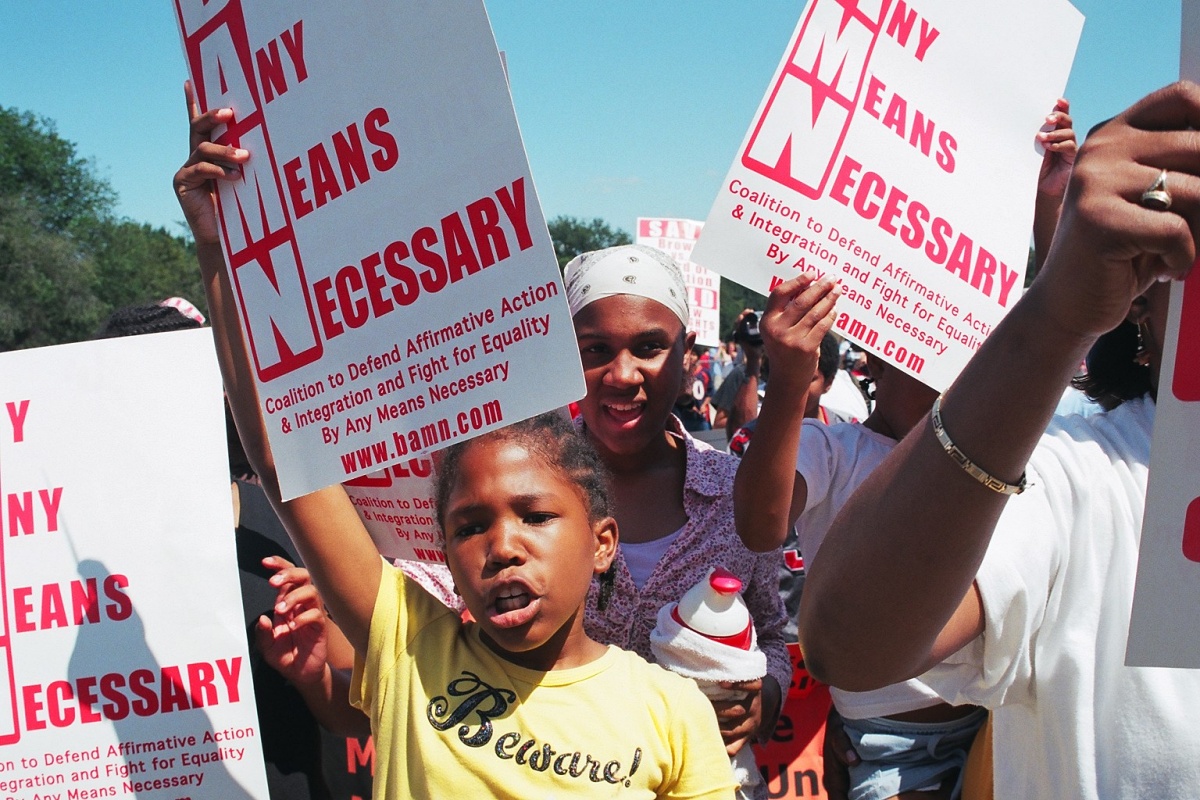
Elvert Barnes • Attribution-ShareAlike (CC BY-SA 2.0) Flickr


Jul 11, 2023 2:00 PM
The gutting of affirmative action in higher education was consistent with the court’s tradition of suppressing and managing people the country never wanted.
The shock of the Supreme Court’s fatal assault on affirmative action may have worn off in recent days, but many progressives still lament what they regard as the hijacking of the court by Donald Trump. Few consider the possibility that, at least with respect to race, the court was not hijacked at all, and the gutting of affirmative action in higher education was consistent with the court’s tradition of suppressing and managing people the country never wanted.
As a human being, Trump is a phenomenal disaster. But we are blessed that he lacks a filter, and he freely shares the disturbing, weird thoughts that fill his warped brain. While we marvel that he questioned the admission of “all these people from shithole countries” into the U.S. in lieu of immigrants from countries like Norway, we must also acknowledge that his sentiments are demonstrably consistent with the very essence of the U.S. ideal. That is, that the U.S. project is for white people.
Africans and the First Nations are an unwanted “other” with a racial status that can never be rehabilitated. We know this because the Supreme Court told us so. In the 1857 case of Dred Scott v. Sandford, the U.S. Supreme Court explained:
“Yet the men who framed [the Declaration of Independence] were great men--high in literary acquirements--high in their sense of honor, and incapable of asserting principles inconsistent with those on which they were acting. They perfectly understood the meaning of the language they used, and how it would be understood by others; and they knew that it would not in any part of the civilized world be supposed to embrace the negro race, which by common consent, had been excluded from civilized Governments and the family of nations, and doomed to slavery.”
Related stories
In 1823 the Supreme Court used its decision in Johnson v. McIntosh to say: “…the tribes of Indians inhabiting this country were fierce savages, whose occupation was war, and whose subsistence was drawn chiefly from the forest. To leave them in possession of their country, was to leave the country a wilderness…”
The passage of time did not soften the court’s viewpoint. When it decided Plessy v. Ferguson in 1896, the Justices explained: “The object of the [14th] amendment was undoubtedly to enforce the absolute equality of the two races before the law, but, in the nature of things, it could not have been intended to abolish distinctions based upon color, or to enforce social, as distinguished from political, equality, or a commingling of the two races upon terms unsatisfactory to either.”
In other words, if these unwanted people must remain, then by all means let’s keep them as far out of sight and out of the minds of white people as we can. Even in 1954 when Plessy was overturned by Brown v. Board of Education, arguably the doctrine of “separate but equal” was rejected not because of racial enlightenment but instead because Jim Crow was awkward, burdensome, and limited access to Black consumer dollars.
Racial integration in the years that followed was forced by mass movements. The country grudgingly came to terms with the fact that, as a practical matter, Africans would never be shipped en masse to Liberia, and the First Nations would not be forever contained on reservations. Still, these people were unwanted –except for purposes of entertaining white people on the stage or in athletic arenas. Certainly, they were unwanted at universities where they might obtain credentials that would prepare them to – God forbid – compete with white people.
The Supreme Court was aware of its duty when in 1978 it decided Bakke v. University of California. The case was brought by a white unsuccessful medical school applicant who complained that his denial of admission was caused by the university’s affirmative action program. The case is widely remembered as one that not only gave universities license to maintain affirmative action programs, but which also provided guidelines for how to maintain these programs within constitutional bounds. Undetected by many is the way in which white privilege imposed and insinuated itself into the case.
The gutting of affirmative action in higher education was consistent with the court’s tradition of suppressing and managing people the country never wanted.
It is sometimes forgotten that initially, affirmative action was regarded as a reparations remedy. The University of California believed it to be such, and while the Bakke opinion does not say so explicitly, this notion was likely very troubling to the white Justices, as the idea of reparations troubles many white people. The court moved quickly to dismiss reparations as an acceptable justification for affirmative action. Bakke’s majority opinion says:
“Hence, the purpose of helping certain groups whom the faculty of the [University of California-Davis] Medical School perceived as victims of ‘societal discrimination’ does not justify a classification that imposes disadvantages upon persons like [the purportedly aggrieved white man], who bear no responsibility for whatever harm the beneficiaries of the special admissions program are thought to have suffered.”
Not only did the white Justices use their privilege and power to knock down an idea that made them personally uncomfortable, but they went a step further and used that same privilege to endorse an idea that was not only in their comfort zone, but which also promised benefits for students who enjoyed comparable white privilege. The court embraced the argument that students benefit from exposure to students of different backgrounds with different perspectives. Although affirmative action could not be about doing justice for students impacted by historical racial crimes and discrimination, it could be used to make students of color available to satisfy the curiosity of white students, and maybe even to provide them with some measure of entertainment. The Bakke decision explained:
“The fourth goal asserted by petitioner is the attainment of a diverse student body. This clearly is a constitutionally permissible goal for an institution of higher education. Academic freedom, though not a specifically enumerated constitutional right, long has been viewed as a special concern of the First Amendment. The freedom of a university to make its own judgments as to education includes the selection of its student body.”
The Supreme Court visited the affirmative action issue again in 2003 when cases against the University of Michigan found their way to the court’s docket. Affirmative action survived, but it is reasonable to believe that it was preserved in large measure because it was regarded as important to the interests of white privilege and power – specifically the military-industrial complex. The military establishment and major corporations argued forcefully for preservation of programs that might ensure the flow of people of color through the universities and into corporate suites and the Pentagon. In a friend of the court brief filed by retired military leaders in the Harvard/University of North Carolina case, it was argued that “officer corps diversity is far more than a laudable goal – it is a strategic imperative.” In explaining the importance of affirmative action, the brief said:
“Recent military engagements have frequently required close collaboration with people of diverse racial and ethnic backgrounds. In February 2020, for example, the Secretary of Defense ordered deployment of an Army brigade to Africa to train and assist African countries to better compete with China and Russia in those regions.”
These former military officers were smart enough to understand the problematic optics of having a silver-haired, square-jawed white man directing military operations in Africa. Likewise, multinational corporations attempting to cut deals for extraction of oil and mineral resources from the southern hemisphere understood the value of sending someone with brown skin to negotiate. Disregarding for the moment the ethics of such thinking, of great significance is the fact that it is the interests of everyone but the intended beneficiaries of affirmative action that receive the most attention.
Consequently, it should come as no surprise that in this most recent case, the plight of students of color took a back seat to the interests of a MAGA horde traumatized by demographers’ predictions that white people will become a racial minority; and also the military-industrial complex as the court carved out an affirmative action exception for military academies.
Fears that white social, economic, and political dominance are slipping away have evolved into a mass mania that set in motion the dynamics needed for the election of a President who would appoint Justices willing to enable and enforce the will of white workers in panic mode. The thinking seems to be that if a giant wall can’t stop the growth of brown communities, then at least the Supreme Court can ensure that people of color are deprived of their opportunities for success.
When all is said and done, the Supreme Court has done a perfect job for the people for whom the country was intended – white people. This may strike many as a crass, alarming reality, but it is a reality nonetheless. If the rest of us can’t handle the truth, then certainly Clarence Thomas can. He may have been born as a member of a community of unwanted people, but by golly he will do everything possible to separate himself from it – by any means necessary. (With heartfelt apologies to Malcolm X.)
Comments

Powered by RoundtableAn AI/DeFi-powered Enterprise Media Operating System. Learn more at Roundtable.io.© Roundtable 2026. By using this site you agree to the Terms of Use and Privacy Policy