


Feb 1, 2023 5:49 PM
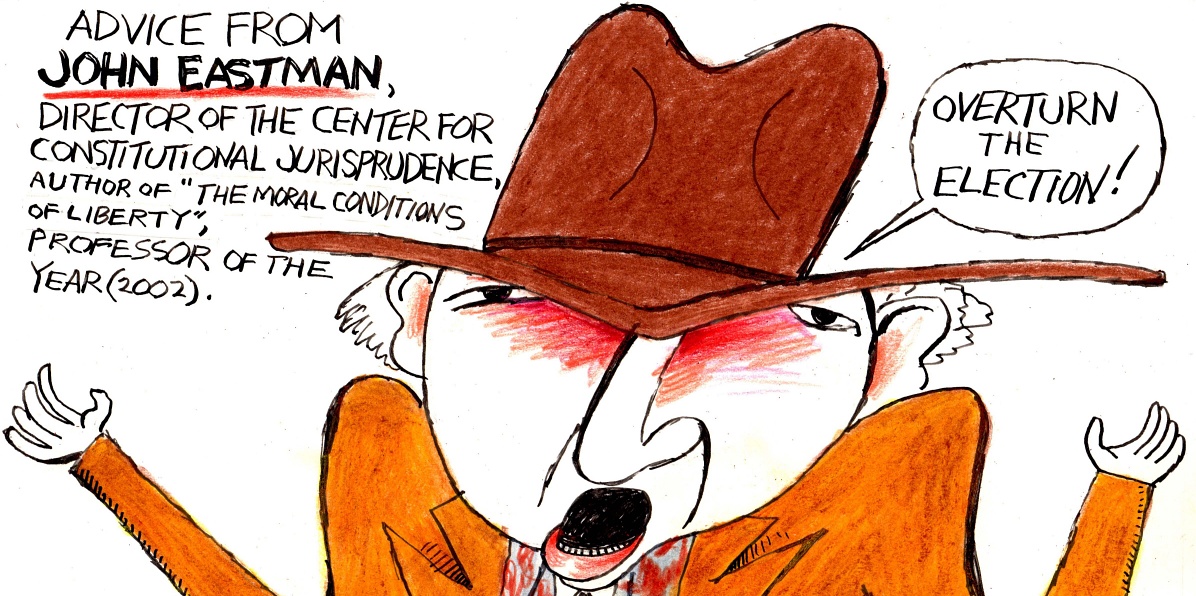
Trump’s Consigliere: John Eastman faces disbarment for his misconduct and unethical behavior seeking to overturn the 2020 election.
We’ve learned that Donald Trump didn’t do it alone. In his illegal plots to overturn the 2020 election, Trump was aided and abetted by scores of enablers who checked their morals at the door and helped him pursue his seditious coup. One of those people was John Eastman, Trump’s consigliere and the chief architect of his illegal strategy to retain the presidency by any means necessary.
On March 28, 2022, in the case of Eastman v. Thompson, U.S. District Judge David Carter found it was more likely than not that Eastman and Trump “dishonestly conspired to obstruct the Joint Session of Congress on January 6” and that the conspiracy between Eastman and Trump was “a coup in search of a legal theory” which “spurred violent attacks on the seat of our nation’s government” and threatened to “permanently end[] the peaceful transition of power.”
In the final report of the House Select Committee on January 6, issued on December 22, 2022, the Committee specifically named Eastman in the four criminal referrals to the Department of Justice for “corruptly” “obstructing, influencing, or impeding” a official proceeding or “attempting to do so;” for conspiracy to defraud the United States, for conspiracy to make a false statement, and for inciting, assisting, or providing aid and comfort for an insurrection against the authority of the United States.
The State Bar of California Seeks to Disbar Eastman for Unethical Conduct
On January 26, 2023, in the most detailed accusations against Eastman to date, the State Bar of California filed a 35-page complaint alleging eleven counts of misconduct seeking his disbarment and other penalties. The complaint alleges that beginning in December 2020 Eastman worked with Trump and his campaign to develop a legal and political strategy to dispute the results of the November 3, 2020 election by “promoting the idea that the election was tainted by fraud, disregard of state election law, and misconduct by election officials” despite all the information to the contrary.
Related stories
In particular, on December 1, 2020, Attorney General Barr publicly stated, “to date, we have not seen fraud on a scale that could have effected a different outcome in the election.” By early January 2021, more than 60 courts had dismissed cases alleging fraud in the presidential election. Approximately 30 of these cases were dismissed or had injunctive relief denied based on determinations by a judge that the pleadings failed to allege facts sufficient to state a claim or that no actual evidence of election fraud had been presented, or after an evidentiary hearing and a finding that the evidence presented by the plaintiffs was insufficient on the merits.
As just a few examples, on November 6, 2020, in Michigan, a court denied a request for injunctive relief, concluding that the plaintiffs’ motion was “based upon speculation and conjecture” and that there was “no evidence to support accusations of voter fraud.” On November 21, 2020, in Pennsylvania, a court granted a motion to dismiss some claims based on lack of standing but others for failure to state a claim, concluding that the allegations of election fraud rested on “strained legal arguments without merit and speculative accusations, unpled in the operative complaint and unsupported by evidence.” On December 8, 2020, in Arizona, the state’s Supreme Court concluded that the trial court was correct in its determination, after an evidentiary trial, that the plaintiff had failed “to present any evidence of ‘misconduct,’ ‘illegal votes’ or that the Biden Electors ‘did not in fact receive the highest number of votes for office,’ let alone establish any degree of fraud or a sufficient error rate that would undermine the certainty of the election results.”
Consequently, by early December 2020, Eastman “knew, or was grossly negligent in not knowing, that there was no evidence upon which a reasonable attorney would rely of election fraud or illegality that could have affected the outcome of the election, and that there was no evidence upon which a reasonable attorney would rely that the election had been ‘stolen’ by the Democratic Party or other parties acting in a coordinated conspiracy to fraudulently ‘steal’ the election from Trump.”
Nevertheless, Eastman “continued to work with Trump and others to promote the idea that the outcome of the election was in question and had been stolen from Trump as the result of fraud, disregard of state election law, and misconduct by election officials.”
In doing so, the State Bar alleges that Eastman violated his obligations as an attorney in two ways. First, “he provided legal advice, formulated legal strategies, and engaged in litigation based on, and made public statements propounding, allegations of election fraud that he knew, or was grossly negligent in not knowing, were false.”
Second, “based on misinterpretations of historical sources, misinterpretations of law review articles, and law review articles that he knew or was grossly negligent in not knowing were themselves fundamentally flawed, he provided, and proposed actions based on, legal advice regarding the unilateral authority of the Vice President to disregard or delay the counting of electoral votes that he knew, or was grossly negligent in not knowing, was contrary to and unsupported by the historical record and established legal authority and precedent, including the Electoral Count Act and the Twelfth Amendment, such that no reasonable attorney with expertise in constitutional or election law would have concluded that the Vice President was legally authorized to take the actions respondent proposed.”
The State Bar complaint contains eleven charges of misconduct, which can be grouped into three categories. The first is an overarching count encompassing a wide range of activities by which Eastman violated his obligation “to uphold the Constitution and the laws of the United States by engaging in a course of conduct.” The second category involves two counts of seeking to mislead courts in two lawsuits in which Eastman represented Trump. Finally, in eight counts he is accused of committing various acts “involving moral turpitude, dishonesty, and corruption in willful violation of Business and Professions Code.”
Eastman Is Accused of Violating His Oath to Uphold the Constitution and the Laws of the United States
The Two-Page Memo
On December 23, 2020, Eastman wrote and circulated a two-page memo providing legal advice to Trump and Vice-President Michael Pence. Eastman asserted that at the upcoming Joint Session of Congress to count electoral votes on January 6, 2021, Pence had the legal authority to take unilateral action with respect to the electoral votes of seven states that had voted for Biden (Arizona, Georgia, Michigan, Pennsylvania, Nevada, New Mexico, and Wisconsin).
Specifically, Eastman proposed that Pence “announce[ ] that he has multiple slates of electors, and so is going to defer decision on that until finishing the other States.” Eastman then proposed two alternative courses of action. Under the first, Pence would “announce[ ] that because of the ongoing disputes in the 7 States, there are no electors that can be deemed validly appointed in those States.” Without electors appointed for those states, Trump’s 228 electoral votes would constitute a majority of the 454 appointed electors. Eastman advised “Pence [to] then gavel[ ] President Trump as re-elected.”
In the alternative, after “[h]owls, of course, from the Democrats,” Pence would concede that 270 electoral votes were required for a majority. Under the Twelfth Amendment, when no candidate receives a majority of votes cast by the appointed electors, the House of Representatives chooses the President voting by state delegation. Because Republicans controlled 26 state delegations, Eastman advised that “President Trump is re-elected there as well.”
According to the State Bar, Eastman “knew, or was grossly negligent in not knowing” that the two-page memo’s assertion that the “7 states have transmitted dual slates of electors to the President of the Senate” was “false and misleading,” in that, as he knew at the time:
- (pursuant to federal law “the governor of each of those states had submitted a certificate of ascertainment [indicating] that the Biden electors, not the Trump electors, had been appointed because the Biden electors received more votes in those state’s election;
- no other state official of any of those states had submitted a purported certificate of ascertainment naming Trump electors; and
- as a result, no legal authority on behalf of any state had taken any action to support the contention that Trump electors were the legitimate electors for any of the seven states.”
In fact, astonishingly, the State Bar reveals that on January 10, 2021, Eastman himself admitted in an email that the purported Trump electors from these seven states “had no authority” because “[n]o legislature [had] certified them.”
Bannon’s War Room
On January 2, 2021, on Steve Bannon’s radio program “Bannon’s War Room,” Eastman told the audience there was “massive evidence” of fraud involving absentee ballots in the 2020 presidential election, “most egregiously in Georgia and Pennsylvania and Wisconsin.” He also stated there had been “more than enough” absentee ballot fraud “to have affected the outcome of the election.”
The State Bar alleges he made these statements “with the intent to encourage the audience listening to the radio program and the general public to question the legitimacy of the election results.” In fact, he “knew or was grossly negligent in not knowing, that these allegations regarding absentee ballot fraud were false and misleading,” because he “knew at the time that there was no evidence upon which a reasonable attorney would rely [on] absentee ballot fraud in any state in sufficient numbers that could have affected the outcome of the election.”
The Six-Page Memo
The next day, January 3, 2021, Eastman wrote and circulated a six-page legal memorandum falsely claiming that Pence had the legal authority to take various actions, including “determin[ing] on his own which [slate of electors] is valid” or “adjourn[ing] the joint session of Congress.”
The six-page memo asserted that the election was tainted by “outright fraud (both traditional ballot stuffing and electronic manipulation of voting tabulation machines),” despite the fact that there was “no evidence upon which a reasonable attorney would rely [of] ‘outright fraud,’ including either ‘traditional ballot stuffing’ or ‘electronic manipulation of the voting tabulation machines,’ in any state involving enough votes to affect the outcome of the election.”
The six-page memo presented alternative scenarios in which Pence, as the “ultimate arbiter,” either unilaterally counted no electors for each of the seven states that had purportedly submitted “dual slates of electors,” or he unilaterally sent the election to the House of Representatives under the procedures established by the Twelfth Amendment, or he unilaterally adjourned the Joint Session without counting the electoral votes in the hope that Republican legislatures in the seven states would later appoint or certify a slate of Trump electors.
Eastman boasted that his plan was “BOLD” but claimed, “this Election was Stolen by a strategic Democrat plan to systematically flout existing election laws for partisan advantage; we’re no longer playing by Queensbury Rules, therefore.” Again, the State Bar alleges he “knew, or was grossly negligent in not knowing, that this assertion was false and misleading.”
Not done yet, Eastman advised that Pence could “determine that the ongoing election challenges must conclude before ballots can be counted, and adjourn[] the joint session of Congress.” Then “[t]aking the cue, state legislatures [could] convene, order a comprehensive audit/investigation of the election returns in their states, and then determine whether the slate of electors initially certified is valid, or whether the alternative slate of electors should be certified by the legislature.”
This time, Eastman specifically cited federal statute 3 U.S.C. § 2 as his statutory basis, in fact, the State Bar alleges he “knew, or was grossly negligent in not knowing, that 3 U.S.C. § 2 did not authorize any state legislature to appoint or certify electors after Election Day in the factual circumstances present in the 2020 election.”
The State Bar alleges that the courses of action Eastman proposed “were contrary to and unsupported by the historical record, and contrary to and unsupported by established legal authority and precedent, including the Electoral Count Act and the Twelfth Amendment.” In fact, his legal theory was based on “misinterpreted historical sources, misinterpreted law review articles, and law review articles which he knew, or was grossly negligent in not knowing, were themselves fundamentally flawed, such that no reasonable attorney with expertise in constitutional or election law would conclude that Pence was legally authorized to take the actions” he proposed.
Remarkably, the State Bar reveals in an earlier email exchange in October 2020, Eastman himself had recognized these courses of action were improper. In particular, he stated that he did not agree that Pence, who serves as President of the Senate, could determine which votes to count on January 6, 2021, because, in Eastman’s own words, “3 U.S.C. § 12 says merely that [the President of the Senate] is the presiding officer, and then it spells out specific procedures, presumptions, and default rules for which slates will be counted. Nowhere does it suggest that the President of the Senate gets to make the determination on his own. § 15 doesn’t, either.” In addition, he stated, “I don't think [Article II] entitles the Legislature to change the rules after the election and appoint a different slate of electors in a manner different than what was in place on election day. And 3 U.S.C. § 15 gives dispositive weight to the slate of electors that was certified by the Governor in accord with 3 U.S.C. § 5.”
Two Meetings With Pence’s Lawyer
The charges go far beyond these two memos. On January 4, 2021, Eastman and Trump invited Pence, Pence’s White House Counsel Greg Jacob and Pence’s Chief of Staff Marc Short to the Oval Office. Eastman presented only two courses of action for Pence to take on January 6: reject the electors from the seven states that Eastman falsely and misleadingly asserted had submitted “dual slates of electors,” or delay the count to give those states legislatures time to certify Trump’s electors. Pence flatly rejected these options, responding that he did not possess the legal authority to carry out either of them.
The next day, Eastman met again with Jacob and Short and told them, “I’m here asking you to reject the electors.” But Eastman retreated from his initial request “to reject the electors,” shifting instead to proposing that Pence delay the count because that would be more “palatable.” Remarkably, he admitted that his proposals were contrary to historical practice, violated several provisions of statutory law, and would likely be unanimously rejected by the Supreme Court.
The State Bar alleges that Eastman’s various assertions prompted Trump to tweet his followers at 1:00 a.m. on January 6, 2021: “If Vice President @Mike_Pence comes through for us, we will win the Presidency . . . Mike can send it back!” At approximately 8:17 a.m., Trump tweeted, “States want to correct their votes . . . All Mike Pence has to do is send them back to the States, AND WE WIN. Do it Mike, this is a time for extreme courage!”
Eastman Lies in a Speech at the January 6 Rally at the Ellipse of the National Mall
Eastman didn’t simply remain behind the scenes writing memos and holding meetings. On January 6, 2021, he spoke to the crowd of tens of thousands of people at the notorious rally (promoted as a “Save America” march) at the Ellipse of the National Mall in Washington, D.C. His speech was broadcast live on television. He was introduced by Rudy Giuliani as “Professor Eastman” and was described as “one of the preeminent constitutional scholars in the United States.”
Eastman told the audience, “We know there was fraud, traditional fraud that occurred. We know that dead people voted.”
Eastman told the audience, “We know there was fraud, traditional fraud that occurred. We know that dead people voted.” In fact, the State Bar alleges “there was no evidence upon which a reasonable attorney would rely of fraud in any state election, involving deceased voters or otherwise, which could have affected the outcome of the election.”
In particular, the State Bar notes that while Trump claimed that some 5,000 ballots in Georgia were cast by deceased voters, the Georgia State Election Board found just four such votes, all of which had been returned by relatives. Similarly, Michigan's Office of the Auditor General determined that only 1,616 votes in Michigan, or 0.03% of the total ballots, were cast by voters who were deceased on Election Day and primarily involved people who were alive when they voted prior to Election Day. And the Nevada Secretary of State determined that only 10 dead voters had ballots cast in their names.
Eastman also also told the crowd that Dominion electronic voting machines had fraudulently manipulated the election results both during the 2020 presidential election and during the January 5, 2021, run-off election in Georgia for its two Senate seats. “They” put ballots “in a secret folder in the machines, sitting there waiting until they know how many they need,” and that after the polls closed, “unvoted ballots” were matched with “an unvoted voter” to fraudulently change the election totals in favor of Joe Biden and the Democratic candidates in the Georgia runoff election. Eastman added that analysis of the vote percentages showed that “they were unloading the ballots from that secret folder, matching them—matching them to the unvoted voter and voila we have enough votes to barely get over the finish line.”
In fact, the State Bar alleges there was no evidence upon which a reasonable attorney would rely on fraud through electronic manipulation of Dominion voting tabulation machines, because on or about November 12, 2020, the Elections Infrastructure Government Coordinating Council and the Election Infrastructure Sector Executive Committees issued a joint statement which stated that the “2020 presidential election was the most secure in American history” and “there was no evidence that any voting system deleted or lost votes, changed votes, or was in any way compromised.” Furthermore, no reasonable expert in statistical analysis of election results would conclude that the vote percentages related to the Dominion voting machines indicated that the machines had been used to fraudulently manipulate the election results.
Eastman concluded his January 6 speech by stating: “And all we are demanding of Vice President Pence is this afternoon at 1:00 he let the legislators of the state look into this so we get to the bottom of it, and the American people know whether we have control of the direction of our government, or not. We no longer live in a self-governing republic if we can’t get the answer to this question. This is bigger than President Trump. It is a very essence of our republican form of government, and it has to be done. And anybody that is not willing to stand up to do it, does not deserve to be in the office. It is that simple.”
He made this demand despite the fact that by this time on January 6, 2021, before the Joint Session of Congress began, Pence had publicly rejected Eastman proposed plan in a written statement that concluded: “It is my considered judgment that my oath to support and defend the Constitution constrains me from claiming unilateral authority to determine which electoral votes should be counted and which should not.”
After Eastman finished his speech, Trump took the podium and told the crowd and television audience: “Thank you very much, John. . . . John is one of the most brilliant lawyers in the country, and he looked at this and he said, ‘What an absolute disgrace that this can be happening to our Constitution.’ . . . Because if Mike Pence does the right thing, we win the election. All he has to do, all this is, this is from the number one, or certainly one of the top, Constitutional lawyers in our country. He has the absolute right to do it.”
Trump concluded his speech by urging his supporters to walk with him to the Capitol: “Now, it is up to Congress to confront this egregious assault on our democracy. And after this, we’re going to walk down, and I’ll be there with you, we’re going to walk down, we’re going to walk down. . . . [W]e’re going to try and give our Republicans, the weak ones because the strong ones don’t need any of our help. We’re going to try and give them the kind of pride and boldness that they need to take back our country. So let’s walk down Pennsylvania Avenue.”
Even as Violence Rages at the Capitol, Eastman Continues to Pressure Pence
We all know what happened next. But what many may not know, according the State Bar, is that while “the violent protestors were attacking the Capitol Building,” Eastman and Trump “continued to urge Pence to delay the electoral vote count.”
At approximately 12:14 p.m., Greg Jacob, Pence’s counsel, had sent Eastman an email that stated, “I just don’t in the end believe that there is a single Justice on the United States Supreme Court, or a single judge on any of our Courts of Appeals, who is as ‘broad minded’ as you when it comes to the irrelevance of statutes enacted by the United States Congress, and followed without exception for more than 130 years.” The email closed by stating that Jacob “ha[d] run down every legal trail placed before me to its conclusion, and I respectfully conclude that as a legal framework, it is a results oriented position that you would never support if attempted by the opposition, and essentially entirely made up.”
At approximately 2:20 p.m., Secret Service agents removed Pence from the Senate floor, and the Senate and House were abruptly called to recess as the mob of protestors moved further into the building.
At approximately 2:24 p.m., Trump tweeted, "Mike Pence didn't have the courage to do what should have been done to protect our Country and our Constitution."
At approximately 2:25 p.m. Eastman replied to Jacob’s email, stating, “You think you can’t adjourn the session because the [Electoral Count Act] says no adjournment, while the compelling evidence that the election was stolen continues to build and is already overwhelming? The ‘siege’ is because YOU and your boss did not do what was necessary to allow this to be aired in a public way so the American people can see for themselves what happened.”
The State Bar alleges that Eastman knew that his statement claiming “compelling” and “overwhelming” evidence that the election was “stolen” was false and misleading.
Of course, again in great detail, the State Bar alleges that Eastman knew that his statement claiming “compelling” and “overwhelming” evidence that the election was “stolen” was false and misleading.
At approximately 5:40 p.m., Capitol Police cleared and secured the Capitol building, and Congressional leaders announced that they would proceed with counting the electoral votes.
At approximately 6:09 p.m., unbowed, Eastman sent Jacob another email, stating, “adjourn[ing] to allow the state legislatures to continue their work” was the “most prudent course.”
At approximately 11:32 p.m., after a nearly nine-hour delay, the House and Senate resumed the Joint Session.
In an email to Jacob sent at approximately 11:44 p.m., Eastman falsely stated, “The Senate and House have both violated the Electoral Count Act this evening - they debated the Arizona objections for more than 2 hours. Violation of 3 USC 17. And the VP allowed further debate or statements by leadership after the question had been voted upon. Violation of 3 USC 17. And they had that debate upon motion approved by the VP, in violation of the requirement in 3 USC 15 that after the vote in the separate houses, ‘they shall immediately again meet.’ So now that the precedent has been set that the Electoral Count Act is not quite so sacrosanct as was previously claimed, I implore you to consider one more relatively minor violation [of the law] and adjourn for 10 days to allow the legislatures to finish their investigations, as well as to allow a full forensic audit of the massive amount of illegal activity that has occurred here.”
The next day at approximately 3:42 a.m., Pence announced that a majority of votes in the Electoral College votes had been cast for Biden and that Biden had thus been elected to the presidency.
Summing up, the State Bar alleges that Eastman “did not act with intent either to reach an accurate and reasonable legal conclusion regarding the scope of Pence’s authority under the Twelfth Amendment and the Electoral Count Act or to take adequate steps to form an accurate and reasonable determination of whether the election was affected by fraud or illegality involving enough votes to have affected the outcome of the election.” Consequently, Eastman “willfully failed to support the Constitution and the laws of the United States, in violation of Business and Professions Code section 6068(a), in that:
- Without legal or factual support, [Eastman] sought to have Vice President Pence unilaterally disregard the electoral votes of certain states or delay the counting of electoral votes at the Joint Session of Congress, in violation of Article II, Section 1, and the Twelfth Amendment of the United States Constitution and the Electoral Count Act (3 U.S.C. § 15);
- Without legal or factual support, [Eastman] sought to reverse the outcome of the presidential election by depriving the voters of certain states of their right to have their votes in the 2020 election determine their states’ electoral votes, in violation of those states’ laws, federal statutes, and the United States Constitution; and
- [Eastman] participated in numerous overt acts in furtherance of a shared plan with Trump and others to pressure Pence to, without legal or factual support, reject the electoral votes of certain states or delay the electoral count, and thereby dishonestly conspired to obstruct the Joint Session of Congress on January 6, 2021, in violation of 18 U.S.C. § 371.”
Eastman is Accused of Seeking to Mislead Courts in Two Lawsuits in Which He Represented Trump.
On December 7, 2020, the State of Texas filed a lawsuit in the U.S. Supreme Court, Texas v. Pennsylvania, 141 S. Ct. 1230 (2020), against Pennsylvania, Georgia, Michigan, and Wisconsin, whose electors were pledged to vote for Joe Biden in the 2020 presidential election. The lawsuit sought to “enjoin the use of unlawful election results without review and ratification” by the legislatures of the four states. Two days later, Eastman filed a motion on behalf of Trump to intervene in the case. In his motion, he expressly adopted the allegations made by Texas.
The State Bar alleges that by “expressly adopting these false and misleading statements and presenting them to the Supreme Court as a basis of relief for Trump, Eastman sought to mislead the Supreme Court by an artifice or false statement of fact or law, in willful violation of Business and Professions Code, section 6068(d).”
On December 31, 2020, as co-counsel, Eastman also filed a Verified Complaint for Emergency Injunctive and Declaratory Relief in federal court in Georgia on behalf of Trump in the case of Trump v. Kemp. The complaint requested an emergency injunction to de-certify Georgia's election results.
Once again, the State Bar alleges that Eastman knew “there was no evidence upon which a reasonable attorney would rely that the alleged irregularities in Georgia, even collectively, occurred in sufficient number as to affect the outcome of the election in Georgia, as the margin of votes for Biden in Georgia was over 11,000 votes,” and “there was no evidence upon which a reasonable attorney would rely that the allegedly fraudulent or unlawful actions in the administration of Georgia’s election approached that margin.”
In addition, according to the State Bar, Fulton County election officials did not remove a suitcase of hidden ballots from under a table out of view of election observers and fraudulently process the ballots. In fact, “video evidence established that the ballots at issue were in a room filled with people including election monitors, until the boxes—not suitcases—containing the ballots were placed under a table in preparation for the poll watchers to leave for the evening. Those boxes were reopened and their contents retrieved and scanned before poll watchers left when the state official monitor intervened, instructing the workers that they should remain to tabulate the votes.”
Furthermore, based upon accusations of fraudulent conduct, the Georgia Secretary of State conducted an investigation and determined that the video evidence did not show secreting and counting of illegal ballots, and there was no evidence of improper activity.
By including these false and misleading statements in the Verified Complaint for Emergency Injunctive and Declaratory Relief, the State Bar alleges Eastman “sought to mislead the court by an artifice or false statement of fact or law, in willful violation of Business and Professions Code, section 6068(d).”
Eastman is Accused of Committing Various Acts Involving Moral Turpitude, Dishonesty, and Corruption in Willful Violation of the Law
In eight separate counts, the State Bar accuses Eastman of committing acts “involving moral turpitude, dishonesty, and corruption in willful violation of Business and Professions Code section 6106.”
- First, he knew that his assertions in the two-page memo were false and misleading,
- Second, when Eastman publicly stated on “Bannon’s War Room”on January 2, 2021 there was “massive evidence” of fraud involving absentee ballots in the 2020 presidential election, “most egregiously in Georgia and Pennsylvania and Wisconsin,” and there had been “more than enough” absentee ballot fraud “to have affected the outcome of the election,” he knew, or was grossly negligent in not knowing, that these allegations regarding absentee ballot fraud were false and misleading.
- Third, Eastman knew his statements in the six-page memo were false and misleading.
- Fourth, Eastman knew the statements he made on January 6, 2021, during his speech at the Ellipse of the National Mall in Washington, D.C., were false and misleading.
- Fifth, on January 6, 2021, while the Capitol was being stormed by a crowd of violent protestors, Eastman knew that his statements in his email to Greg Jacob about “compelling” and “overwhelming” evidence that the election was “stolen,” were false and misleading.
- Sixth, on January 18, 2021, in the American Mind, a publication of the Claremont Institute, Eastman published false and misleading statements in an article regarding the 2020 presidential election entitled “Setting the Record Straight on the POTUS ‘Ask’.”
- Seventh, between December 23, 2020, and January 6, 2021, Eastman “knew that the courses of action he proposed to Pence were contrary to and unsupported by the historical record, contrary to and unsupported by established legal authority and precedent, including the Electoral Count Act and the Twelfth Amendment, and based on the false premise that the seven states at issue had transmitted alternate slates of electors.”
- Eight, Eastman made false and misleading statements in his January 6, 2021 speech at the Ellipse, “with the intent to convince the listener that the outcome of the presidential election had been affected by fraud and to encourage the crowd of protestors to doubt the results of the election and to believe that Pence had the legal authority to delay the counting of electoral votes. By doing so from a position of authority as a professor and purported “preeminent constitutional scholar,” Eastman “contributed to provoking the crowd to assault and breach the Capitol in an effort to intimidate Pence and prevent the electoral count from proceeding, when such harm was foreseeable.”
Will Eastman Be Held Accountable?
On December 15, 1997, Eastman took the following oath that every attorney takes when becoming a member of the Bar:
I, John Eastman, solemnly swear (or affirm) that I will support the Constitution of the United States and the Constitution of the State of California, and that I will faithfully discharge the duties of an attorney and counselor at law to the best of my knowledge and ability. As an officer of the court, I will strive to conduct myself at all times with dignity, courtesy and integrity.
If the State Bar Court finds that Eastman’s conduct “poses a substantial threat of harm to the interests” of his clients or “the public,” he can be disbarred and subject to any other discipline recommended by the Court. He can also be subject to payment of the costs incurred by the State Bar as well as a monetary sanction not to exceed $5,000 for each violation to a maximum of $50,000.
Based on Eastman’s own words and actions he has not supported the Constitution of the United States and the Constitution of the State of California; he has not faithfully discharge the duties of an attorney and counselor at law to the best of his knowledge and ability, and as an officer of the court, he has not conducted himself at all times with dignity, courtesy and integrity.
Eastman “poses a substantial threat of harm to the interests” of his clients and “the public.” He should be disbarred, fined $50,000, and ordered to reimburse California for the costs it has incurred in disciplining him.
And he should be indicted and stand trial for the crimes he has committed against the people of the United States.
Comments

Powered by RoundtableAn AI/DeFi-powered Enterprise Media Operating System. Learn more at Roundtable.io.© Roundtable 2026. By using this site you agree to the Terms of Use and Privacy Policy