


Oct 8, 2025 2:48 PM
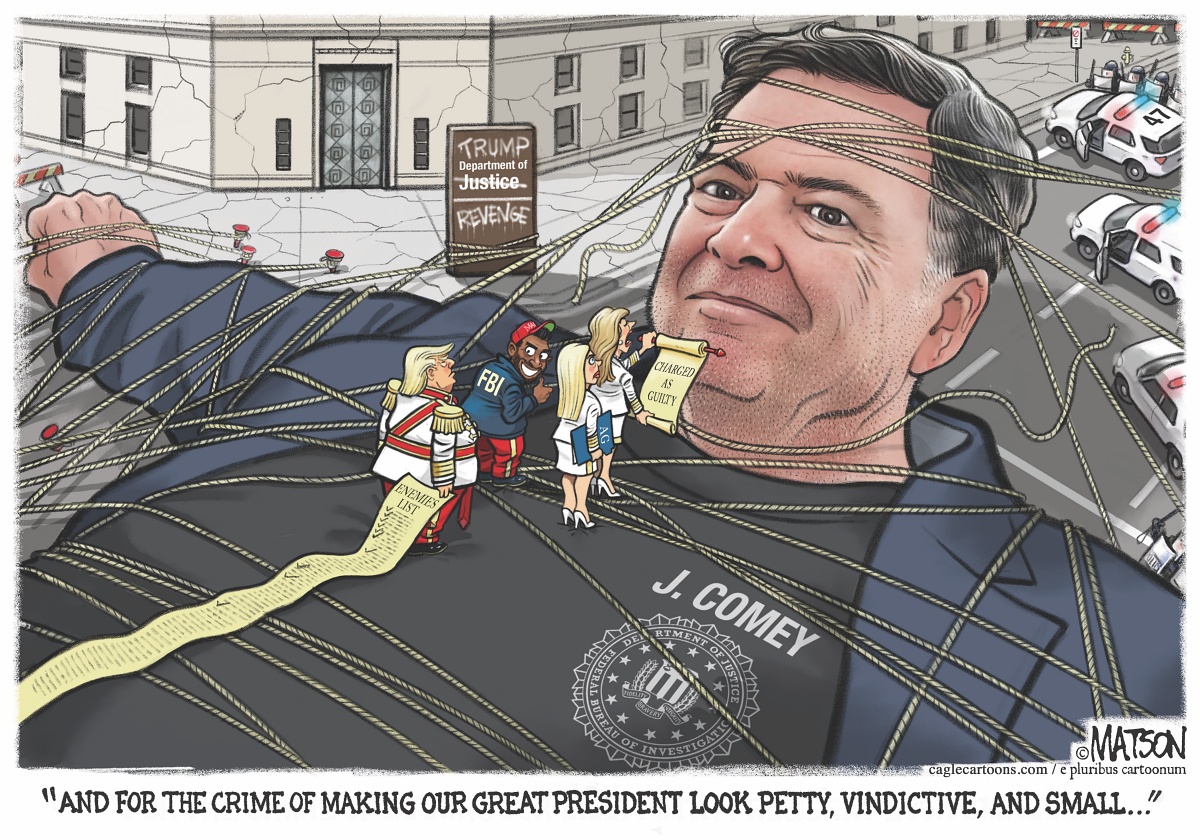
It is ironic that Trump is attacking Comey with a highly politicized indictment, considering Comey may have been Trump’s second greatest asset in 2016, after Russia.
Convicted felon Donald Trump’s directed indictment of James Comey renews the relevancy of the Mueller Report’s unfinished business. Special Counsel Robert Mueller identified eleven counts of Obstruction of Justice against Trump, which were never charged. The Comey indictment is yet another effort by Trump to obstruct the judicial process; especially when coupled with his directive to close the Justice Department’s case against Border Czar Tom Homan, for accepting a $50,000 bribe captured on video in an FBI sting. Formally weaponizing the Justice Department is more consequential beyond anything Trump has done thus far.
The eleven counts of Obstruction of Justice determined by the Mueller Report, later examined by former Special Counsel Jack Smith include:
- What Trump knew and what he denied about Russia and WikiLeaks.
- Trump’s attempt to cover up Michael Flynn’s calls with the Russian ambassador.
- Trump’s intimidation of Director of National Intelligence Dan Coats, and National Security Agency Director Mike Rogers to lie about him being under investigation.
- Trump lying about why he fired Comey, when Comey refused Trump’s demand to say he was not under investigation. The sticking point for avoiding prosecution was Mueller’s assertion that, “The evidence does not establish that the termination of Comey was designed to cover up a conspiracy between the Trump Campaign and Russia.”
- Trump’s efforts to fire Comey, by manufacturing non-existent conflicts to undermine his credibility, and dismiss the Special Counsel. Mueller stated, “The President sought to use his official powers to remove the Special Counsel.”
- Trump ordered White House Counsel Don McGahn to lie about his order to fire the Special Counsel. Mueller stated, “The President nevertheless persisted and asked McGahn to repudiate facts that McGahn had repeatedly said were accurate.”
- Trump attempted to have former Attorney General Jeff Sessions intervene with the Special Counsel, to prevent him from being directly investigated. Mueller stated, “Substantial evidence indicates that the President’s efforts to have Sessions limit the scope of the Special Counsel’s investigation … was intended to prevent further investigative scrutiny of the President’s and his campaign’s conduct.”
- Trump’s efforts to have Sessions withdraw his recusal and assume the lead in the investigation. The Mueller Report stated, “The President believed that an unrecused Attorney General would play a protective role and could shield the President from the ongoing Russia investigation.”
- Trump directed Don Jr. to mislead the press about the intent of the June 9 Trump Tower meeting with Russia, when they offered him damaging information about Clinton’s emails.
- Trump offering pardons to Paul Manafort and Michael Flynn as a form of “witness tampering,” and attempts to influence the jury in Manafort’s trial.
- Trump ordering Michael Cohen to lie to Congress, and resorting to intimidation and character assassination, when Cohen refused. While Cohen lied to Congress about the Trump Tower Moscow project, Mueller concluded there was no evidence to confirm that Trump had instructed him to do so.
Comey’s May 2017 dismissal as FBI Director was the main event that prompted the FBI investigation into obstruction charges against Trump. His ruse and smokescreen for Comey’s firing was over Comey’s not bringing charges against Hillary Clinton, over her missing 30,000 emails. That prompted Trump’s brazen, notorious call out during the campaign of, “Hey Russia, if you’re listening.” Not that Russia needed a prompt from Trump to help him prevail in 2016 – he has proven to be a greater asset to Russia than any KGB agent or double plant. Trump’s grandstanding, baseless indictment of Comey centers on whether he lied during his testimony to the Senate Judiciary Committee in 2020. Comey testified that his relationship with Trump was damaged when he refused the demand for a loyalty pledge.
Related stories
It is ironic that Trump is attacking Comey with a highly politicized indictment, considering Comey may have been Trump’s second greatest asset in 2016, after Russia. A week before the election, Comey held a politically charged press conference to announce that he was not recommending charges against Clinton for using a private email server to conduct official business; but that he found Clinton to have been “extremely careless in their handling of very sensitive, highly classified information.“ However, Comey announced that no “reasonable” prosecutor would be inclined to go forward based on those findings. That was a campaign gift to Trump, who made a huge issue of Clinton’s “missing” emails, which were hacked by Russia. Another gift came from Comey a few days before the 2016 Election, when he announced a reopening of the investigation into Clinton’s emails, after some were found on a laptop belonging to disgraced Congressman Anthony Weiner, who was married to Clinton aide Huma Abedin. Yet, because Comey refused Trump’s demands for an expression of unequivocal loyalty, and a public statement from Comey clearing Trump of collusion with Russia, Trump fired him after Comey ran interference for him in 2016.
Findings of the Mueller report cited several contacts between Comey and Trump, which fueled the suspicion of a politically motivated firing, and Trump’s multi-layered conflicts of interest. They include Trump’s repeated demands of a personal loyalty pledge from Comey at a private dinner in on January 27, 2017, a week after the inauguration. The purpose of that dinner invitation was Trump’s demand that Comey stop the investigation into National Security Adviser Michael Flynn. Comey’s dismissal led deputy attorney general Rod Rosenstein to appoint former FBI director Robert Mueller as a special counsel, to, “oversee the previously confirmed FBI investigation of Russian government efforts to influence the 2016 presidential election and related matters.”
Though the Mueller Report concluded that no members of the Trump campaign had conspired or coordinated with the Russian government, it generated reams of evidence that Russia had indeed interfered in 2016, because it, “established that the Russian government perceived it would benefit from a Trump presidency and worked to secure that outcome.” Clear evidence of Russia favoring a Trump presidency as an asset began in 2013 when they offered Donald Trump Jr., “official documents and information that would incriminate Clinton. Russia made clear its interest in helping Trump defeat Clinton. Trump didn’t need to ask their help; they volunteered it.
Mother Jones reporter David Corn reported on April 18, 2019 that the Mueller Report confirmed, “that Donald Trump and his campaign privately interacted with Russia while Putin’s regime was preparing—and then carrying out—an attack on the 2016 US presidential election; that Russia’s goal (as early as the start of 2016) was to help Trump become president;” and that its determination, “reinforces the case that much wrongdoing occurred on the part of Trump and his crew.” Though not allegedly ordered nor asked to do so by Trump, Russia hacked into Clinton’s email server and found emails later publicized by WikiLeaks, which were another campaign gift to Trump, whether or not they were unsolicited. Though he had been working on various business deals with Russia since 2016, Trump denied it. But somehow, these deceptions and lies were not an actionable crime by Mueller’s assessment. Corn characterized it saying, “A presidential candidate apparently directed a henchman to make contact with—perhaps collaborate with—an ongoing attack on American democracy.” And while the Trump campaign publicly dismissed the possibility of Russia working on his behalf, they continued to solicit Russian-generated information about other WikiLeaks dumps to aid their campaign.
that although the evidence of contacts between Trump campaign officials and Russian operatives may not have been sufficient to establish or sustain criminal charges, several people with the Trump campaign made false statements about their contacts, and took other steps to obstruct the Office’s investigation. The lack of exoneration for Trump is clearly stated in the Mueller Report by saying, “if we had confidence after a thorough investigation of the facts that the President clearly did not commit obstruction of justice, we would so state.”
Mueller was appointed by Acting Attorney General Rod Rosenstein to take over the Russia investigation a week after Comey was fired. That was the primary focus of Mueller’s investigation for Obstruction. It can be argued that Mueller wimped out. While stating that the investigation uncovered “difficult issues,” he could only bring himself to say that Trump presented evidence of being “capable of exerting undue influence over [the investigations].” Why would Mueller assume Donald Trump would not do any such thing he was “capable” of? That question will plague the United States for years to come. The result has been a presidency focused not on governing; but on greed, grift and retribution, with a frightening escalation of authoritarian fascism.
They are flooding the zone with Trump’s “effort to re-write history in his favor.” Even Trump’s defense attorney during the Mueller investigation, Ty Cobb has argued this. Cobb characterized Trump’s strategy as “wholly authoritarian and unconstitutional,” adding, “Trump wants to rewrite history so that the next generation may not know that he incited a violent insurrection, refused to peacefully transfer the power of the presidency after losing an election, stole classified documents and showed them to friends and guests at Mar-a-Lago,...anybody involved in those events that offended him, they’re in real danger.” Cobb also stated that he doubts Comey could be convicted IF the case ever came to trial.
Smith expressed great alarm about the consequences of Trump’s actions for the legal system, saying recently, "My career has been about the rule of law and I believe that today it is under attack like in no other period in our lifetimes," The reports of Smith’s two investigations were closed, because of the Justice Department policy of not charging or indicting a sitting president. So Trump avoided prosecution by getting elected again. But there is a fresh legal effort to compel the release of Smith’s report by The Knight First Amendment Institute at Columbia University and American Oversight, another First Amendment organization filed motions for their release in separate cases on September 30 with the 11th U.S. Circuit Court of Appeals. The residual legal question is whether Trump could still be charged with any of the eleven counts of Obstruction. But with the Supreme Court granting Trump blanket immunity for all his actions while in office, that is not likely to happen; unless Trump lives through the end of his term and a new president orders that it be re-litigated.
The Comey indictment is another element of Trump’s reality TV approach to the presidency. While his first administration had adults in the room to restrain his worst instincts, his current circle of sycophants is fearful of eliciting his wrath, should they dare to oppose any of them. The massive legal opinions against Trump’s reckless acts have not dissuaded him from continuing to flood the zone, to see what sticks to the wall like ketchup on the White House dining room wall.
Comments

Powered by RoundtableAn AI/DeFi-powered Enterprise Media Operating System. Learn more at Roundtable.io.© Roundtable 2026. By using this site you agree to the Terms of Use and Privacy Policy