
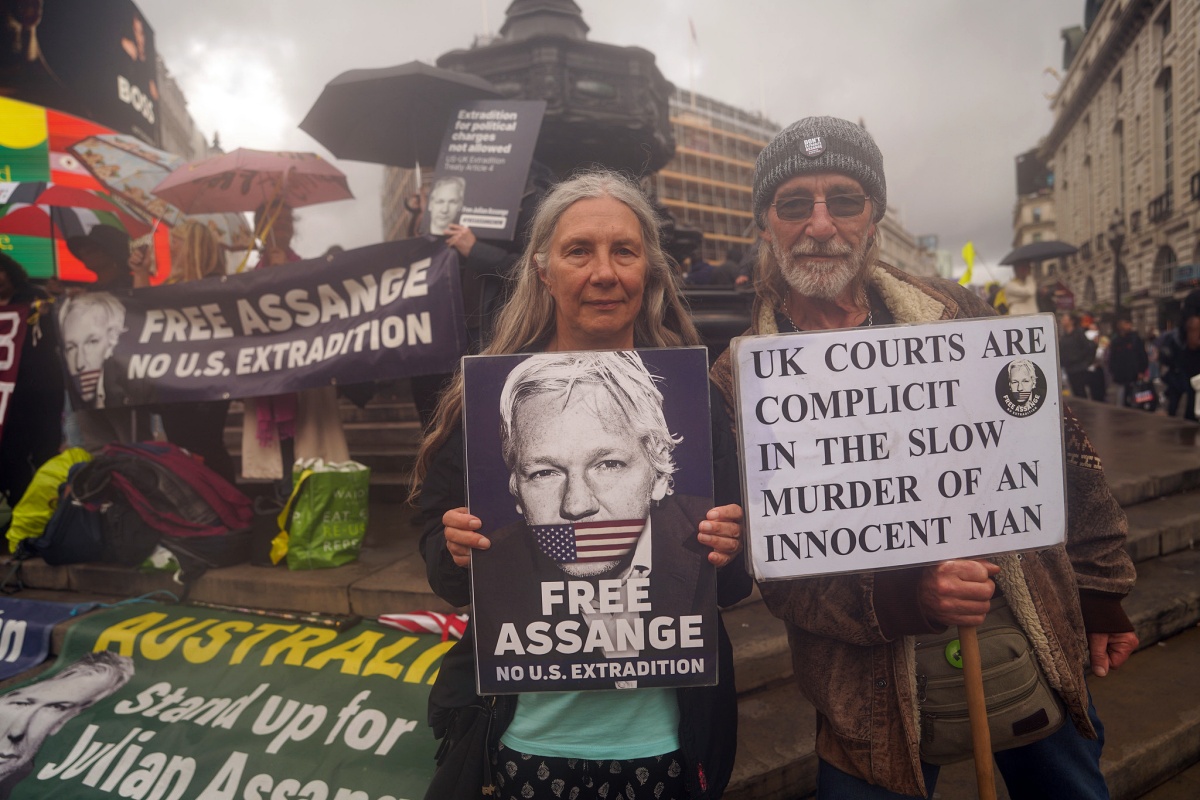
Alisdare Hickson • Attribution-ShareAlike (CC BY-SA 2.0) • Flickr


Oct 22, 2023 8:47 PM
For Australians, securing the release of Assange is broadly supported by a coalition that transcends partisan politics.
Last month, a multi-party delegation of Australian Members of Parliament visited the United States to actively lobby U.S. officials to cease their efforts to extradite Julian Assange. The founder of Wikileaks is an Australian citizen facing charges filed by the Trump administration under the infamous Espionage Act of 1917 for revealing US war crimes and violations of international law.
The issue is so important that Australia’s Prime Minister Anthony Albanese is expected to raise the issue directly with President Biden during his official state visit to Washington beginning October 23.
These stepped-up high level diplomatic efforts are part of widespread international pressure on the Biden administration to drop its relentless efforts to obtain the extradition of Assange from the UK.
On January 4, 2021, British criminal court judge Vanessa Baraister denied the US government’s request to extradite Assange. Given the fact that he had been confined in the Ecuadorian embassy for seven years and then held in the Balmarsh high-security prison since April 12, 2019, the judge found that Assange’s mental condition “is such that it would be oppressive to extradite him to the United States of America.”
Related stories
Instead of simply accepting that decision and distancing itself from the Trump’s outrageous indictment, the Biden DOJ appealed that ruling and convinced the British higher courts to reverse Judge Baraister. As a result, Assange is now subject to extradition unless his further legal appeals can prevail.

On November 28, 2022, declaring that “Publishing is Not a Crime,” the editors and publishers of five international media outlets, The New York Times, the Guardian, Le Monde, El Pais and DER SPIEGEL, released a joint letter calling on the U.S. government to end its prosecution of Assange. The date was significant. Twelve years earlier, on November 28, 2010, the same five media outlets had published a series of revelations in cooperation with Wikileaks that had made headlines around the globe.
The revelations were called “Cable gate,” a set of 251,000 confidential cables from the US State Department that disclosed corruption, diplomatic scandals and spy affairs on an international scale. According to The New York Times, the documents told “the unvarnished story of how the government makes its biggest decisions, the decisions that cost the country most heavily in lives and money.”
Thus Assange came to the U.S. government's attention because he published information highly incriminating and embarrassing to the U.S. government, including the controversial “Collateral Murder” video showing a U.S. air crew in Apache helicopters in July 2007 slaughtering a dozen people in Iraq. The dead included two Iraqis working for Reuters news agency, contradicting U.S. claims that all the dead were insurgents.
Editors of major media organizations have decried the prosecution’s chilling effect on the American press. Washington Post Executive Editor Marty Baron said the indictment “undermines the very purpose of the First Amendment.” USA Today Editor in Chief Nicole Carroll has called it a “chilling attack on press freedoms and the public’s right to know.”
According to Jameel Jaffer of the Knight First Amendment Institute at Columbia University, the charges against Assange “rely almost entirely on conduct that investigative journalists engage in every day. The indictment should be understood as a frontal attack on press freedom.”
For Australians, securing the release of Assange is broadly supported by a coalition that transcends partisan politics. The Australian delegation last month included members of Parliament from the majority Labor Party, the conservative opposition, the Greens, the National party, and an independent party. Their visit followed the publication in The Washington Post of a letter signed by 64 Australian parliamentarians who demanded that “the prosecution and incarceration of the Australian citizen Julian Assange must end.”
Australian Foreign Minister Penny Wong said that Australia had raised the issue with the United States many times, to no avail. Prime Minister Albanese has expressed frustration with the efforts to extradite Assange, publicly declaring that “enough is enough” and raising the issue directly with Secretary of State Antony Blinken, among others.
“Polling shows that nine out of ten Australians think the charges against Julian should be dropped entirely,” according to barrister Greg Barns SC, a legal advisor to the Australian campaign launched on Assange’s behalf.
Australians are not alone in their call to respect press freedoms. Latin American leaders have condemned Washington’s efforts to extradite Assange, headlined by Mexico’s Andrés Manuel López Obrador, Brazil’s Luiz Inácio Lula da Silva, and Colombia’s Gustavo Petro. And in the UK, former Labour Party leader Jeremy Corbyn and other prominent figures have condemned their government’s position.
The Australians have echoed concerns voiced by advocacy groups that countries like China and Russia would seize on the prosecution of Assange as a welcome precedent to use against journalists who publish stories critical of their regimes. Extraditing a foreigner for publishing sensitive information opens Pandora’s box, providing cover for nations seeking to target journalists and dissidents – even noncitizens or those living beyond their borders.
For example, the Assange case complicates efforts to push back against Russia’s inexcusable persecution of The Wall Street Journal’s Evan Gershkovich. As Freedom of the Press Foundation’s Trevor Timm rightly argues, “the Biden administration’s calls to free Gershkovich would have a lot more meaning if they also weren’t attempting to prosecute a publisher for ‘espionage’ here in the United States.”
These days, President Biden needs all the friends he can find. The US – Australia relationship is founded on shared values, including freedom of the press. But when one party in a long-standing relationship ignores the concerns of the other – particularly when the concerns involve shared values – the relationship is weakened. In addition to all the compelling reasons to drop the charges against Assange, the United States should value its relationship with its Australian friends and end its efforts to prosecute Assange.
Comments

Powered by RoundtableAn AI/DeFi-powered Enterprise Media Operating System. Learn more at Roundtable.io.© Roundtable 2026. By using this site you agree to the Terms of Use and Privacy Policy