
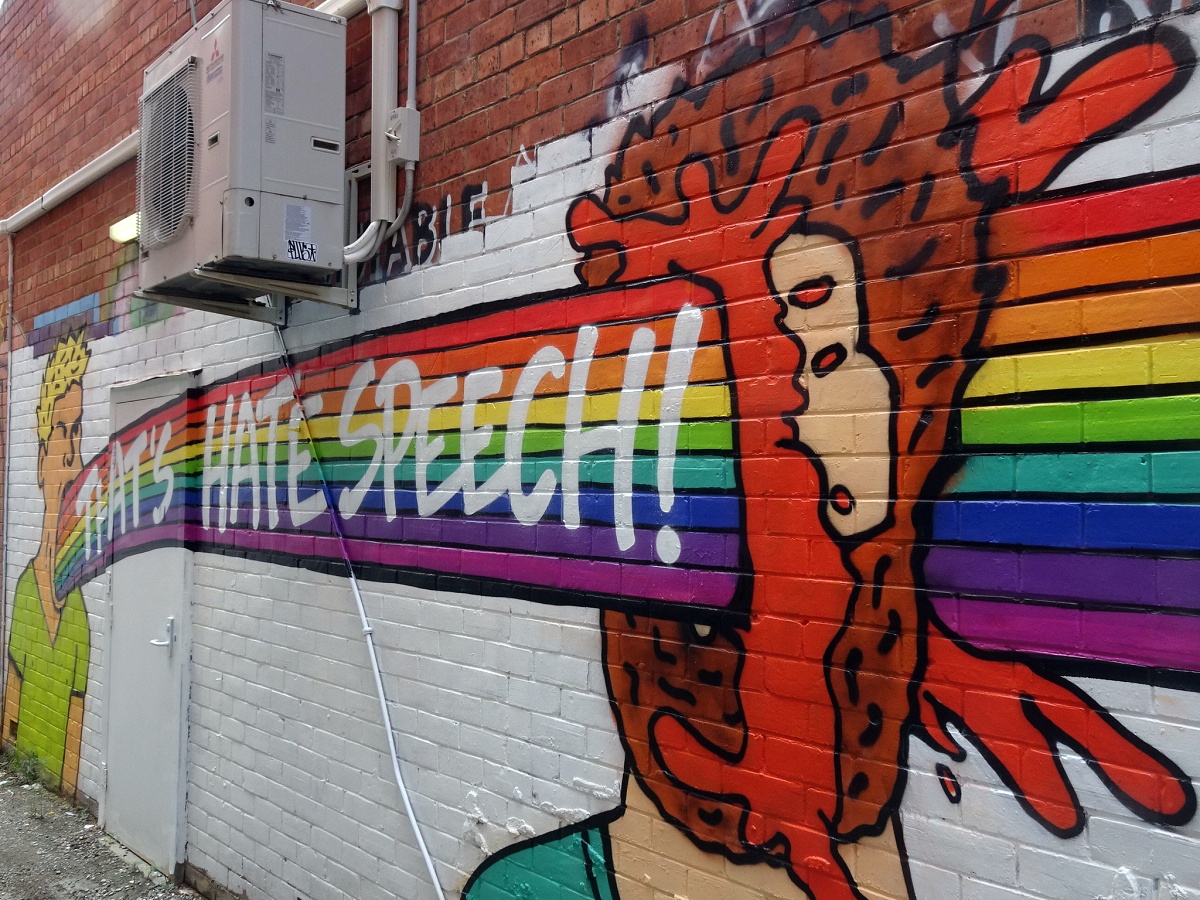
Michael Coghlan • Attribution-ShareAlike (CC BY-SA 2.0) • Flickr


Hate Speech
Mar 10, 2024 4:10 PM
Hopkins’ arguments remind us why not creating a new exception to the First Amendment for hate speech promotes a free and open democracy.
The following review originally appeared in First Amendment News (FIRE) and is reprinted with permission.
Is “hate speech” protected by the First Amendment? Professor W. Wat Hopkins doesn’t think so.
In his new book, “Hate Speech Is Not Free: The Case Against First Amendment Protection,” Hopkins argues that “hate speech” is nothing more than a “verbal attack.” It contains “no ideas of value” and is not part of the marketplace of ideas because its “purpose is not to communicate an idea, but to harm.”
Hopkins, professor emeritus at Virginia Tech, where he taught communications and cyberspace law, is a former editor of the journal Communications Law and Policy. In his slim but densely argued book, he first surveys over a hundred years of First Amendment law and then distills his case into several overlapping arguments. But all told, he fails to make a convincing case that “hate speech” should be excluded from constitutional protection.
Related stories
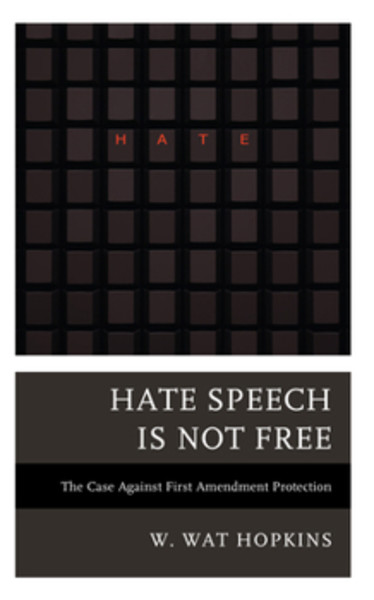
Indeed, Hopkins’ arguments remind us why not creating a new exception to the First Amendment for hate speech promotes a free and open democracy. Granted, Hopkins’ motive is noble—to combat racism, bigotry, and hate. But those of us who support robust and wide-open free speech believe, along with Frederick Douglass, Dr. Martin Luther King Jr., and many others, that free speech is the friend, not the enemy, of the struggle to achieve equality and human dignity for every person.
Throughout this review, I put “hate speech” in quotation marks because it is a term of art that means different things to different people, including different judges. The quotation marks remind us that “hate speech” has yet to command any consensus on which to build a new regime of censorship.
Hopkins’ case against affording ‘hate speech’ First Amendment protection
Hopkins begins by arguing that “the defining feature of hate speech is that ‘it incurs harm discursively when [it] is uttered,’” and its purpose “isn’t to communicate ideas, but to induce psychological harm,” citing articles by Katharine Gelber and Steven H. Shiffrin. He says that noted linguist George Lakoff believes that “hate speech” can “change the brain in ways that is [sic] more harmful than a physical attack.” Consequently, “[h]ate speech can inflict injury by its very utterance” and therefore is prohibited speech under Chaplinsky v. New Hampshire, a 1942 Supreme Court case that recognized certain exceptions to the First Amendment including obscenity, profane and slanderous speech, and what the Court called “fighting words.”

Hopkins also asserts that “hate speech” is valueless. “The fact that its sole purpose is to cause harm is sufficient evidence of its lack of value, but its intent and content also make it valueless.” He argues that just like fighting words and obscenity, “hate speech” is unprotected because, citing Chaplinsky, it is “no essential part of any exposition of ideas, and [is] of such slight social value as a step to truth that any benefit that may be derived from [it] is clearly outweighed by the social interest in order and morality.”
“Hate speech,” he adds, is closely related to unprotected fighting words, threatening speech, and some categories of intimidating speech, because a defining characteristic of “hate speech” is that it is designed to “directly attack” individuals and groups. He argues that protecting persons from fear is a valid reason for prohibiting “hate speech.”
Finally, invoking the views of free speech scholar Alexander Meiklejohn, Hopkins argues that First Amendment protection should extend no further than speech of “self-governing importance” because “a verbal attack has no relation to the business of government.”
Rebutting Hopkins and defending First Amendment protection for ‘hate speech’
Definitional difficulties
The response to Hopkins must begin with his failure to offer a cogent, workable, legally enforceable definition of “hate speech.” He admits that such a definition “is essential if hate speech is to be regulated or, beyond that, cast from First Amendment protection.” He even cites a leading 2020 treatise devoted entirely to “hate speech” which concedes that “hate speech” is “a messy, highly contested concept used in political theory, legal theory, legal documents, and in simple common usage with its meaning changing depending on the context of who is using it and to what ends.”
Hopkins cites, by my count, 17 different definitions of “hate speech,” some of which refer to speech that “threatens,” “insults,” or “attacks” people based on their race, ethnicity, national origin, age, religion, gender, or disability. But he doesn’t even attempt to provide a single definition that would meet constitutional requirements. For almost 100 years, the Supreme Court has insisted that all laws, and especially laws affecting speech, “must be sufficiently explicit to inform those who are subject to it what conduct on their part will render them liable to its penalties. . . . [A]nd a statute which either forbids or requires the doing of an act in terms so vague that men of common intelligence must necessarily guess at its meaning and differ as to its application violates the first essential of due process of law.”
In a book whose single purpose is to ostracize an entire category of speech from public discourse and subject it to criminal, civil, and disciplinary punishment, the author has a special responsibility to define what is and is not “hate speech.”
Is it “hate speech” to accuse the Jewish state of Israel of genocide or apartheid? To accuse the Palestinian organization Hamas of genocide or terrorism? Is it “hate speech” for Palestinian protesters to chant “from the river to the sea”? For defenders of Israel to call for killing all members of Hamas? When it comes to “hate speech” based on age or disabilities, what about attacks on 81-year-old Joe Biden and 77-year-old Donald Trump? And if it is none of these things, then what is it?
If by any definition, “hate speech” directed at individuals already qualifies as fighting words, a true threat, incitement, or part of a criminal act, why do we need a new separate exception that is “so vague that men of common intelligence must necessarily guess at its meaning”?
Other fundamental flaws
There are other fundamental flaws in Hopkins’ argument. He relies heavily on Chaplinsky. There, a member of the Jehovah’s Witnesses was arrested for lashing out at a town marshal, shouting, “You are a God-damned racketeer” and “a damned Fascist.” Characterizing the outburst as “fighting words,” the Supreme Court upheld his criminal conviction. But Hopkins readily admits that “the fighting words doctrine has all but died.” Today, would we actually want someone to go to jail for calling, say, a former president, “a damned Fascist”?
What Hopkins really likes about Chaplinsky is the notion that speech is unprotected when it is “no essential part of any exposition of ideas, and [is] of such slight social value as a step to truth that any benefit that may be derived from [it] is clearly outweighed by the social interest in order and morality.”
No new First Amendment exceptions
In the eighty-plus years since it was decided, Chaplinsky has not given birth to any newly announced Supreme Court exceptions to the First Amendment. Instead, the trajectory of free speech law has been in the opposite direction. Certain forms of libel were never considered protected speech under the First Amendment until New York Times v. Sullivan (1964) held that libel involving public officials, public figures, and matters of public interest, made without knowledge of falsity or in reckless disregard of the truth, is entitled to First Amendment protection. Likewise, obscenity was never considered protected speech until Miller v. California (1973) held that only an obscene work, which, “taken as a whole, lacks serious literary, artistic, political, or scientific value,” can be denied First Amendment protection.
The Court has routinely refused Hopkins’ invitation to use the language in Chaplinsky to expand the number of exceptions to the First Amendment. In United States v. Stevens (2010), the Court refused to exclude so-called “crush videos,” containing depictions of animal cruelty, from First Amendment protection. And in Ashcroft v. Free Speech Coalition (2002), the Court refused to create a new First Amendment exception for virtual child pornography, including computer-generated images, or "any sexually explicit image” that was advertised “in such a manner that conveys the impression it depicts a minor engaging in sexually explicit conduct.”
At its core, Hopkins’ theoretical argument is divorced from the realities of how debates over race, religion, gender, nationalities, and ethnicities are actually conducted in the real world. Much of what he would label “hate speech” is in fact political speech expressed in controversial, hyperbolic, outrageous, and even offensive terms, all of which deserve full First Amendment protection.
Constitutionally protected political ideas
Hopkins repeatedly claims that the essence of “hate speech” “is to cause harm without the expression of any ideas.” But in doing so, he has set a trap for himself. If speech does in fact express an idea—any idea—then it falls outside of Hopkins’ definition and is therefore entitled to First Amendment protection.
Expressions of hatred toward Adolph Hitler and celebration of his death are political ideas and are therefore constitutionally protected. Expressions of hatred toward Ismail Haniyeh, the political leader of Hamas, and calls for his assassination, or expressions of hatred toward Benjamin Netanyahu, Prime Minister of Israel, and calls for his assassination, are all political ideas and are therefore constitutionally protected. These expressions are not to be banished from political debate because Haniyeh is Muslim and Netanyahu is Jewish. And our commitment to robust and wide-open debate does not require that we sanitize these political views by requiring that they be spoken in polite and demur phases like “I oppose Hamas” or “I oppose Israel.”
Using the Chaplinsky framework on which Hopkins bases his entire argument, these expressions of hatred are in fact an “essential part” of the “exposition of ideas,” because they possess significant “social value as a step to truth” which should not be silenced by a generalized “interest in order and morality.”
As Justice Holmes wrote in 1929: “[I]f there is any principle of the Constitution that more imperatively calls for attachment than any other, it is the principle of free thought—not free thought for those who agree with us but freedom for the thought that we hate.”
Slippery slopes
Our law, the Supreme Court, and America itself will slide down a very dangerous slippery slope if we accept Hopkins’ invitation to censor whatever he means by “hate speech.” Today, we may applaud the punishment of speech we loathe, but tomorrow we will rue the day that speech we cherish cannot be spoken. U.S. law has fashioned a few narrow exceptions for fighting words, true threats, incitement, harassment, and speech used in the commission of a crime to deal with speech outside the purview of the First Amendment. We don’t need a new vague and ambiguous exception for “hate speech.”
Instead of policing speech, we need to devote ourselves to the more difficult task at hand: the unfinished business of dismantling the political, social, economic, and societal institutions that perpetuate racism, sexism, discrimination, and bigotry in our country.
Comments

Powered by RoundtableAn AI/DeFi-powered Enterprise Media Operating System. Learn more at Roundtable.io.© Roundtable 2026. By using this site you agree to the Terms of Use and Privacy Policy