
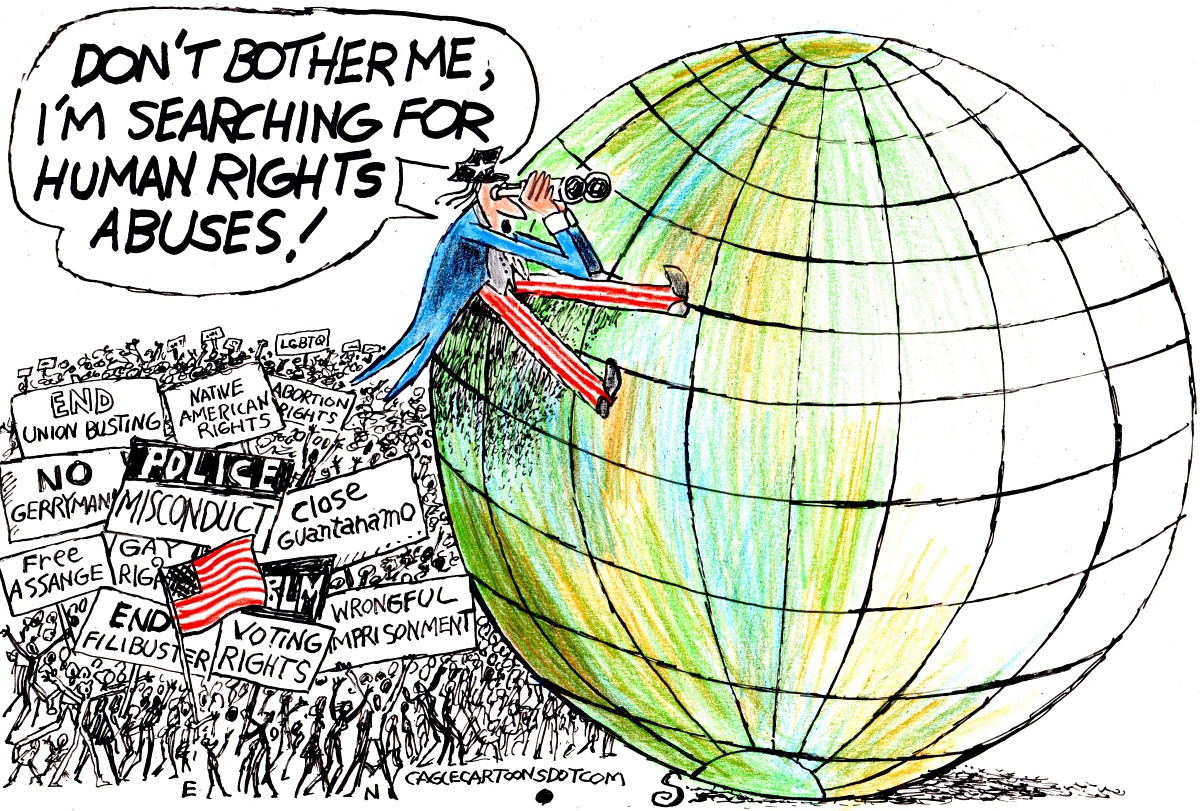
Cagle Cartoons: Randall Enos


Jan 31, 2025 9:26 PM
Musk’s ‘Seig Heil’ is not so easily reshaped into the pale marble of a ‘Roman gesture’ by hands that tremble with the weight of their own deceit.
By the dim glow of the West Wing, Trump toils over the patchwork of his own legend, threading half-truths and bravado into a curtain meant to cloak the chaos of his reign. Each decree, each proclamation, unfurls like a thunderclap—his governance a spectacle of force, meant to dazzle and disorient rather than to lead.
Meanwhile, the acolytes of Musk, spectral figures draped in the tattered shrouds of revisionist myth, labor in vain to chisel away the truth. They wield their distortions like blunt instruments, attempting to sculpt his raised arm into the sterile grandeur of Rome, mistaking the colonnades of history for a sanctuary where infamy might be reborn as greatness. But Musk’s ‘Seig Heil’ is not so easily reshaped into the pale marble of a ‘Roman gesture’ by hands that tremble with the weight of their own deceit. The past, unyielding, watches.
The Trump administration, retreating from the very battlefields it sowed, stumbles in its haste, while the White House budget office struggles to lock the gates on federal grants and loans—money already promised by Congress—leaving institutions adrift and the nation sinking further into tumult. Trump, ever the master of manufactured tempests, conjured a new storm from the ether, painting himself as the lone sentinel against the reckless squandering of taxpayer gold. With a flourish, he declared his righteous stand, proclaiming that he had single-handedly halted a “preposterous waste”—a towering flood of foreign aid poised to spill recklessly into the void.
His chorus of loyal scribes, eager to etch his myth into the annals of populist rage, seized upon the tale, spinning it into a parable of fiscal heroism. They bragged of his decisive hand staying the tide, thwarting a scheme in which, they claimed, $50 million taxpayer dollars were set to vanish into Gaza’s coffers. Trump’s version of the story was more dramatic: “we identified and stopped $50 million being sent to Gaza to buy condoms for Hamas.” The story is about as baseless as his claim that illegal immigrants from Haiti are gobbling down domestic pets belonging to the citizens of a small Ohio city.
Related stories
For decades, the U.S. has kept a silent sentinel at the edge of the Caribbean—a migrant detention outpost standing in the shadow of its more infamous counterpart, the fortress of Guantanamo, a naval base housing a prison where the ghosts of vanished justice whisper through the iron bars that once held men like Khalid Sheikh Mohammed of September 11 infamy. Located on the southeastern coast of Cuba, it is permanently leased from its government as a holdover from the Cold War.
Trump recently signed a memorandum instructing the Departments of Defense and Homeland Security to prepare a 30,000-person facility at Guantanamo Bay — although it’s far from clear it’s currently suitable to house anywhere close to that number of detainees potentially awaiting deportation. With the flourish of his pen, Trump set the gears of a vast machine into motion, commanding the architects of war and border-keeping to conjure a holding ground in a detention facility separate from the notorious high-security jail for foreign terror suspects.
In signing the Laken Riley Act, Trump anointed Guantanamo as the new oubliette of America’s immigration policy, where the unwanted may be cast into the abyss, unseen and uncounted. Named after Laken Riley, a nursing student whose tragic murder became a political lightning rod, the law reflects the ongoing battle over immigration policy in the U.S., wielded as both a measure of public safety and a tool of partisan warfare. Its passage signals a broader shift toward stricter detention policies, further entangling immigration enforcement with the criminal justice system.
The Laken Riley Act stands as another iron link in the growing chain of immigration enforcement laws, requiring the U.S. Department of Homeland Security to detain non-citizens accused or convicted of certain offenses—specifically, theft-related crimes, assaults on police officers, or crimes resulting in death or serious bodily injury. Trump’s signature drags the ink of history across an all-too-familiar page, resurrecting Guantanamo Bay as a holding pen—not for accused terrorists this time, but for the desperate, the displaced, the undesired.
Guantanamo Bay—the name itself is a specter, conjuring images of hooded detainees, indefinite imprisonment, and legal black holes where the rule of law goes to die. Now, in an almost poetic continuation of its legacy, the prison will house migrants, a chilling echo of past MAGA policies that blurred the line between detention and exile.
The center, used traditionally to house Haitian and Cuban migrants intercepted at sea before they reach the United States, is dogged by its own long history of complaints about conditions and claims that it short-circuits migrants’ access to the asylum process.
Now, that outpost stands poised to serve a new master’s vision. To Trump, it is more than a mere holding pen—it is a stage, a monument to his power and resolute toughness, where human lives become pawns in a grand performance of strength. As the tides of migration surge, the base offers a solution carved from stone and steel, a place to corral the desperate before an overburdened system collapses under its own weight.
And now, like a warden surveying his forsaken prison, Trump gleefully imagines its rusted gates thrown wide to welcome the weary, the dispossessed, the undocumented. The ghostly whispers of Abu Ghraib stir in the wind, a dark memory resurrected, a haunting refrain of cruelty reborn in the light of day.
But beyond its function, the true purpose of Guantanamo gleams in the cold, calculating eye of political theater. Here, Trump casts himself as the iron-fisted guardian of the homeland, the architect of a fortress meant not only to cage bodies but to send a message across oceans: Turn back. You are not welcome. To his followers, it is proof of promises kept, a tableau of might and resolve—a testament that the walls he once pledged to build need not be made of brick and mortar when barbed wire and fear will suffice.
Stephen Collinson writes: “The symbolism of the location is perfectly resonant with the hardline tone of a migrant crackdown run by the gruff White House border czar Tom Homan and Homeland Security Secretary Kristi Noem, who joined a federal enforcement team on the streets of New York soon after being confirmed. She hailed the arrest of an undocumented migrant facing criminal charges on X, saying, ‘Dirtbags like this will continue to be removed from our streets.’”
Kristi Noem, fresh from dehumanizing immigrants as “dirtbags” during an ICE raid, now plays the role of enforcer with a cold bureaucratic efficiency. Her revocation of Temporary Protected Status for hundreds of thousands of Venezuelan migrants isn't just policy—it’s a statement, a warning, a flex of power that leaves an entire population in limbo. For these individuals, the promise of refuge in the United States is now being revoked by an administration that sees them not as people, but as a logistical problem to be warehoused offshore.
And as Fox News spins the gears of governance, Trump moves in predictable fashion. His administration doesn’t just embrace the most draconian interpretation of immigration enforcement—it revels in it. Secretary of State Marco Rubio and Defense Secretary Pete Hegseth, both plucked from the ranks of right-wing media darlings, are not merely executing policy; they are actors in a performance designed to reinforce a narrative of strength, sovereignty, and punishment.
Hegseth calls Guantanamo a “perfect place” to hold migrants “safely in the interim.” But Guantanamo has never been about safety—only about the kind of liminal, lawless space where the U.S. can do what it would never dare on its own soil. And so, the administration resurrects the worst ghosts of the past, disguising cruelty as pragmatism, erasing human dignity under the guise of law and order.
This is not policy. It is a spectacle. A theatre of deterrence where the suffering of migrants is not an unfortunate consequence, but the very point.
Trump’s decree, a grim resurrection of past cruelties, casts Guantanamo Bay once more into the role of a forsaken purgatory—this time, not for alleged terrorists, but for the most vulnerable. In a chilling spectacle of authoritarian zeal, he vows to fill the island prison with the so-called “worst criminal aliens,” a faceless horde conjured from the fevered rhetoric of nativist fear.
The ghosts of Abu Ghraib whisper through the rusted fences, as Trump’s border czar, Tom Homan, assures the nation that Immigration and Customs Enforcement will run the operation smoothly. Details remain hazy, as if obscured by the very fog of war that once cloaked the prison’s darkest deeds. The migrant facility that has long housed those plucked from the sea—Haitians, Cubans—stands woefully inadequate for the tens of thousands Trump envisions interred there. But this administration speaks not of constraints, only of expansion.
With Orwellian precision, Homeland Security Secretary Kristi Noem echoes the mantra of fear: these detainees will be "the worst of the worst." Yet the numbers betray the lie. Study after study has shown that immigrants, whether documented or not, commit crimes at lower rates than native-born citizens. But reality bends beneath the weight of propaganda, and in Trump’s America, migrants are no longer desperate souls seeking refuge—they are the new enemy, stripped of name, of history, of humanity.
Beyond Guantanamo’s razor wire, Cuba watches with scorn, a government long opposed to the U.S. occupation of its soil condemning the move as yet another act of brutality. But the island prison stands, unchanged, waiting for its new captives. And as the order is signed, the world is left to wonder: how much further can a country stray before it no longer recognizes its own reflection?
From Havana, condemnation rings out. President Miguel Díaz-Canel denounces the move as a grotesque extension of an occupation Cuba has long deemed illegal. Díaz-Canel wrote on X: “In an act of brutality, the new US government announces the imprisonment at the Guantanamo Naval Base, located in illegally occupied territory Cuba, of thousands of migrants that it forcibly expels, and will place them next to the well-known prisons of torture and illegal detention”.
With the flourish of his executive order, the naval base transforms into a vast cage, its gates flung open to receive those who crossed an invisible line in search of hope, only to find themselves swallowed by a system designed to break them.
“Most people don’t even know about it,” Trump boasts, as if revealing some long-buried relic of American power, a secret weapon against the faceless menace he conjures in the minds of his followers. According to Trump, “We have 30,000 beds in Guantanamo to detain the worst criminal illegal aliens threatening the American people. Some of them are so bad we don’t even trust the countries to hold them, because we don’t want them coming back…So we’re going to send them out to Guantanamo. This will double our capacity immediately, right? And tough. That’s a tough – that’s a tough place to get out of.”
Not shelters, not homes—beds in a purgatory where “the worst of the worst”, as he calls them, will be exiled beyond the reach of due process and human dignity. He speaks not of individuals but of numbers, not of lives but of containment.
The ghosts of past detainees linger in the air—the Haitian refugees held in the 1990s, the so-called enemy combatants tortured in the years following 9/11. Now, the target has shifted, but the machinery remains the same. America, a nation built by immigrants, now corrals them like prisoners of war, casting them into the outer darkness.
Stephen Collinson writes that “the symbolic association between the military detention center and the migrant camp — even though they are separate — is likely to further stigmatize migrants.”. Collinson quotes Vince Warren, executive director of the Center for Constitutional Rights, as saying: “President Trump’s decision to use Guantánamo – global symbol and site of lawlessness, torture, and racism – to house immigrants should horrify us all…Like many of Trump’s authoritarian attacks on human rights, this one has shameful precedents in US history. Long before the second Bush administration used the facility to hold and abuse nearly 800 Muslim men and boys as part of its ‘war on terror,’ the first Bush administration held Haitian refugees there to try to deny them their rights under international law”.
Collinson further warns: “The separate migrant facility at Guantanamo Bay has its own checkered civil rights record and its use will concern migrant rights groups who are already raising concerns that Trump’s deportation crackdown infringes access to asylum claims for undocumented migrants. In a report late last year, the International Refugee Assistance Project cited testimony from refugees that conditions at the facility were inhumane and unlawful. The report called on the government to shut down the center and to give asylum seekers the same legal rights as migrants detained in the interior United States. It said conditions were characterized by undrinkable water, exposure to open sewage, and poor medical care and schooling facilities for children.”
And so the stage is set. The United States, a nation built on the promise of liberty, edges closer to an era where human rights are an inconvenience, where the powerless are swept away to a distant island, locked away in the shadows of history’s most shameful chapters.
But such action comes with its rewards, as House Republican Anna Paulina Luna introduced a bill Tuesday to carve President Trump’s figure onto Mount Rushmore, saying that "remarkable accomplishments for our country and the success he will continue to deliver deserve the highest recognition and honor on this iconic national monument". All hail to the Chief!
Comments

Powered by RoundtableAn AI/DeFi-powered Enterprise Media Operating System. Learn more at Roundtable.io.© Roundtable 2026. By using this site you agree to the Terms of Use and Privacy Policy