


Apr 2, 2023 7:04 PM
Updated Apr 3, 2023 2:18 AM
Grand juries do not decide whether the accused is guilty or innocent. They decide if there is enough evidence to charge the accused in a court of law.
Back in 1987, with the release of Tom Wolfe's Bonfire of the Vanities, the phrase "a grand jury would indict a ham sandwich" entered American parlance. It spoke to the cozy relationship between the county district attorney, state attorney general or federal US attorney, the court and law enforcement.
Tom Wolfe indicates, in his novel, that the grand jury's decision to indict or to refrain from indicting has everything to do with that cozy relationship and less to do with evidence. Historically, it seems that Tom Wolfe was right -- at least that would explain why the term was so widely embraced by a broad cross section of American society.
But lately, the tide seems to be turning. Grand juries have been handing down indictments, charging state actors who have typically avoided being held accountable for their misdeeds.
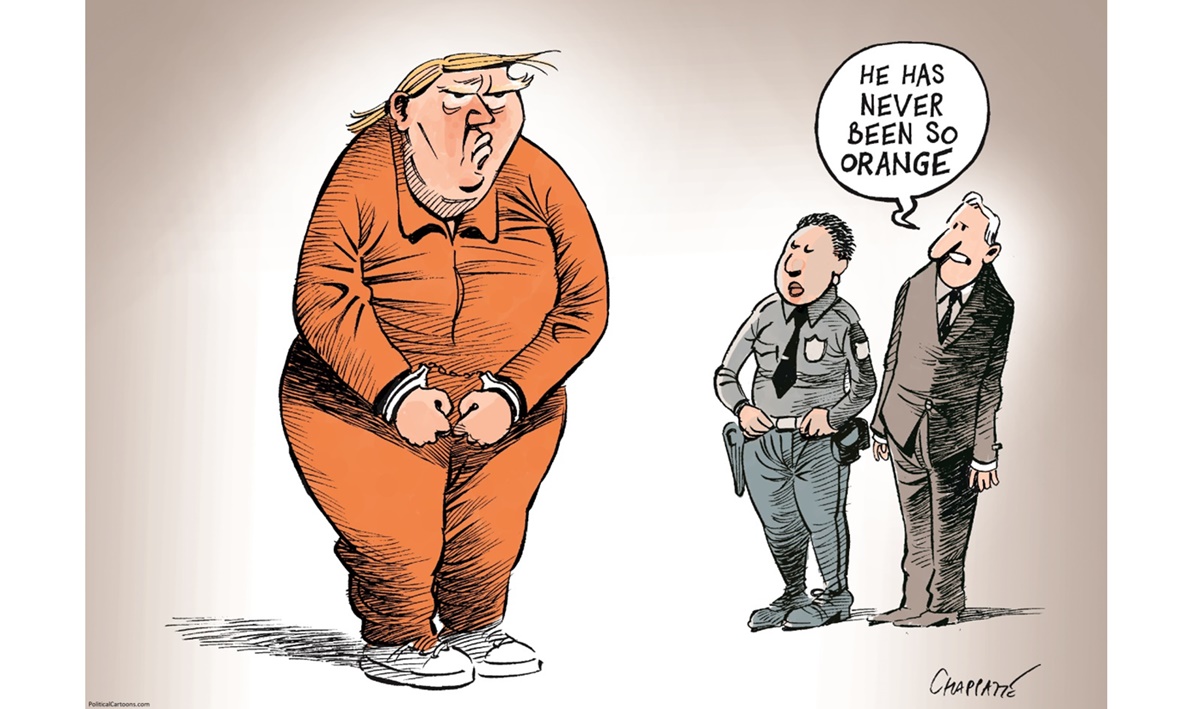
Tuesday President Donald Trump will be the first former president to be arrested. This is a step in the right direction for a nation that is increasingly losing trust in law enforcement and the "justice" system.
Related stories
Case in point, the unchecked power of the nation's police "unions" who's abuse of their collective bargaining power has shielded their members from accountability for the killings of unarmed Black people and other heinous misconduct. Their wall of unchecked power seemed impenetrable.
Until recently...
Take a look at a press release published by the U.S. Attorney's Office, Northern District of California on March 29, 2023 concerning Joanne Marian Segovia, the executive direct of the San Jose Police Officers Association (POA).
PRESS RELEASE
SAN JOSE – The Office of the United States Attorney has filed a federal criminal complaint charging Joanne Marian Segovia with attempt to illegally import a controlled substance in connection with a scheme to bring synthetic opioids into the country and distribute them throughout the United States, announced United States Attorney Ismail J. Ramsey and Homeland Security Investigations Special Agent in Charge Tatum King. The criminal complaint was filed on March 27, 2023, and unsealed the next day.
According to the complaint, Segovia, 64, of San Jose, is the Executive Director of the San Jose Police Officers’ Association (SJPOA). The complaint alleges that Segovia used her personal and office computers to order thousands of opioid and other pills to her home and agreed to distribute the drugs elsewhere in the United States.
The complaint alleges that Segovia was apprehended as part of an ongoing Homeland Security investigation into a network that was shipping controlled substances into the San Francisco Bay Area from abroad.
The complaint alleges that between October 2015 and January 2023, Segovia had at least 61 shipments mailed to her home, originating from countries including Hong Kong, Hungary, India, and Singapore. The manifests for these shipments declared their contents with labels like “Wedding Party Favors,” “Gift Makeup,” or “Chocolate and Sweets.” But between July 2019 and January 2023, officials intercepted and opened five of these shipments and found that they contained thousands of pills of controlled substances, including the synthetic opioids Tramadol and Tapentadol. Certain parcels were valued at thousands of dollars’ worth of drugs.
Also alleged is that Segovia used encrypted WhatsApp communications to plan the logistics for receiving and sending pill shipments. For example, the complaint describes a three-year period between January 2020 and March 2023 during which Segovia is alleged to have exchanged hundreds of messages with someone using a phone with an India country code. The messages discussed details for shipping and payment of pills and contained hundreds of pictures of tablets, shipping labels, packaging, payment receipts, and payment confirmations.
The complaint alleges that Segovia used her office at the San Jose Police Officers’ Association to distribute controlled substances. For example, in spring 2021, Segovia was told by a supplier to send a package to a woman in North Carolina. Segovia then sent this supplier a photograph of a shipment made using the UPS account of San Jose Police Officers’ Association.
According to the complaint, Segovia continued to order controlled substances even after being interviewed by federal investigators in February 2023. On March 13, 2023, federal agents seized a parcel in Kentucky, containing valeryl fentanyl, addressed to Segovia. The package allegedly originated from China on March 10, 2023 and declared its contents as a “clock.”
Segovia is charged with attempt to unlawfully import valeryl fentanyl, in violation of 21 U.S.C. § 952(a).
A criminal complaint merely alleges that crimes have been committed, and, like all defendants, Segovia is presumed innocent until proven guilty beyond a reasonable doubt. If convicted, Segovia faces a maximum statutory sentence of 20 years. In addition, as part of any sentence, the court may order the defendant to serve at least 3 years of supervised release and to pay a fine of up to $250,000. However, any sentence following conviction would be imposed by the court after consideration of the U.S. Sentencing Guidelines and the federal statute governing the imposition of a sentence, 18 U.S.C. § 3553.
Assistant U.S. Attorney Joseph Tartakovsky is prosecuting the case with the assistance of Margoth Turcios. This prosecution is the result of investigation by HSI.
Comments

Powered by RoundtableAn AI/DeFi-powered Enterprise Media Operating System. Learn more at Roundtable.io.© Roundtable 2026. By using this site you agree to the Terms of Use and Privacy Policy