
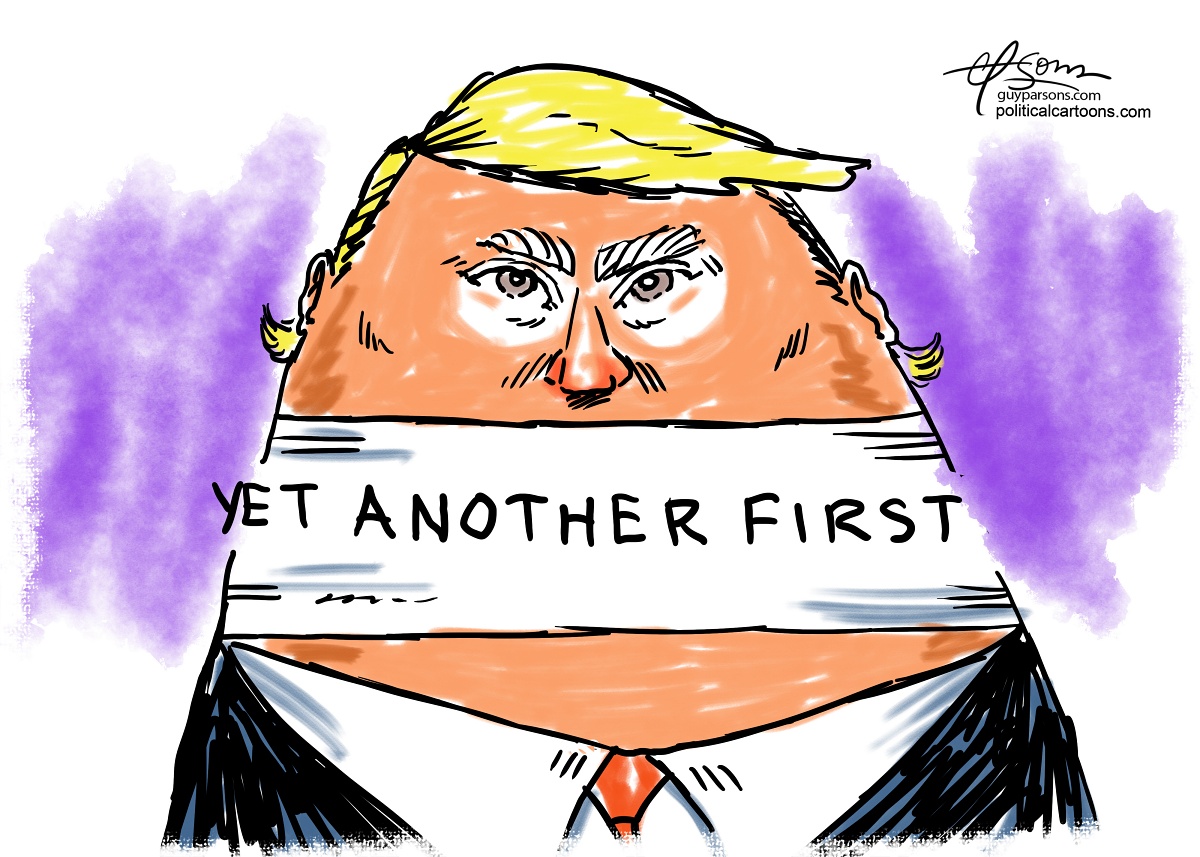


Cagle Cartoons: Guy Parsons
Dec 9, 2023 10:16 PM
Are the courts destroying our First Amendment freedom of speech (as Trump argues)? OR are they protecting our judicial processes and the Sixth Amendment right to a fair trial?
Let’s get into this a bit. There are three competing principles involved here:
- the First Amendment right to free speech,
- the Sixth Amendment right to a fair trial, and
- (the fair and orderly administration of justice.
To be clear, many areas of law involve (and must find ways to resolve) competing interests. No single interest (either one held by an individual or group of individuals or one held by the government or one of its agencies or offices) trumps all others. (Pun intended.)
Not even a “compelling government interest,” such as the interest in protecting state secrets or national security, is absolute.
Related stories
Nor is any individual constitutional right absolute.
Think about it. No two people have identical interests in fact. For example, you have an interest in your property and I have an interest in mine. What if your property interest conflicts with mine? We could be best friends but our interests may be in conflict.
The same happens between individuals and their own chosen government. You might have voted for those who hold office or not — you still live in this country (your country, your homeland) and you therefore intrinsically agree to adhere to the “social contract” that says you must limit your own “rights” for the sake of the continued existence of all of us (society).
No form of government can eradicate conflicts of interest — either between individuals (or groups) or between people and government.
There is no way around these conflicts. No form of government can eradicate conflicts of interest — either between individuals (or groups) or between people and government. Courts of law must exist to hear and adjudicate and they must base their decisions on sound reasoning and long-standing principles, which must be applied equally across the board.
Of course, we may also disagree about what is equal application of the law. But facts (individual situations, factual circumstances) differ so equal application does not mean identical application or outcomes.
Whether we like it or not, Trump is different from any other defendant. He’s a public figure, a former president, and a candidate for office. But these factors do not give Trump any absolute rights. Judges still must weigh these factors just as they weigh factors in other cases.
Chutkan’s Gag Order
Judge Chutkan has repeatedly stated (both in her decisions and during oral argument) that the right to free speech must give way to the orderly administration of justice by the court.
In Judge Chutkan’s October 17, 2023 gag order in Trump’s D.C. election interference case , she quoted “binding Supreme Court precedent”:
“[T]he First Amendment must not be allowed to divert the trial from the very purpose of a court system to adjudicate controversies, both criminal and civil, in the calmness and solemnity of the courtroom according to legal procedures.”
And
“Although litigants do not surrender their First Amendment rights at the courthouse door, those rights may be subordinated to other interests that arise in this setting. For instance, on several occasions this Court has approved restriction on the communications of trial participants where necessary to ensure a fair trial for a criminal defendant.”
(On October 20th, Chutkan stayed the gag order. On the 29th, on the motion of the Special Counsel, she reinstated it.)
In the cases Chutkan cites in her gag order (including several Circuit Court cases), among the judicial concerns articulated were:
- the right to a fair trial, and
- concerns about tainting a jury pool, and
- tampering with witnesses.
These are not mutually exclusive; they are intertwining concerns.
The right to a fair trial is of course a Sixth Amendment right held by the defendant. But it is also the public’s right to have those accused of crimes fairly tried based on evidence in a court of law.
Other than the Sixth Amendment right to a fair trial, the other concerns are not strictly articulated in the Bill of Rights but follow from the nature of judicial processes themselves. A jury’s verdict must be based on evidence received in open court, not from outside sources.
In the 1966 landmark case that Chutkan quotes from Sheppard, the Supreme Court (quoting previous Supreme Court decisions from the early 1940’s) noted that “trials are not like elections, to be won through the use of the meeting-hall, the radio, and the newspaper” and that no one should be punished for a crime without “a charge fairly made and fairly tried in a public tribunal free of prejudice, passion, excitement, and tyrannical power.”
Chutkan borrows a phrase from yet another 1940’s Supreme Court decision: “Freedom of discussion should be given the widest range compatible with the essential requirement of the fair and orderly administration of justice.”
In one case, U.S. v. Brown (and quoting yet another Supreme Court case from 1979), the Court noted that courts have “an affirmative constitutional duty to minimize the effects of prejudicial pretrial publicity.” The Brown court explained:
"The beneficiaries of this duty include not only the defendant in a given trial, but other defendants as well, such as co-defendants in the same case or defendants in related cases (as there are here), whose fair trial rights might be prejudiced by the extrajudicial statements of other trial participants. The vigilance of trial courts against the prejudicial effects of pretrial publicity also protects the interest of the public and the state in the fair administration of criminal justice."
The Brown court added: “It makes no difference that [the defendant] is contesting the gag order as violative of his First Amendment rights instead of embracing it as protective of his Sixth Amendment right to a fair trial.”
What Judge Chutkan is not doing is trying to silence Trump or take away his right to free speech. She is actually trying to protect his rights to a fair trial and proper legal and judicial processes. He has these rights whether he wants them or not.
Comments

Powered by RoundtableAn AI/DeFi-powered Enterprise Media Operating System. Learn more at Roundtable.io.© Roundtable 2026. By using this site you agree to the Terms of Use and Privacy Policy