
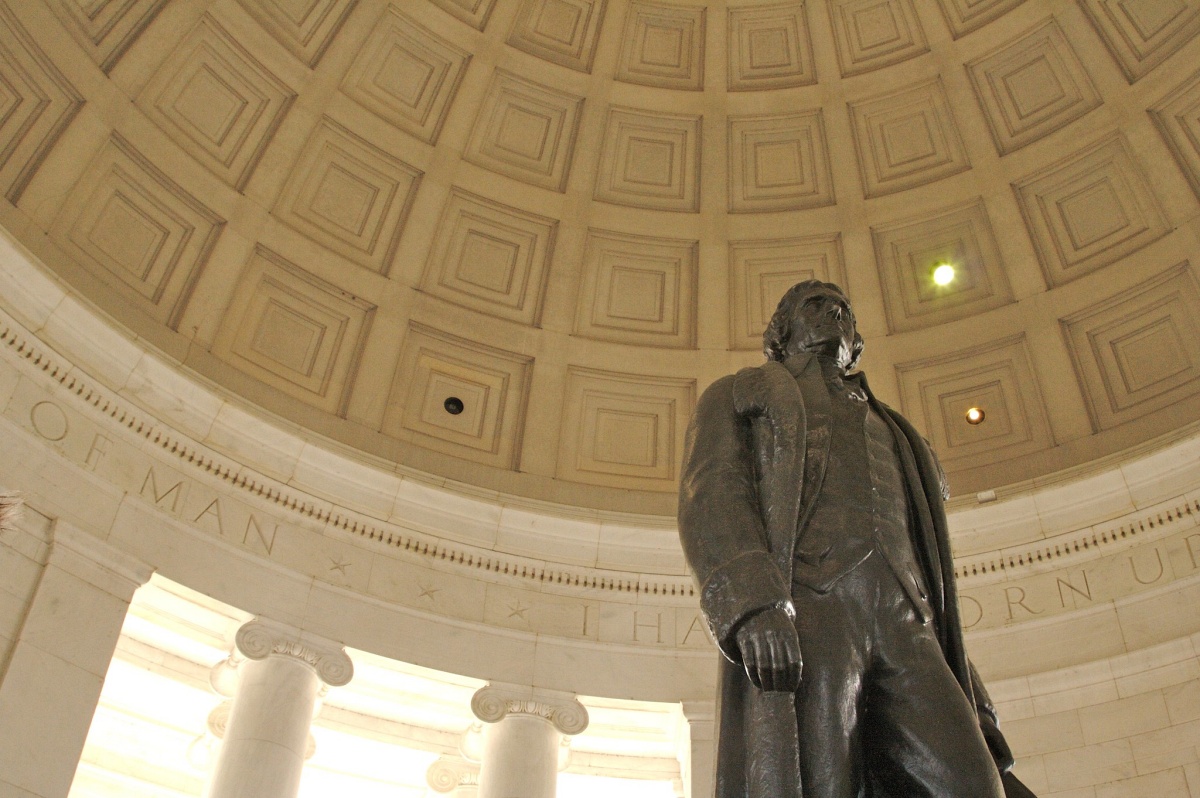
Via Tsuji • Attribution-NonCommercial-NoDerivs (CC BY-NC-ND 2.0) • Flickr


Thomas Jefferson
Jan 7, 2024 6:13 PM
Jefferson proposed that the Constitution be amended to remove the independence of the judiciary.
In April 1807, during the Aaron Burr trial, President Thomas Jefferson wrote a letter to a U.S. Senator that contained a shocking proposal, one that — had it been carried out according to the President’s wishes — would have changed the fabric of our nation forever. Jefferson proposed that the Constitution be amended to remove the independence of the judiciary.
Had Jefferson been successful, there would be no Supreme Court. There’d be Donald Trump trying to retain or regain power. Trump would be merely one in a long line of autocrats and dictators. There would be no separation of powers, no checks and balances, no independent judiciary.
The Constitution, if it existed, would be meaningless. The Executive could do whatever it wanted, as long as it could be justified as being consistent with “the common sense of the nation” (as Jefferson put it).
Jefferson’s wish didn’t come true but here we are today being told by a current presidential candidate that as a former president he is immune to prosecution for crimes he allegedly committed and if he is elected he will “terminate” the Constitution so he can make America great again and be the People’s “retribution” for the harms committed against them by Sleepy Joe’s Deep State.
Related stories
Trump (beloved by many) has fooled half of America. Our beloved Jefferson might have done the same.
Last week, two articles came out, written by two different respected academics, on issues related to the Supreme Court and judicial independence. These two articles reminded me of Jefferson’s proposal.
Stephen Vladek, Chair in Federal Courts at the University of Texas School of Law (who has written some very interesting pieces recently on his “One First” substack column), wrote this past week about the Supreme Court’s annual Year-End Report.
Since Vladek found little to say about the current Court’s report (noting that the report says “nary a word (or even hint) about any of the controversies swirling around the Court, or its declining public support, or the increasingly significant role it is likely to play in the 2024 election cycle”), he focused on the last report that addressed any significant issues: Chief Justice Rehnquist’s 2003 report about relations between Congress and the Judiciary.
In that report, Rehnquist suggested that Congress should “ask the Judiciary its views” on significant pieces of legislation. Rehnquist focused on providing “a history of more robust legislative-judicial cooperation in statutory reforms directed at the courts.”
Vladek says: “it’s fairly remarkable, viewed through a more current lens, for the Chief Justice of the United States to devote the crux of his annual report to a sustained critique of one of the other branches of government.” But “the moral of the story was that both branches are at their best when they are in productive, regular conversation with each other.”
This raised a question in my mind, so I wrote Vladek, asking him:
“Aren’t courts in the business of making determinations on cases and controversies and not issuing declarative opinions? Wouldn’t ‘more robust legislative-judicial cooperation in statutory reforms directed at the courts’ undermine the Court’s independence? Wouldn’t it encourage kowtowing in both directions? Of course, what we have now runs opposite to that — with a Supreme Court running counter not only to cooperation with other branches but to its own precedent.”
Vladek hasn’t answered me — but this is a basic tenet of judicial independence in the U.S. — courts are not supposed to issue opinions on matters not directly before them. And the idea of the Court “cooperating” with Congress just stuck in my gut.
The second scholar who wrote a piece on the judiciary was Timothy Snyder. He is an American historian specializing in the history of Central and Eastern Europe, the Soviet Union, and the Holocaust and is the Richard C. Levin Professor of History at Yale University and a permanent fellow at the Institute for Human Sciences in Vienna.
Writing in his column, “The Pitchfork Ruling,” about the efforts to remove Trump from ballots under section 3 of the 14th Amendment, Snyder starts with his conclusion that “Trump cannot be a candidate for any state or federal office in the United States of America.”
One phrase in Synder’s article particularly caught my attention: “As a person attempts regime change from a position of executive power, he will (again, utterly predictably) try to discredit the other branches of government, the legislative and the judicial. This will involve mocking them.”
Synder of course was referring to Trump but this also reminded me of some things I had noticed in Jefferson’s letters (particularly some interchanges he had with Madison mocking Patrick Henry and wishing him dead!). I was then reminded of this 1807 letter President Thomas Jefferson wrote during the Burr trial (whom he also wished dead).
President Jefferson’s Proposal
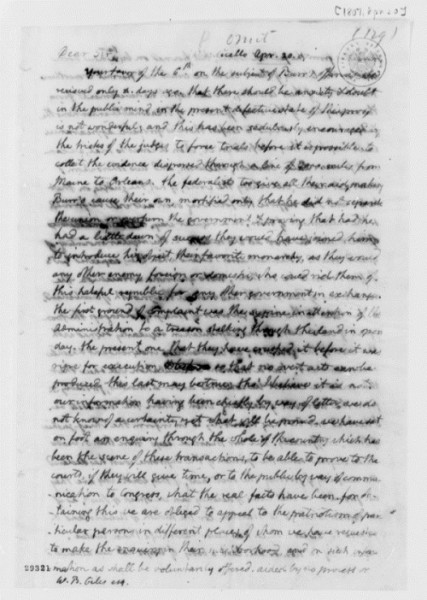
At the outset of the trial, when Chief Justice John Marshall was ruling in ways Jefferson didn’t like, Jefferson wrote this shocking letter to U.S. Senator William Giles, in which he proposed that “the people” should:
“amend the error in our constitution which makes any branch independant of the nation, they will see that one of the great co-ordinete branches of the government, setting itself in opposition to the other two, and to the common sense of the nation, proclaims impunity to that class of offenders which endeavors to overturn the constitution, and are themselves protected in it by the constitution itself.”
(Jefferson’s original spelling retained.)
Does this remind you of someone? Someone who claims the protection of the Constitution while attempting to overturn it (or throw it out)? Yes, Trump. He calls on the protection of the Constitution, says his due process rights have been violated, still says the election was stolen — while claiming that no laws bind him, he has absolute immunity, he can do and say whatever he wants and the Constitution should be terminated!
Jefferson, of course, was obviously referring to Burr — but how Jefferson imagined Burr was endeavoring to “overturn the constitution” is not clear. Burr defending himself at trial against Jefferson’s charges was not overturning the Constitution. Burr going into hiding for fear of being assassinated was not overturning the Constitution. Not even Burr and his assembled men carrying weapons into the western wilderness was anything close to an attempt against the Constitution or nation.
And even if Burr was engaging in insurrection or treason (which I am certain he wasn’t), that wouldn’t have been “overturning” the Constitution, at least not literally.
In fact, it was Jefferson’s proposal that would have overturned the Constitution, had it been taken up.
Unbeknownst to most, Burr had always adhered to the principles of the Revolution and Constitution. While Jefferson is sometimes identified as a strict constitutional constructionist, it was Burr, not Jefferson, who insisted on strict constitutional construction during their 1801 electoral tie. Jefferson wished Burr to politely the election, even against the wishes of the body constitutionally assigned to break the electoral tie. Burr insisted that the House of Representatives must decide, as was constitutionally required. That was when Jefferson’s hatred of Burr started.
However that may have been, what is more more important (and more confusing) in Jefferson’s statement is what he says about judicial independence.
Jefferson — our most beloved founding father — wanted the Constitution amended to remedy the purported “error” of judicial independence!
Let me say that again. Jefferson wanted the judiciary NOT to be independent of the other two branches. At least when the judiciary “set itself in opposition to the other two.” The suggestion he appears to make is that it be merged with the executive branch.
So I must ask: what good is it to have three independent branches if it is not permissible for any one of them to be in opposition to the other two? The whole idea of independent branches is to offer divergent positions. That is what “checks and balances” is about.
There is, moreover, no such thing as the Jeffersonian ideal of “the common sense of the nation.” How would the judiciary or Congress align itself with the common sense of the nation? By agreeing with the President? (For it is he alone who asserts that he knows what that common sense is.)
That was not all that Jefferson was saying either. Even more alarmingly, he further and even more shockingly wrote that “if [the Court’s] protection of Burr produces this amendment it will do more good than his condemnation could have done . . . and if his punishment can be commuted now for an useful amendment of the constitution, I shall rejoice in it.”
In other words, Jefferson was also saying that he was willing to “commute” Burr’s punishment in exchange for such a “useful” constitutional amendment!
This is an admission about Jefferson’s true intentions in relation to Burr. He really didn’t care whether Burr was guilty or not, whether Burr was convicted or not, as long as the President could get what he wanted politically, which was essentially to have all branches in agreement with (subject to) the Executive. Jefferson wanted to consolidate power in the Executive.
(This was not the only moment in which Jefferson moved to consolidate executive power. Leonard Levy and Henry Adams both discuss Jefferson’s despotic actions during the Embargo Acts towards the end of his second administration. See also Roger G. Kennedy’s study of Burr, Hamilton and Jefferson; he called Jefferson’s approach to acquisition of western territory “amoebic despotism.”)
Class of Offenders (Outlaws)
In his letter to Senator Giles, Jefferson stated that the judiciary “proclaims impunity to that class of offenders which endeavors to overturn the constitution, and are themselves protected in it by the constitution itself.”
He was saying that Burr was in a “class of offenders” who were endeavoring to overturn the constitution. Did Jefferson really think this?
Jefferson had previously put his weight solidly behind the creation of an “outlawry” act in Virginia, which allowed the legislature to declare a person guilty of crimes, thus outside the law and subject not only to arrest on no further grounds than legislative declaration but to outright assassination by any person. (See Leonard Levy, Jefferson and Civil Liberties: The Darker Side.)
This was the “class of persons” to which Jefferson was referring in his letter to Giles. Burr, in Jefferson’s opinion, could and should be declared guilty of crimes without due process and be treated as outside the law (outlawed), even subject to extrajudicial, extralegal murder. This was what the revered author of the Declaration of Independence was proposing!
And indeed, Jefferson acted on that belief. Not only did Jefferson proclaim Burr guilty to the nation before Burr was even charged but he issued an order to have Burr captured or killed. (Which was the reason Burr supposedly jumped bail [itself untrue — he was not out on bail] and went into hiding in the Mississippi wilderness, which people alleged showed his guilt.)
Have we been fooled not just by Trump but by our beloved Thomas Jefferson? If so, we’ve been fooled for a long, LONG time.
Let me add three background points: (1) the case against Burr (and particularly the case Jefferson had in mind and personally pushed on the prosecution) was exceptionally weak, largely due to the fact that (2) Burr did not commit a crime and had no nefarious motives such as Jefferson ascribed to him, which (3) Jefferson knew because he had approved of Burr’s plans in advance and Burr had kept him informed the entire time of exactly what he was doing.
(I documented and detailed all this in my book “Malice: Thomas Jefferson’s Conspiracy to Destroy Aaron Burr.”)
So now, think about where we would be today if Jefferson’s proposed amendment had been adopted. What would have happened to our Constitution and the rule of law? To our democratic republic? To our coordinate branches? To our judiciary? To our nation?
It’s simple. We would’ve ended up with an autocracy — perhaps a relatively “benevolent” one, for a time anyway, an “amoebic despotism,” but not a democracy. The Constitution and the courts would have been discarded in favor of executive power (or put under executive control). Burr might have been pardoned but that wouldn’t have made much difference to anyone, including Burr (who was anyway ultimately acquitted but after Jefferson’s defamatory declarations, still widely viewed as guilty). Jefferson destroyed Burr’s career and whatever good Burr could have done in his lifetime and ever after.
Perhaps the lesson in all this is that things are not always what they seem. Trump has fooled a lot of people and so has Jefferson. Those who complain of persecution by their enemies, such as both Trump and Jefferson have done or did, tend to garner more sympathy from the populace but it is not likely deserved.
Don’t be fooled.
Post script: In a 2003 scholarly article about the 1801 electoral tie, I mentioned the supplicating tone of a letter that Jefferson wrote to Burr at the moment the tie became known. I discussed a kind of subliminal coded language he engaged in with Burr. Now, twenty years later, I still believe that understanding these hidden, coded aspects of Jefferson may be the key to understanding not just Jefferson but the situation we find ourselves in today.
Comments

Powered by RoundtableAn AI/DeFi-powered Enterprise Media Operating System. Learn more at Roundtable.io.© Roundtable 2026. By using this site you agree to the Terms of Use and Privacy Policy