


Jul 13, 2026 5:08 PM
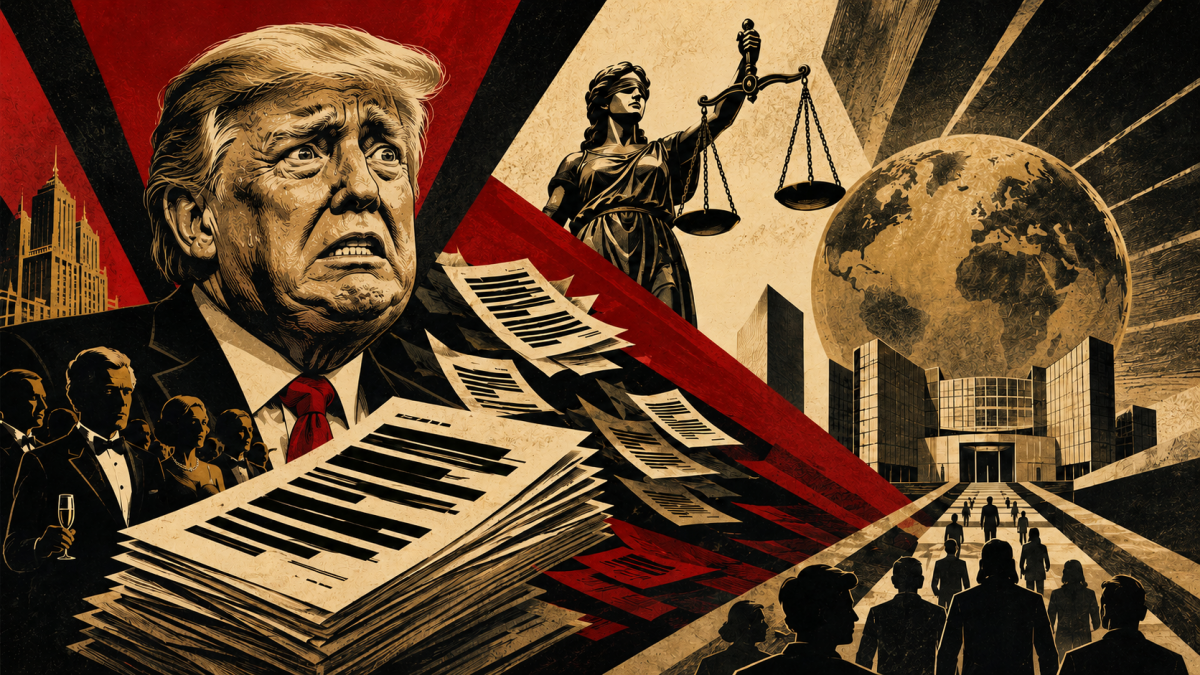
UN experts say Epstein’s network may constitute crimes against humanity as Trump fights to shield the powerful from domestic and international accountability.
On July 2, 2026, Jack Smith — the former Special Counsel who built a case establishing "proof beyond a reasonable doubt" that Donald Trump criminally schemed to overturn the 2020 election, and who, before his DOJ appointment, served as a prosecutor in the Office of the International Criminal Court — told MS NOW he was still ready to bring his cases to trial the moment Trump leaves office.
"Yeah. Correct," Smith confirmed. "The facts and the evidence are preserved and waiting for review." He was speaking about domestic criminal charges. The international legal record is in the same condition: documented, authenticated, and waiting.
On November 19, 2025, Trump signed the Epstein Files Transparency Act into law. Congress had passed it 427 to 1. He had little choice.
Six weeks later, his Justice Department was defending extensive redactions protecting powerful men — including Epstein's one-time best friend Trump — while exposing victims' names.
Related stories
By January 2026, Trump was calling public concern a "hoax." By February 2026, independent experts appointed by the United Nations Human Rights Council had reviewed those same files and reached a conclusion that no American official has been willing to state, and that the Trump administration has done everything in its power to prevent any court from adjudicating.
The Epstein network, the UNHRC experts said, may constitute crimes against humanity.
They were precise about what that means. Under international criminal law, the experts wrote in their February 17, 2026 statement, crimes against humanity occur when acts such as rape, sexual slavery, trafficking, torture or murder are committed as part of a widespread or systematic attack against a civilian population.
They concluded applying this framework — Article 7 of the Rome Statute — to the Epstein files: "So grave is the scale, nature, systematic character, and transnational reach of these atrocities against women and girls, that a number of them may reasonably meet the legal threshold of crimes against humanity."
Their closing sentence was addressed to power: "No one is too wealthy or too powerful to be above the law."
That sentence has a direct answer.
On June 29, 2026, Acting Attorney General Todd Blanche sent a formal letter to the ICC's President declaring that the Court has no jurisdiction over Americans — anywhere in the world — and that any assertion of such authority is "illegitimate" and "unlawful." Eight ICC judges had been sanctioned. Three were suing the United States in federal court.
The Trump administration, having signed a transparency law under Congressional compulsion, was simultaneously telling the world's accountability court to mind its own business.
It cannot entirely do so, and here is why the ICC argument matters even for Americans who have given up on it.
Venezuela ratified the Rome Statute in 2000 and remains a member. On January 3, 2026, the United States conducted Operation Absolute Resolve — a military strike on Venezuelan territory that extracted Venezuela's sitting president, killed Cuban nationals on Venezuelan soil, and failed by a single Senate vote to be repudiated by Congress.
The crime of aggression under the Rome Statute's Kampala Amendments applies to crimes committed on State Party territory regardless of the perpetrator's nationality. The United States is not a Rome Statute party. Venezuela is.
The ICC therefore has potential territorial jurisdiction over conduct committed on Venezuelan soil by American forces — and Blanche's letter, however forceful, cannot wish that jurisdiction away.
None of this means anyone is going to The Hague.
The obstacles are enormous, the jurisdictional arguments are contested, and the Trump administration will resist on every front. But legal exposure and political resistance are different things.
The evidence exists. The framework exists. The territorial jurisdiction argument exists.
Published polls show nearly half of Americans believe the files were not fully released — that elite co-conspirators who trafficked women and girls for decades remain protected by the same institutional deference that shielded them while Epstein lived.
The UN's own appointed legal experts have now called what those files describe by its proper legal name.
The record — domestic and international — is preserved and waiting for review.
The question — as it has been since Nuremberg in 1945 — is whether the law applies to the powerful, or only to everyone else.
Comments

Powered by RoundtableAn AI/DeFi-powered Enterprise Media Operating System. Learn more at Roundtable.io.© Roundtable 2026. By using this site you agree to the Terms of Use and Privacy Policy