


May 5, 2025 12:34 AM
Updated May 5, 2025 2:08 PM
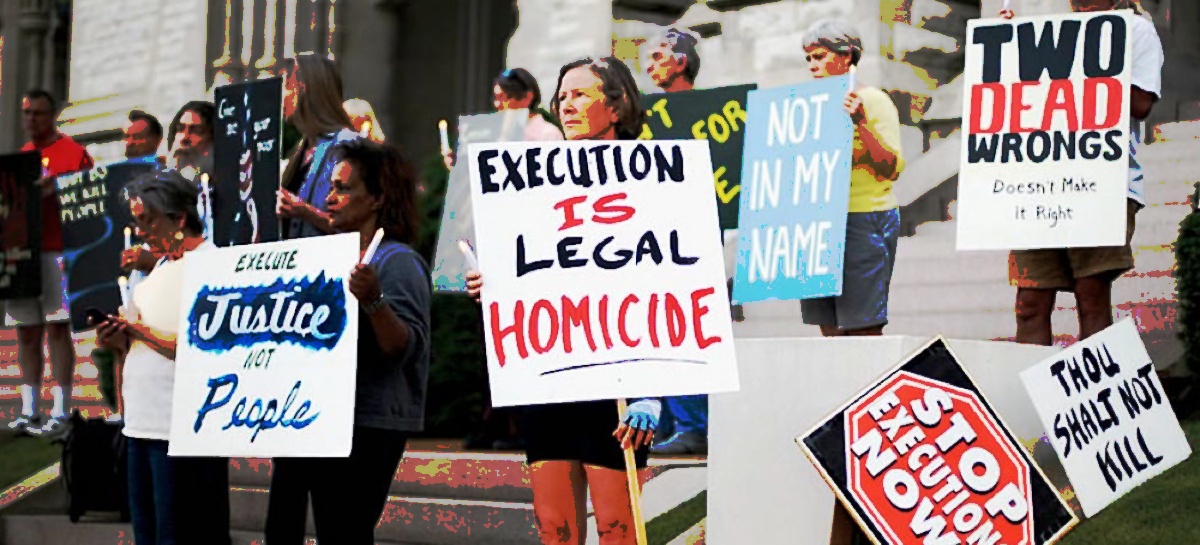
After beginning his second presidential term, Trump wasted little time in trying to increase both federal and state executions.
I never cared much for Henry VIII of England—beheading two wives and Thomas Moore, et cetera. But it wasn’t until after I watched the PBS series “Wolf Hall” that I realized that these individuals were just a small fraction of the almost 60 people that he condemned to death, most by beheading, but also by burning at the stake and starvation, and some had their bodies drawn and quartered after being hanged. Besides the Renaissance thinker and once English chancellor (1529-32) Moore, another beheaded politician was the star of “Wolf Hall,” Thomas Cromwell himself, Henry VIII’s principal adviser from 1532 to 1540—and so ably played in the series by Mark Rylance.
Why all those beheadings and other gruesome life-ending horrors? Mainly because Henry’s opponents refused to go along with all his wife changing and/or stipulations which followed from those decisions including making him, not the Catholic pope, the head of the Church of England.
In Steven Pinker’s Enlightenment Now: The Case for Reason, Science, Humanism, and Progress ( 2018) he writes that “gradually European countries stopped executing people for any but the most heinous crimes,” and indicates that by the middle of the 19th century Great Britain had winnowed down to 4 (as compared to 222 at some earlier time) the number of capital punishment offenses. The UN’s Universal Declaration of Human Rights in 1948 ushered in more restrictions, and “in Europe today [2018] it lingers only in Belarus”—where there was one case in 2022 and none in 2023 and 2024.
As late as the early twentieth century, however, legal executions were public spectacles in many countries. In 1857, in a visit to Paris, the writer Leo Tolstoy described one attended by some twelve to fifteen thousand people, including women and children—decades later Tolstoy became a preacher of non-violence and influenced Gandhi’s thinking on the subject. The execution was carried out by using a guillotine, and Tolstoy wrote that when he “saw the head separate from the body, and how they both thumped into the box at the same moment, I understood, not with my mind but with my whole being, that no theory of the reasonableness of our present progress can justify this deed; and that though everybody from the creation of the world, on whatever theory, had held it to be necessary, I know it to be unnecessary and bad.” (In the USA illegal executions in the form of lynchings were also often public spectacles—see the photo accompanying the article that mentions a few lynchings in Marion, Indiana in 1930.)
Related stories
Gradually, not only did lynchings cease in the USA, but legal executions declined sharply, especially on the federal level. Since 1977 there have been only 16 federal executions, and 13 of those were carried out in the late months of the first Trump administration. 27 states, however, still allow them today, especially in Texas and most southern states, and in 2024 there were still 25 of such.
Among the many reasons why we should follow almost all of Europe’s example and abolish the death penalty throughout the USA, several were mentioned by President Obama in 2015. Racial bias, wrongful convictions, and botched executions were three that he provided. For example, as he added, “We know that there were people who’ve been on death row that have been freed because, later on, it’s been proven that they were innocent.” (See also here for racial bias and wrongful convictions.)
President Trump’s favorable attitude toward the death penalty has been indicated, as has racial bias and wrongfull convictions. A good example combining at least two of the three occurred in 1989 when the Central Park Five, five black and Latino teenagers, were wrongly convicted of raping a white woman, Trisha Meili, while she was jogging in New York City’s Central Park.
Trump, still a few decades away from the presidency, placed full-page pieces in The New York Times and three other papers that called for the restoration of the death penalty for the killers. “I want to hate these murderers...I am not looking to psychoanalyze or understand them, I am looking to punish them.”

The five young men claimed that the police coerced them into confessing, and their convictions were vacated in 2002. In 2014, settling their civil-rights lawsuit, the city paid them $41 million. In 2019, during his first term as president, Trump refused to apologize for his earlier remarks, saying that the five “admitted their guilt,” and that some of the prosecutors thought “that the city never should have settled that case.” “You have people on both sides” of the matter was his conclusion.
After beginning his second presidential term, Trump wasted little time in trying to increase both federal and state executions. The AP news service reported that not only had Trump (during his first term) carried out federal executions at a rate “more than under any president in modern history,” but that just hours after beginning his second term he “signed a sweeping execution order...that directs the attorney general to ‘take all necessary and lawful action’ to ensure that states have enough lethal injection drugs to carry out executions.” He also compelled “the Justice Department to not only seek the death penalty in appropriate federal cases but also to help preserve capital punishment in states that have struggled to maintain adequate supplies of lethal injection drugs.”
During the Obama and Biden presidencies it seemed like the USA was following Europe’s example and on its way to ending capital punishment, at least at the federal level. But for Trump this signaled, as his second-term Attorney General Pam Bondi indicated, that the Democratic political leadership disregarded...important responsibilities and supplanted the will of the people with their own personal beliefs. Those at the very highest levels of the [Justice] Department failed to seek death sentences against child rapists, mass murderers, terrorists, and other criminals. More appalling, the Department's leadership sought and received from former President Biden—commutations for the death sentences of 37 murderers that Department of Justice prosecutors had tirelessly secured over the past three decades. These actions severely undermined the rule of law and grievously damaged the public's trust in the justice system. For the victims of these horrific crimes and the loved ones left behind, these actions betrayed our sacred duty and broke our promise to achieve justice.
The Trump administration disagreed with most of Europe that in regard to the death penalty and many other areas—like climate change—Europe was progressing, however haltingly. Trump’s motto was “Make America Great Again,” and in many ways he seemed to wish to go back to an earlier period of our history—before Affirmative Action, before attempts to grapple with climate change, before international cooperation with our NATO partners, et cetera.
Although I do not agree with all of Pinker’s Enlightenment Now: The Case for Reason, Science, Humanism, and Progress, I think he is correct to opt for “Reason, Science, Humanism, and Progress.” But much of Trump’s Make-America-Great-Again motto heads us in the other direction—the wrong one.
Comments

Powered by RoundtableAn AI/DeFi-powered Enterprise Media Operating System. Learn more at Roundtable.io.© Roundtable 2026. By using this site you agree to the Terms of Use and Privacy Policy