


Feb 27, 2025 5:56 PM
Updated Mar 5, 2025 4:03 AM
Donald Trump Returns to Power Wrapped in the Criminal Immunity Bestowed by His Subservient Supreme Court
Donald Trump Returns to Power Wrapped in the Criminal Immunity Bestowed by His Subservient Supreme Court More Videos
Donald Trump’s return to the White House poses a far greater threat to America than his first term as President because now he is armed with new-found criminal immunity.
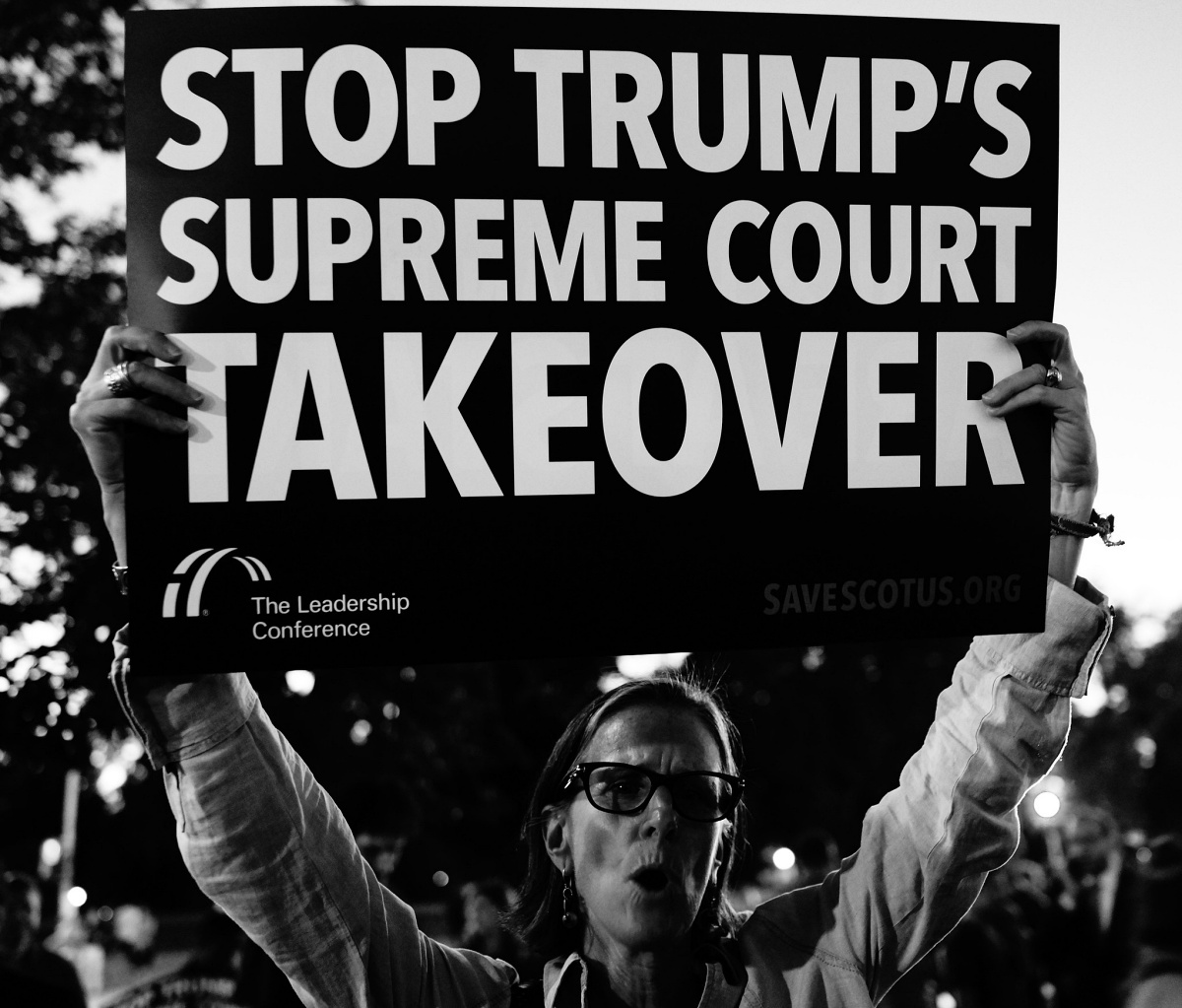
Throughout his rise to power, Trump has recruited obedient enablers to do his bidding. His henchmen have compliantly cleared the way for him to lie, steal, and conspire to get whatever he wants. As he mounted his campaign for a second term, he took that strategy to a new and even more corrupt level: He enlisted the six conservative Republican justices on the United States Supreme Court to grant him the freedom to brazenly break the law with absolute impunity. As Trump rolls out his authoritarian Executive Orders and dangerous new policies, it is important to understand exactly what the Court did and how Trump 2.0 will unfold without one of the traditional guardrails on which our democracy depends – the deterrent threat of criminal prosecution.
On July 1, 2024, in Donald J. Trump v. United States of America – the name of the case says it all – the six arch-conservative justices (three of whom Trump appointed) awarded their liege a vast and complex criminal immunity scheme. This shameful, craven, and result-oriented decision was the latest entry in the rogues’ gallery of the most contemptible and politically-driven decisions in Supreme Court history.
In his hypocritical majority opinion, Chief Justice John Roberts had the audacity to assure the American people that the “president is not above the law,” as he and his fellow Republican accomplices proceeded to literally invent sweeping presidential immunity, complete with new rules of evidence highly favorable to the President, none of which appear anywhere in the Constitution and none of which have ever been recognized by the Court in its 236 year history.
Related stories
Specifically, in Trump, the majority delivered Trump a tailor-made “Stay-Out-of-Jail” trifecta of expanded presidential protections: First, absolute immunity for crimes committed when a President engages in “core” official acts and a near-conclusive presumption of immunity for other official acts; second, a brand new rule of criminal procedure making a President’s motives irrelevant; and third, another new rule excluding evidence of a President’s official acts from a criminal trial for his unofficial acts.
Justice Sonia Sotomayor wrote a blistering 30-page dissent, joined by Justices Elena Kagan and Ketanji Brown Jackson, calling the ruling “deeply wrong,” “nonsensical,” “disastrous,” “troubling,” “utterly indefensible,” “twisted irony,” “newly minted core immunity,” “extraordinary,” and “a law-free zone.” Instead of following the custom of ending her dissent “respectfully,” Sotomayor ended it ominously: “With fear for our democracy, I dissent.”
In her own searing and analytical 22-page dissent, Jackson, characterized the majority opinion as “flawed reasoning,” “concocted,” “breaks new and dangerous ground,” “devise[d] from whole cloth,” “oddity,” “a five-alarm fire,” “intolerable,” “unwarranted,” and “plainly antithetical to bedrock constitutional norms.”
The Conservatives Abandon Their Pet Doctrine of Originalism
“We thus conclude,” Roberts wrote, “that the President is absolutely immune from criminal prosecution for conduct within his exclusive sphere of constitutional authority,” and he is “presumptively” immune for acts committed within “the outer perimeter of his official responsibility.”
Although Roberts ruled there is no immunity for “unofficial acts,” the path forward is purposely fraught with uncertainty, as he himself conceded: “[T]here is not always a clear line between the President’s personal and official affairs.” The bottom line was graphically illustrated by Sotomayor: “When he uses his official powers in any way, under the majority’s reasoning, he now will be insulated from criminal prosecution,” she warned. “Orders the Navy’s Seal Team 6 to assassinate a political rival? Immune. Organizes a military coup to hold onto power? Immune. Takes a bribe in exchange for a pardon? Immune. Immune, immune, immune.”
Jackson observed that one of the President’s “core” powers is appointing and removing members of his cabinet. And so she asked, Does that mean that a President is absolutely immune if he “removes” the Attorney General by poisoning him?
In arriving at its multi-layered immunity scheme, the majority cited a few general principles about the separation of powers among the three branches of government and alluded to vague worries that Presidents may be “unduly cautious” and not as “energetic” and “vigorous” in carrying out their official duties if they face criminal prosecution for breaking the law. Notably it cited no text in the Constitution to support the existence of presidential immunity.
In 2022 this very same conservative majority overturned Roe v. Wade because the Framers did not specifically include in the Constitution the exact words “right to abortion” or “right to privacy.” Yet it now conveniently conjures up “presidential criminal immunity,” which likewise appears nowhere in the text of the Constitution. All of a sudden, when dealing with the leader of the Republican party, the conservatives easily cast aside their hallowed “originalism.” This crass and naked use of unreviewable power drenches the Court in disgrace and dishonor. Sotomayor said it succinctly: On the question of “whether a former President enjoys immunity from federal criminal prosecution,” she wrote, the “majority thinks he should, and so it invents an atextual, ahistorical, and unjustifiable immunity that puts the President above the law.”
Then Sotomayor proceeded to demolish the majority’s claim that history was on its side by proving the very opposite. First, she confirmed that the “Framers clearly knew how to provide for immunity from prosecution.” They did so for members of Congress for their “speech and debate” on the floor of the House and Senate. She cited the 1998 legal memo from Kenneth Starr’s investigation of President Bill Clinton that concluded that if the Framers “had wanted to create some constitutional privilege to shield the President ... from criminal indictment,” they could have done so. But they did not. In fact, the Constitution expressly contemplates that an official, including the President, may “be liable and subject to Indictment, Trial, Judgment and Punishment, according to Law,” in the event of impeachment and conviction. If a President had absolute immunity, even one who had been impeached and removed from office could not be prosecuted.
Bereft of any support in the actual text of the Constitution, the majority tried to claim that immunity is somehow “rooted” in “constitutional tradition.” But Sotomayor proved that nothing in our history “supports the majority’s entirely novel immunity from criminal prosecution for official acts.” In fact, she showed convincingly that the historical evidence “cuts decisively against it.”
At the Constitutional Convention, James Madison asked if the delegates wanted to consider whether “privileges ought to be allowed to the Executive,” but there is no record of the subject ever being put on the agenda. Delegate Charles Pinckney commented that “No privilege ... was intended for [the] Executive.” In fact, in Federalist No. 69, Alexander Hamilton confirmed that former Presidents would be “liable to prosecution and punishment in the ordinary course of law.” Sotomayor cited several additional examples in this same vein.
More recently, she noted that ex-President Richard Nixon accepted his pardon from President Gerald Ford for “any charges which might be brought against me for actions taken during the time I was President of the United States.” The final report of Lawrence Walsh, independent counsel in the Iran/Contra matter, stated that “because a President, and certainly a past President, is subject to prosecution ... the conduct of President Reagan in the Iran/Contra matter was reviewed by Independent Counsel against the applicable [criminal] statutes.”
Perhaps the most damning evidence comes from Trump himself. During his second impeachment trial in 2021, to encourage Senators to acquit, Trump’s impeachment counsel assured them that “no former officeholder is immune” from “investigation, prosecution, and punishment” and if any thought he committed a crime, “[a]fter he is out of office, you can go and arrest him.”
“In sum,” Sotomayor wrote, “the majority today endorses an expansive vision of Presidential immunity that was never recognized by the Founders, any sitting President, the Executive Branch, or even President Trump’s lawyers, until now. Settled understandings of the Constitution are of little use to the majority in this case, and so it ignores them.”
Beyond absolute immunity, the majority also bestowed “presumptive immunity” on official acts outside the President’s “core” responsibilities, which prosecutors can try to rebut by proving that a prosecution would pose no “danger of intrusion on the authority and functions of the Executive Branch.” Sotomayor emphasized how insurmountable such a burden is: “No dangers, none at all”? “It is hard to imagine,” she wrote, “a criminal prosecution for a President’s official acts that would pose no dangers of intrusion on Presidential authority in the majority’s eyes.” When “presumptive immunity” is this “conclusive,” it becomes an “ironclad presumption,” and therefore the same as “absolute” immunity.
What is baffling about the insurmountable hurdle the majority created is that we are talking about a prosecution after the President has left office, which can no longer interfere with the discharge of his duties as President. If no one is above the law, then it should be of no concern that an ex-President, like any ordinary American charged with a crime, must tolerate the instrusions and burdens of facing a criminal prosecution.
On that pivotal issue the majority relied on a single case, Nixon v. Fitzgerald (1983). But that case involved a civil lawsuit, not criminal charges. There, A. Ernest Fitzgerald sued former President Nixon for money damages, claiming he was fired from a government job without lawful cause. The Court found that ex-Presidents have absolute immunity from civil lawsuits. But Chief Justice Warren Burger’s concurring opinion emphasized that the immunity granted in that case was “limited to civil damages claims,” rather than “criminal prosecution.” And even the four dissenting justices agreed that a “contention that the President is immune from criminal prosecution in the courts,” if ever made, would not “be credible.” Clearly, if anything, this civil case contradicts the majority’s ruling in Trump.
Indeed, the majority completely ignored how the law distinguishes criminal from civil immunity. Lower court judges are immune from civil lawsuits seeking money damages, “but they are subject to criminal prosecutions as are other citizens,” according to a 1976 Supreme Court decision. In that case, a unanimous Court made clear that it had “never suggested that the policy considerations which compel civil immunity for certain governmental officials also place them beyond the reach of the criminal law.” That is the exact opposite of what the majority in Trump has now held.
“In every use of official power, the President is now a king above the law,” Sotomayor wrote. “The court effectively creates a law-free zone around the president, upsetting the status quo that has existed since the founding.” The immunity the court created now “lies about like a loaded weapon” for any president to use for their own political gain or financial interests, “with the knowledge that they are inoculated from criminal liability,” she added.
Justice Jackson warned that the Court has declared for the first time that “the most powerful official in the United States can . . . become a law unto himself.” She added that “[f]rom this day forward, Presidents of tomorrow will be free to exercise the Commander-in-Chief powers, the foreign affairs powers, and all the vast law enforcement powers enshrined in Article II however they please — including in ways that Congress has deemed criminal and that have potentially grave consequences for the rights and liberties of Americans.”
The Nation and 46 Presidents have functioned for 236 years without insulating Presidents from prosecution for crimes committed in office. Until now.
The Conservative Majority Ties Prosecutors’ Hands By Excluding Evidence of a President’s Motives
But inventing presidential immunity wasn’t enough. In just a few words, the conservative majority also wiped out one of the key components of most criminal prosecutions in American law. They declared that in “dividing official from unofficial conduct, courts may not inquire into the President’s motives.”
The conservatives claimed they were very worried that “judicial examination” of allegations of “improper purpose” would intrude on presidential responsibilities. Citing nothing but the civil case of Fitzgerald - a case which said it was not applicable to criminal prosecutions - the majority claimed that inquiring into a President’s motives would “cripple” him from carrying out his duties if – heaven forbid! – he knew that “the motives that control his official conduct may, at any time, become the subject of inquiry.”
“Under that rule,” Sotomayor responded, “any use of official power for any purpose, even the most corrupt purpose indicated by objective evidence of the most corrupt motives and intent, remains official and immune.” Under the majority’s test, “the category of Presidential action that can be deemed ‘unofficial’ is designed to be vanishingly small.”
The Conservative Majority Blurs the Difference Between Official and Unofficial Acts
Throwing crumbs, the conservative majority confirmed that when it comes to purely unofficial, private acts, there is no immunity whatsoever, absolute or presumptive. But even here, in two very important ways they tipped the balance in favor of Trump and any future lawless President.
First, they purposely refrained from providing a clear definition of the difference between official and unofficial acts because the “categorization raises multiple unprecedented and momentous questions about the powers of the President and the limits of his authority.” Instead, they punted those questions back to the lower courts.
As a result of this uncertainty, judges, prosecutors, and defense counsel will be forced to conduct painstaking reviews of the meager tea leaves the majority has provided and then test those clues against the myriad facts in each case, followed by potentially multiple, lengthy and extensive appeals first to the courts of appeals and then the Supreme Court. Once each new case arrives there, these very same conservatives - or more of them chosen by Trump now that he has been reelected or future Presidents - will be free to critique in minute detail every legal and evidentiary ruling the lower courts have made to see if they have shown suitable deference to the former President. The whole process could last longer than Jarndyce v. Jarndyce in Dicken’s Bleak House.
Second, the majority announced that in a prosecution for unofficial acts, evidence of official acts must be excluded. Although she joined every other aspect of the majority opinion, this was a bridge too far even for Justice Amy Coney Barrett. Using the example of a bribery charge, she pointed out that “excluding from trial any mention of the official act connected to the bribe would hamstring the prosecution.” To make sense of charges “alleging a quid pro quo, the jury must be allowed to hear about both the quid and the quo, even if the quo, standing alone, could not be a basis for the President’s criminal liability.”
Here Barrett aligned herself with the three dissenters. As Sotomayor pointed out, “Even though the majority’s immunity analysis purports to leave unofficial acts open to prosecution, its draconian approach to official-acts evidence deprives these prosecutions of any teeth.” She added that if a former President cannot be held criminally liable for his official acts, “those acts should still be admissible to prove knowledge or intent in criminal prosecutions of unofficial acts.”
“A King Above the Law”
In the closing portions of Jackson’s magnificent dissent, she emphasized the essential role that deterrence plays in our system of criminal law. Deterrence, she wrote, is “a key justification for adopting and maintaining systems that ensure accountability for criminal conduct.” Likewise, “decreasing the certainty of accountability for wrongful acts at least arguably reduces incentives to follow the law.”
When “everyone is subject to the law, the potential of criminal liability operates as a constraint on the actions and decisions of everyone, including the President,” she noted. “After today, that reality is no more. Consequently, our Nation has lost a substantial check on Presidents who would use their official powers to commit crimes with impunity while in office.”
“Having now cast the shadow of doubt over when - if ever - a former President will be subject to criminal liability for any criminal conduct he engages in while on duty,” Jackson wrote, “the majority incentivizes all future Presidents [and one might add, reelected ones] to cross the line of criminality while in office, knowing that unless they act ‘manifestly or palpably beyond [their] authority’..., they will be presumed above prosecution and punishment.”
The People Are the “Ultimate Safeguard”
Justices Sotomayor and Jackson issued these alarming warnings four months before the 2024 election. Forewarned, the American people - or at least enough of them to elect Trump - took no heed.
This is a dark moment in the history of the United States, made even darker by the Supreme Court. Yet we can take solace in the fact that people all over the country are organizing and mobilizing resistance. Within days after Trump was sworn in, the ACLU filed two separate lawsuits against Trump, one to defend birthright citizenship, as mandated by the Fourteenth Amendment, and another to challenge Trump’s attempt to “fast track” deportations. Twenty-four states and cities also filed lawsuits challenging Trump’s attack on birthright citizenship.
And on his third day in office, Trump suffered his first legal setback when, on January 23, a federal judge temporarily blocked his executive order denying U.S. citizenship to the children of parents living in the country illegally, calling it “blatantly unconstitutional.” “I’ve been on the bench for over four decades. I can’t remember another case where the question presented was as clear as this one is,” U.S. District Judge John Coughenour, a Ronald Reagan appointee, told a Justice Department attorney. “I have difficulty understanding how a member of the bar could state unequivocally that this is a constitutional order,” he added.
And then Trump suffered another legal setback less than a week later when, on January 28, a different federal judge, U.S. District Judge Loren AliKhan, temporarily blocked Trump’s plan to impose a massive freeze on federal aid. The lawsuit was filed by the National Council of Nonprofits; SAGE, a pro-LGBTQ advocacy organization for older adults; the American Public Health Association; and small-business group Main Street Alliance. They were represented by Democracy Forward, a progressive legal organization that has frequently battled Trump in the courts. Then, amid confusing announcements from the White House suggesting that Trump’s freeze was on hold, on February 3 Judge AliKhan extended her temporary stay into a preliminary injunction. Rejecting the arguments from the Trump Department of Justice, she wrote, in a 30-page ruling, the "declarations and evidence presented by Plaintiffs paint a stark picture of nationwide panic in the wake of the funding freeze. Organizations with every conceivable mission — healthcare, scientific research, emergency shelters, and more — were shut out of funding portals or denied critical resources beginning on January 28."
Three other lawsuits have been filed, challenging the legality of Trump’s Department of Government Efficiency (DOGE), and additional lawsuits are expected to be filed challenging all of Trump’s most egregious actions as they occur.
Public outrage forced Trump to withdraw his nomination for Matt Gaetz as Attorney General. Republicans now have historically slim majorities in the House and Senate. There are special elections this year, and soon the groundwork will be laid for the 2026 mid-term elections in which control of the House and Senate will be at stake, offering the possibility of blocking more parts of Trump’s outrageous legislative agenda.
All of this and more, one suspects, is exactly what Justice Jackson had in mind when she ended her dissent with a call to arms: “The seeds of absolute power for Presidents have been planted.” “[As] we enter this uncharted territory, the People, in their wisdom, will need to remain ever attentive, consistently fulfilling their established role in our constitutional democracy, and thus collectively serving as the ultimate safeguard against any chaos spawned by this Court’s decision.”
Comments

Powered by RoundtableAn AI/DeFi-powered Enterprise Media Operating System. Learn more at Roundtable.io.© Roundtable 2026. By using this site you agree to the Terms of Use and Privacy Policy