
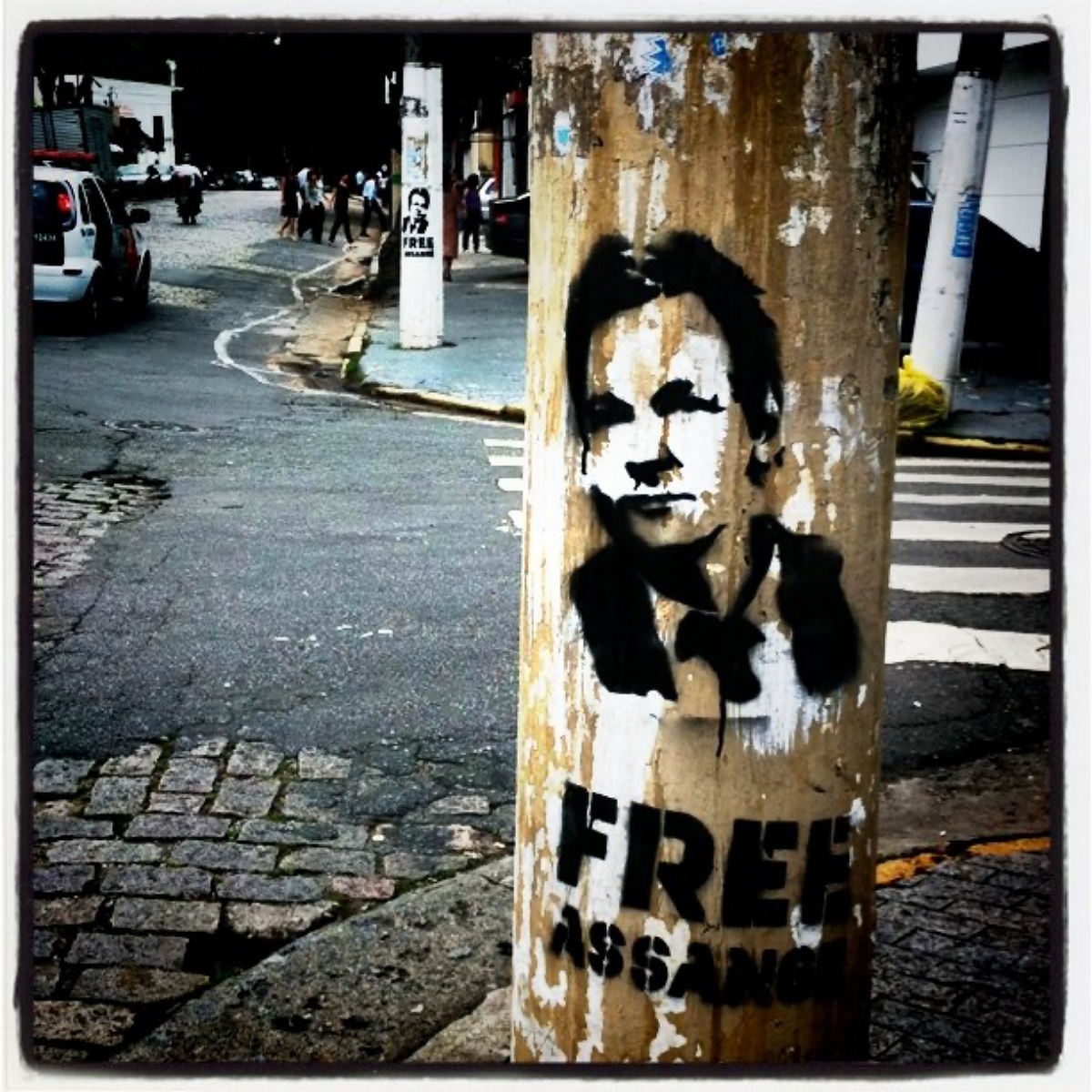
Priscilla Jordão • Attribution-ShareAlike (CC BY-SA 2.0) • Flickr


Free Assange
Dec 23, 2023 5:02 AM
Updated Dec 23, 2023 1:24 PM
Case Sets Stage for Exposing CIA Clandestine Surveillance of Attorneys and Journalists
In a stunning decision on December 19, a federal court in New York ruled that attorneys and journalists may pursue their civil complaint against the Central Intelligence Agency. The plaintiffs allege their constitutional rights were violated by illegal surveillance during their visits with WikiLeaks founder Julian Assange between January 2017 and March 2018 at the Ecuadorean Embassy in London, where he had been granted asylum.
The 27-page decision in Kunstler v CIA, written by US District Judge John G. Koeltl, , denied the CIA’s motion to dismiss the case. This important ruling sets the stage for the plaintiffs to gather documentary evidence and take depositions under oath exposing the details of the CIA’s alleged wrongdoing. The result may be a public trial as early as next year. The case presents a rare opportunity for the clandestine operations of the CIA – an agency that prides itself on secrecy – to be subjected to public scrutiny and accountability.
Attorneys and Journalists Sue CIA, Pompeo, Undercover Global, and David Morales Guillen
Assange is a journalist and publisher and the founder of WikiLeaks, a multi-national media organization and library. The US indicted Assange for allegedly violating the Espionage Act of 1917 and other charges regarding computer intrusion. If extradited to the US, he faces 175 years in prison.
Assange, fearing even before the indictment that he would be extradited and face charges, took refuge in the Ecuadorean Embassy in London until April 2019, when he was abruptly arrested by British authorities. He has been detained in HM Belmarch Prison ever since.
Related stories
In August 2022, Margaret Ratner Kunstler, Deborah Hrbek, John Goetz, and Charles Glass sued the CIA and former director Mike Pompeo, as well as David Morales Guillen and his professional security firm based in Spain, Undercover Global S.L. Kunstler and Hrbek are attorneys practicing law in New York, and Goetz and Glass are journalists who report on national security issues.
Federal Court Rules CIA Must Face Accusations of Violating the Constitutional Rights of Attorneys and Journalists Who Visited WikiLeaks Founder Julian Assange in Ecuadorean Embassy
Their civil complaint alleges that in April 2017, Pompeo announced in one of his first speeches that “as CIA Director he would target whistleblowers who exposed clandestine and/or illegal efforts by the United States government aimed at countries perceived to be hostile to U.S. interests.” Pompeo specifically labeled WikiLeaks as “a nonstate hostile intelligence service.” He called Assange a “narcissist,” “fraud,” and a “coward,” and “pledged that his office would embark upon a ‘long term’ campaign against WikiLeaks.”
The plaintiffs allege that at a January 2017 private security industry convention at the Las Vegas Sands Hotel in Las Vegas, Nevada, UC Global and its founder and Chief Executive Officer David Morales Guillen were recruited to conduct surveillance on Assange and his visitors on behalf of the CIA while providing security at the Ecuadorean Embassy. In particular, it is alleged that Pompeo recruited UC Global and Morales to “obtain confidential information in the possession of the Plaintiffs concerning Assange, his legal cases and the Plaintiffs themselves.” The plaintiffs allege that Pompeo approved and authorized this arrangement.
To implement the agreement with the CIA, Morales created an operations unit, improved UC Global’s systems, and set up live streaming from the United States so that surveillance could be accessed instantly by the CIA, according to the lawsuit. Then, from around January 2012 until the Ecuadorean government terminated UC Global’s contract around April 2018, it is alleged that Morales, UC Global, Pompeo, and the CIA did the following: (a) converted video surveillance of Assange to audiovideo surveillance by placing hidden microphones on new cameras; (b) placed hidden microphones inside the Embassy and switched out recordings that were downloaded twice-monthly and given to the CIA; (c) ensured that the CIA could in real time directly observe and listen to Assange’s daily activities at the Embassy; (d) copied and took images of the passports, including pages with stamps and visas, of all visitors; and (e) seized, dismantled, imaged, photographed and digitized the computers, laptops, mobile phones, recording devices and other electronics brought into the Embassy by the plaintiffs, including but not limited to IMEI and SIM codes, fronts, backs and insides of visitors’ devices, and downloaded stored material.
It is also alleged in the lawsuit that the data collected by UC Global was either personally delivered to Las Vegas, Washington, D.C., and New York City by Morales (who traveled to these locations more than sixty times in the three years following the Las Vegas convention) or was placed on a server that provided external access to the CIA.
The plaintiffs allege that each time they visited Assange at the Embassy, they were required to leave with the security guard at the Embassy reception desk their devices, which contained “confidential and privileged information and documents” from or about confidential sources and clients. The plaintiffs allege that they were unaware their electronic information was copied and their meetings with Assange recorded and given to the CIA until October 2019, after documents in a Spanish criminal case against Morales and UC Global were unsealed and reported on by the press. They also allege that they would not have brought their electronic devices into the Embassy had they known their information was being copied and given to the CIA.
Consequently, the plaintiffs assert that by authorizing and implementing unlawful surveillance techniques, the CIA, under the color of federal authority, violated their right to be free from unreasonable searches and seizures as guaranteed by the Fourth Amendment. As a result, the plaintiffs are seeking an injunction against the CIA from “utilizing in any way, or revealing to any third party, the content of materials seized from Plaintiffs[;] . . . and an order requiring the CIA to purge and destroy all such materials from their files.”
Claims of Copying Contents of Plaintiffs’ Electronic Devices Will Move Forward
The centerpiece of the case is the plaintiffs’ claim that the CIA illegally copied the contents of their electronic devices. This is the claim that survived the government’s motion to dismiss.
In his ruling Judge Koeltl noted that the Fourth Amendment protects the “right of the people to be secure in their persons, houses, papers, and effects, against unreasonable searches and seizures.” He explained that according to established law, the “touchstone of Fourth Amendment analysis is whether a person has a constitutionally protected reasonable expectation of privacy.”
And whether an individual has a reasonable expectation of privacy hinges on whether (1) the plaintiff exhibited an actual (subjective) expectation of privacy and (2) if the person’s subjective expectation is “one that society is prepared to recognize as reasonable.
Judge Koeltl rejected the government’s argument that the plaintiffs had failed to sufficiently allege that Morales and UC Global were acting as agents of the CIA. He ruled that “the plaintiffs made sufficient allegations that Pompeo and the CIA, through Morales and UC Global, infringed upon their constitutionally protected expectation of privacy.” On a motion to dismiss, the court must consider whether the plaintiffs’ complaint contains sufficient factual matter to state a claim for relief that is “plausible on its face” and “allows the court to draw the reasonable inference that the defendant is liable for the misconduct alleged.” In this case, Judge Koeltl found that “the misconduct alleged is a violation of the plaintiffs’ reasonable expectation of privacy in the contents of their electronic devices under the Fourth Amendment. The Government concedes that the plaintiffs had a right to privacy in the contents of their electronic devices.”
The Supreme Court has previously held that a warrant is generally required before searching the contents of a cell phone. In this case, plaintiffs allege no warrant was sought or obtained.
Court Dismissed Two Additional Claims and Removed Pompeo as an Individual Defendant
Judge Koeltl found that the plaintiffs did not exhibit an actual, subjective expectation of privacy in their conversations with Assange. He found that they knew Assange was surveilled before the CIA’s alleged involvement, and they did not allege that they would not have met with Assange had they known their conversations would be surveilled. Indeed, he found that the plaintiffs do not appear to contest that they were aware there were security devices at the Ecuadorean Embassy for the protection of Embassy personnel and visitors—only that they did not expect that their conversations would be overheard and recorded by the CIA. But then the judge made the following leap: “The knowledge that their conversations could be overheard by security personnel at the Embassy indicates that they could not have expected that their conversations with Assange would be private.” The judge did not recognize the difference between the plaintiff’s awareness of typical security at the embassy and the entirely different matter that their conversations would be overheard and recorded by the CIA.
The judge went on to find that “an expectation of privacy in conversations with Assange at the Ecuadorean Embassy in London would not be recognized as reasonable by society.” His reason for this conclusion was that society has come to accept “a significant level of video surveillance in government buildings and all manner of public spaces.” He stated, “it is simply unreasonable for any person to believe that their public conduct, as it might be and often is recorded by one of those security cameras, nonetheless should remain private from observation.” But Judge Koeltl did not explain how cases dealing with video surveillance of “public conduct” in the “public spaces” in government buildings was comparable to what he deemed to be society’s reasonable expectation that private conversations would be overheard and recorded by the CIA.
Judge Koeltl also dismissed the plaintiffs’ claim against the CIA for photographing their passports and devices. Citing previous Supreme Court decisions, he held that “[A] person has no legitimate expectation of privacy in information he voluntarily turns over to third parties,” even if “the information is revealed on the assumption that it will be used only for a limited purpose.” As a result, “the Government is typically free to obtain such information from the recipient without triggering Fourth Amendment protections.”
The plaintiffs left their devices with the security guard at the Embassy reception desk, and Judge Koeltl found there “is no suggestion that they did so involuntarily.” Consequently, they “voluntarily conveyed information about the outward appearance of their devices to Embassy security in the normal course of business—that is, keeping the Embassy secure—and assumed the risk that the information may be conveyed to the Government.” They “voluntarily disclosed the passports to the security personnel at the Embassy as they would voluntarily do at airports around the world,” Accordingly, the government’s motion to dismiss the plaintiffs’ claim against the CIA with regard to the photographs of their passports and devices was granted.
The allegations against Pompeo were based on what is known as a Bivens claim, which is generally a claim against a law enforcement agent arising directly from the Constitution itself rather than any criminal statute passed by Congress. The plaintiffs were seeking to expand Bivens to apply to Pompeo. However, Judge Koeltl ruled that as a presidential appointee confirmed by Congress, Pompeo was not a law enforcement agent; he was in a new category, and new categories are precluded where “special factors” are involved that will potentially impair governmental interests, such as national security, and frustrate Congress’ policymaking role. In addition, the Supreme Court has never extended Bivens to conduct that occurred outside the United States. For these reasons, the court dismissed Pompeo as an individual defendant. However, plaintiffs can still take his deposition and call him as a witness at trial.
Forcing the CIA Into the Open Is Long Overdue
The detailed allegations in Kuntsler v CIA shock the conscience. It is appalling that our government would engage the services of a foreign security firm to surreptitiously gather private data from electronic devices belonging to attorneys and journalists visiting the target of a US indictment while that target is under asylum in a foreign embassy. It is rare for the US government, let alone the CIA, to be forced to stand trial and be held accountable for violating the constitutional rights of Americans. It is always an uphill battle to pursue public interest lawsuits like this one against the government. Most of these lawsuits are dismissed at the outset on a peremptory motion to dismiss based on any number of defenses, legal arguments, and immunities devised over the years by largely pro-government courts, including the US Supreme Court, which defer to the executive and legislative branches.
As Kunstler v CIA demonstrates, it only takes one viable claim that survives a motion to dismiss to allow public interest plaintiffs to move ahead into full-fledged discovery, with the goal of unearthing critical evidence of government wrongdoing that would not otherwise have seen the light of day.
And that, after all, is exactly why Julian Assange has been wallowing in prison for 4½ long years for the crime of journalism–for unearthing critical evidence of government wrongdoing that would not otherwise have seen the light of day.
It will be a long haul to bring the CIA to a public trial. Government lawyers will no doubt throw up every obstacle and legal maneuver. The plaintiffs’ highly capable legal team will be require to meet the government toe-to-toe. Judge Koeltl will be tested time and again. The outcome is unknown. What is known is that for once the CIA will be dragged out of the shadows and forced to defend itself in a court of law.
Comments

Powered by RoundtableAn AI/DeFi-powered Enterprise Media Operating System. Learn more at Roundtable.io.© Roundtable 2026. By using this site you agree to the Terms of Use and Privacy Policy