


Jun 29, 2023 9:17 PM
ACA 8 would give incarcerated individuals the freedom to choose when and how they offer labor.
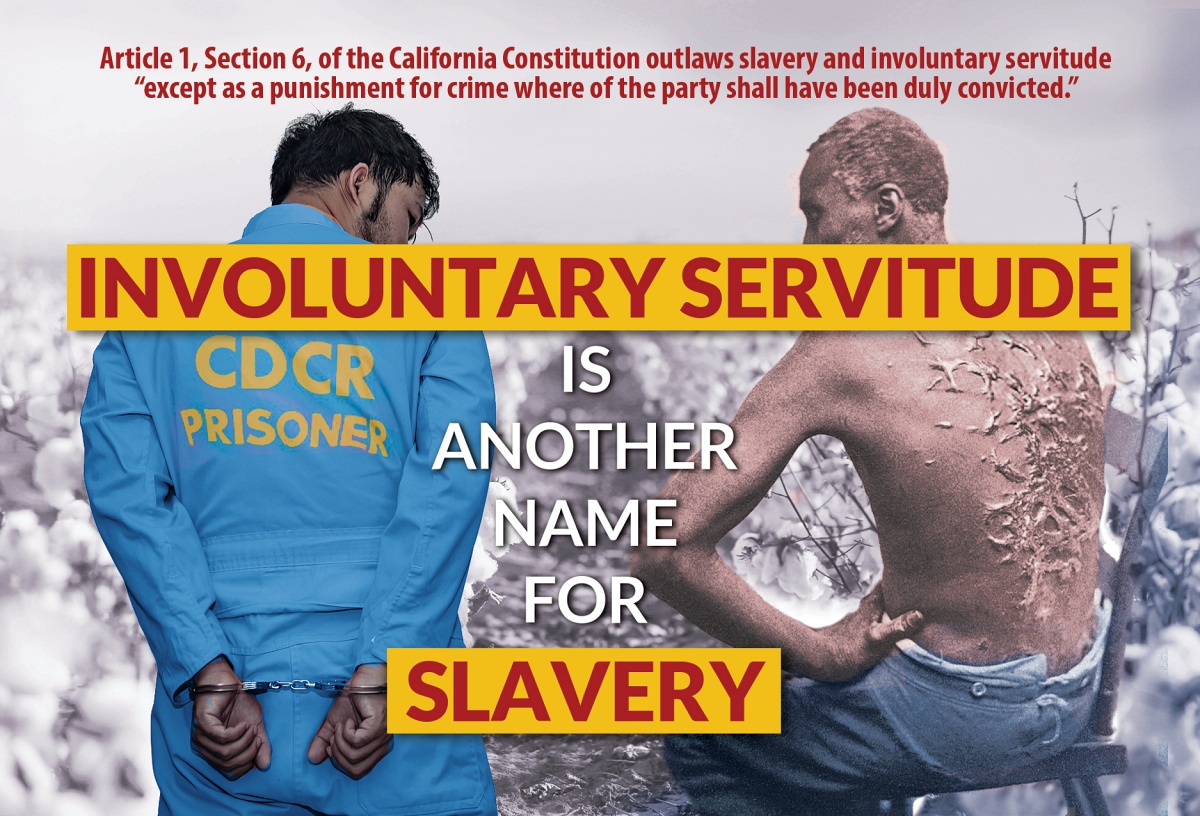
Juneteenth, a federal holiday commemorating the emancipation of enslaved African Americans, was recognized nationwide on June 19th, 2023, and yet, slavery still exists in California. Legal Services for Prisoners with Children's (LSPC) grassroots arm, All of Us or None (AOUON), organized a collaborative effort on Juneteenth to campaign against the legalized practice of slavery within California prisons. Article 1, Section 6 of the California Constitution permits involuntary servitude “as a punishment for crime,” and essentially functions as a loophole for the California government to legally enslave incarcerated individuals.
“Not enough people are aware that slavery still exists and that language still exists in our federal Constitution in 2023,” says LSPC Deputy Director Paul Briley. According to Briley, AOUON’s core initiative for this collaborative demonstration is to educate the public on the prevalence of modern-day slavery: “Everybody is under the impression that slavery was over in 1865, when really, when the 13th Amendment was ratified, it legalized slavery.”
“Everybody is under the impression that slavery was over in 1865, when really, when the 13th Amendment was ratified, it legalized slavery.”
As a civil and human rights organization fighting on behalf of formerly and currently incarcerated people, AOUON is dedicated to breaking the shackles of mass incarceration through political activism, policy reform, and the amplification of the lost or silenced voices of those imprisoned.
Related stories
At the Juneteenth celebration of 2023, several AOUON organizers gathered across California to abolish involuntary servitude within prisons by advocating for the passing of California ACA 8—a state constitutional amendment that would remove the exception clause permitting slavery as punishment, so that incarcerated people are not forced to work or cruelly punished for work absences. ACA 8 would give incarcerated individuals the freedom to choose when and how they offer labor.
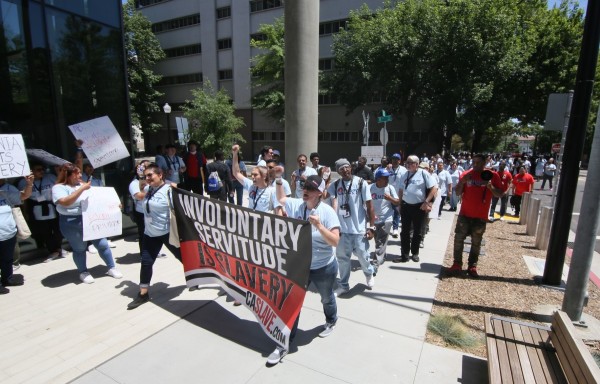
Multiple AOUON chapters and community organizations tabled and spoke at various Juneteenth events throughout California to campaign against slave labor practices. “This year, more people are speaking on Juneteenth and hanging banners in Berkeley, San Francisco, East Palo Alto, San Diego, Los Angeles … it’s spreading in terms of resistance to common day practices of slavery,” states LSPC Executive Director Dorsey Nunn.
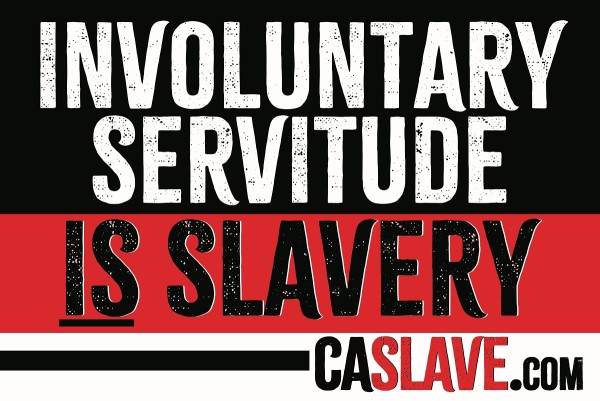
Chris Lodgson from Coalitions for a Just and Equitable California, along with AOUON organizers Henry Ortiz and Jeronimo Aguilar, addressed the crowd at Sacramento’s 20th Annual Juneteenth event to illustrate the reality of involuntary servitude within the prison system: “This criminal conviction business, this prison business, don’t get it twisted—it’s about enslavement,” Ortiz proclaimed. As the organizers spoke, behind them stood fellow AOUON members holding up a banner with the message: “Involuntary Servitude Is Slavery.”
The AOUON Riverside Chapter tabled at Fairmount Park for the city’s 3rd Annual Juneteenth celebration, with the same banner hanging inside their booth, and their table scattered with ACA 8 informational pamphlets, resources to support their cause, and various AOUON merchandise with messages like “Retired Slave” and “Never Again.” Informing our community of the injustice of inhumane labor practice proves vital to gaining the support necessary to pass restorative legislation and, ultimately, reforming our state constitution.
LSPC Managing Director Dr. Tanisha Cannon elucidated a lack of social awareness surrounding the correlation between involuntary servitude and slavery: “Many of our brothers and sisters are still being held as slaves under a different name, and it’s just a new version of Jim Crow,” she says.
If ACA 8 passes in the California State Legislature, voters will have the opportunity to truly abolish slavery in our state’s Constitution. ACA 8 will help liberate and restore human rights to all, including those incarcerated. Several other states, such as Alabama, Tennessee, Oregon, and Vermont, have already passed such legislation—it’s time for California to follow suit. As Briley illuminated, “this will be the first time since slavery that black people have the opportunity to vote on something related to slavery.”
Nunn also highlighted the historical political opportunity that young voters could be presented with: “Your generation could actually prohibit slavery right now…your first vote could be on the question of slavery,” he explained.
AOUON is dedicated to getting ACA 8 passed and educating the public on this issue. “The singular most important thing people can do to support this cause is talk about it,” states LSPC Policy Fellow Alissa Moore. “If people start talking about it, you can’t help but get pissed off. If you don’t, you’re part of white silence and white complacency, and you’re part of keeping the structure of white supremacy in place in our culture. So talk about it.”
Conversation, while crucial, is not the only way to support this cause. Briley explains that people can actively “reach out to the legislature in their district, show up to hearings, and if time permits, the State Capital, and vote on this issue.”
AOUON is actively working to involve community members in this effort. “There is a want to be a part of this movement to abolish slavery,” according to Dr. Cannon. “We are still fighting a fight that our ancestors have been fighting for centuries, and this is a historical moment in time.”
Everyone, including those incarcerated, deserves to be protected from slavery and inhumane treatment. A criminal conviction should not permit the state or large corporations to violate basic human rights for the purpose of profit.
Comments

Powered by RoundtableAn AI/DeFi-powered Enterprise Media Operating System. Learn more at Roundtable.io.© Roundtable 2026. By using this site you agree to the Terms of Use and Privacy Policy