


Dec 13, 2025 8:08 AM
Updated Dec 13, 2025 4:45 PM
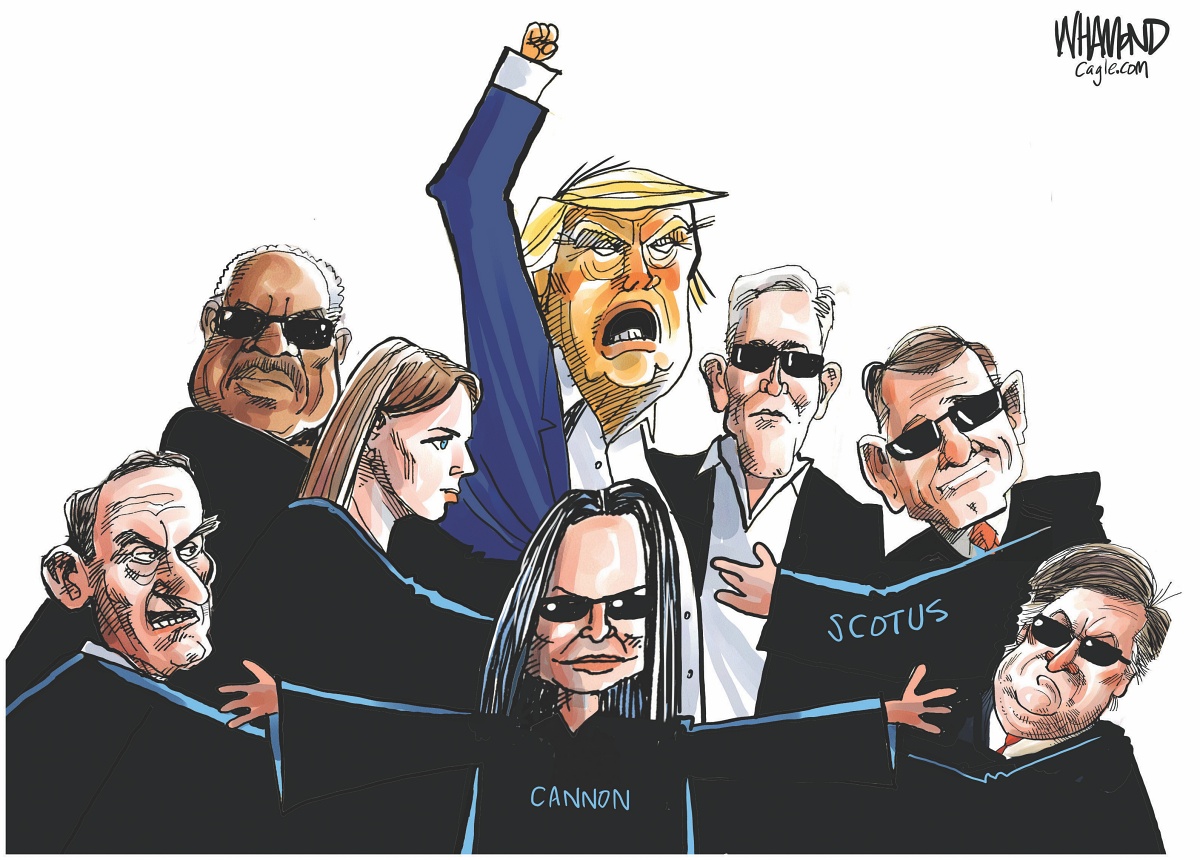
Conservative judges view our highest court as abetting the Trump agenda, and that view is one shared by a plurality of our citizens.
"Injustice: How Politics and Fear Vanquished America's Justice Department" is the name of a new book by Carol Leonnig and Aaron C. Davis. In it the authors write, “Our reporting on his [Donald Trump’s] new administration’s rejection of the rule of law and other sacred norms offers a signpost of where the United States is likely heading. Whether you like or dislike what the Justice Department is doing under Trump in his second term, many inside the department fear a cycle has begun of mixing politics and prosecutions that will fundamentally change justice in America for decades to come.” The word “injustice” is also a fit description of Trump’s approach to law and order, and not just within the Justice Department.
What is notable about Trump’s injustice agenda is that it extends to foreign, as well as domestic, affairs--e.g., U.S. military strikes against alleged drug boats in the Caribbean. And it is not just liberals and progressives who lament Trump’s approach to justice, but also many more conservative justices.
Two such noted justices are former U.S. Judges Mark Wolf (of the U.S. District Court for the District of Massachusetts and previously [1975-1977] U. S. Attorney General, and J. Michael Luttig (of the U. S. Court of Appeals for the Fourth Circuit from 1991 to 2006), appointed respectively by President Reagan and George H. W. Bush. In this regard, they join many other conservatives, especially pundits, who have lambasted our current president's policies.
Since Luttig has been the initial one to object publicly to Trump, let’s take him first. As an Appeals Court judge, he had 33 of his law clerks later serve as clerks for either Supreme Court Justice Thomas or Justice Scalia. But in January 2021 he opposed Trump when he argued that Vice President Pence “did not have the constitutional authority to alter or otherwise change certified electoral votes for the presidential certification in Congress.” In June of 2022, he testified that "it is breathtaking that these arguments even were conceived, let alone entertained by the president of the United States at that perilous moment in history," and that “Trump and his allies and supporters are a clear and present danger to American democracy.”
Related stories
That same year Luttig contributed to ‘Lost, Not Stolen: The Conservative Case that Trump Lost and Biden Won the 2020 Presidential Election.’” At the end of it the signatories wrote, “We are political conservatives who have spent most of our adult lives working to support the Constitution and the conservative principles upon which it is based: limited government, liberty, equality of opportunity, freedom of religion, a strong national defense, and the rule of law.”
In November 2023 he said, "I am more worried for America today than I was on January 6. For all the reasons that we know, his [Trump’s] election would be catastrophic for America's democracy."
One of Luttig’s latest written efforts is an essay, “President for Life,” which he wrote for The Atlantic (December 2025). Among his words are the following:
The 47th president prefers to stir feelings of fear, vulnerability, hopelessness, and political inevitability—the sense that he, and only he, can rescue the nation from looming peril. Since his second inauguration, Donald Trump has seized authoritarian control over the federal government and demanded the obedience of the other powerful institutions of American society—universities, law firms, media companies. The question weighing heavily on the minds of many Americans is whether Trump will subvert next year’s midterm elections or the 2028 presidential election to extend his reign.
With his every word and deed, Trump has given Americans reason to believe that he will seek a third term, in defiance of the Constitution. It seems abundantly clear that he will hold on to the office at any cost, including America’s ruin. . . .
But Trump is different from all prior presidents in his utter contempt for the Constitution and America’s democracy. . . .
Today, Trump has vastly greater powers than he did in 2020. . . . The Supreme Court, meanwhile, has paved the way for a third Trump term, as it did for his current term, by essentially granting him absolute immunity from criminal prosecution for any crimes he might commit in violation of the Constitution or the laws of the United States. . . .
For anyone who doubts that Trump is contemplating a monarchical reign, consider how very far down that road he already is. Since returning to office, he has sought absolute power, unchecked by the other branches of government, the 50 states, or the free press. . . .
The Supreme Court, too, has largely given the president its imprimatur to continue his power grab. . . .
Among the other conservative judges to criticize Trump, Mark Wolf is perhaps the most outstanding. He also wrote in The Atlantic magazine (November 2025). Among the words of his essay (“Why I Am Resigning”) are these: “I no longer can bear to be restrained by what judges can say publicly or do outside the courtroom. President Donald Trump is using the law for partisan purposes, targeting his adversaries while sparing his friends and donors from investigation, prosecution, and possible punishment. This is contrary to everything that I have stood for in my more than 50 years in the Department of Justice and on the bench. The White House’s assault on the rule of law is so deeply disturbing to me that I feel compelled to speak out. Silence, for me, is now intolerable.”
In Wolf’s essay he quoted and praised these words, “Nothing can more weaken the quality of life or more imperil the realization of the goals we all hold dear than our failure to make clear by word and deed that our law is not an instrument of partisan purpose.” Below that he wrote, “I decided all of my cases based on the facts and the law, without regard to politics,” and “this is the opposite of what is happening now.” Like Luttig, he also criticized our present Supreme Court (see below) for its pro-Trump rulings.
In the remainder of his essay, he criticized Trump’s seeking of indictments against three political adversaries, New York Attorney General Letitia James, former FBI Director James Comey, and Senator Adam Schiff; Trump’s “dismantling the offices that could and should investigate possible corruption by him and those in his orbit”; and his ignoring of the “unlawful influence of money on official decisions” by Trump and his administration.
Judges and courts have been a regular part of Trump’s life from at least 1973, when the Justice Department sued Trump Management (with Donald listed as its president) for discriminating against Blacks. According to Wikipedia, “From 1973 until he was elected president in 2016,” he and “his businesses were involved in over 4,000 legal cases” in U. S. federal and state courts “including battles with casino patrons, million-dollar real estate lawsuits, personal defamation lawsuits, and over 100 business tax disputes.” According to another Wikipedia article, which has just been updated, “Since the 1970s, at least 28 women have accused Donald Trump of sexual misconduct”–that same article quoted Trump’s famous 2016 remark, “When you're a star, they [women[ let you do it. You can do anything. . . . Grab 'em by the pussy.”
In social media posts of late November 2025, “Trump expressed support for imprisoning a group of Democratic lawmakers for what he termed ‘seditious behavior.’” That behavior was “urging U.S. military service members to defend the U.S. Constitution and disobey orders that violate the law,” and Trump claimed it was “punishable by DEATH.”
A Trump “litigation tracker” site, updated on 8 December 2025 offers this summary:
- 253 active cases challenging Trump administration actions
- 19 suits by the Trump administration challenging state or local laws
- 17 Supreme Court stays or orders to vacate lower court orders
- 1 Supreme Court affirmation of a lower court order
- 8 suits where judges ruled for the federal government in a summary judgement or by dismissing a suit
- 9 suits where judges ruled against federal government in a summary judgement or permanent injunction
- 6 criminal prosecutions by the Department of Justice [Since Dec. 8th judges have ruled against Trump in the cases of former FBI Director James Comey and New York Attorney General Letitia James.)
Since the beginning of his second presidential term, Trump has often lost cases in lower courts, but generally had better support in the Supreme Court, where he has nominated three of the nine justices, all of which—along with earlier appointed Justices Thomas and Alito—usually support his actions. At times, the highest court has overturned lower court decisions.
Criticism of the Supreme Court is widespread. In a recent Gallup poll, “forty-three percent of Americans [the highest percentage in the last three decades] think the current Supreme Court is too conservative”—only 17 percent say it is “too liberal.”
Even conservative Justices Luttig and Wolf share this negative view. Luttig writing, “The Supreme Court, meanwhile, has paved the way for a third Trump term, as it did for his current term, by essentially granting him absolute immunity from criminal prosecution for any crimes he might commit in violation of the Constitution or the laws of the United States.” And “the Supreme Court, too, has largely given the president its imprimatur to continue his power grab. It has either effectively reversed lower-court rulings against the president using the so-called shadow docket, or allowed the administration to proceed until the Court determines the constitutionality of various actions, by which time the damage to the Constitution, the U.S. government, and American society will have been done, as the justices well know.”
Although Judge Wolf’s Atlantic essay does not contain as much criticism of our highest court as has Luttig’s piece in the same publication, Wolf did write that in considering “Trump’s many executive orders and other unprecedented actions,” it did repeatedly remove "the temporary restraints imposed on those actions by lower courts in deciding emergency motions on its ‘shadow docket’ with little, if any, explanation.”
Thus, both conservative judges view our highest court as abetting the Trump agenda, and that view is one shared by a plurality of our citizens. In September 2025, Trump signed an order that allowed the Department of Defense to call itself the “Department of War.” Perhaps, in such a spirit, “The Department of Injustice” would be a more appropriate name than the present designation.
Comments

Powered by RoundtableAn AI/DeFi-powered Enterprise Media Operating System. Learn more at Roundtable.io.© Roundtable 2026. By using this site you agree to the Terms of Use and Privacy Policy