


Mar 26, 2025 11:58 AM
Updated Apr 3, 2025 2:37 AM
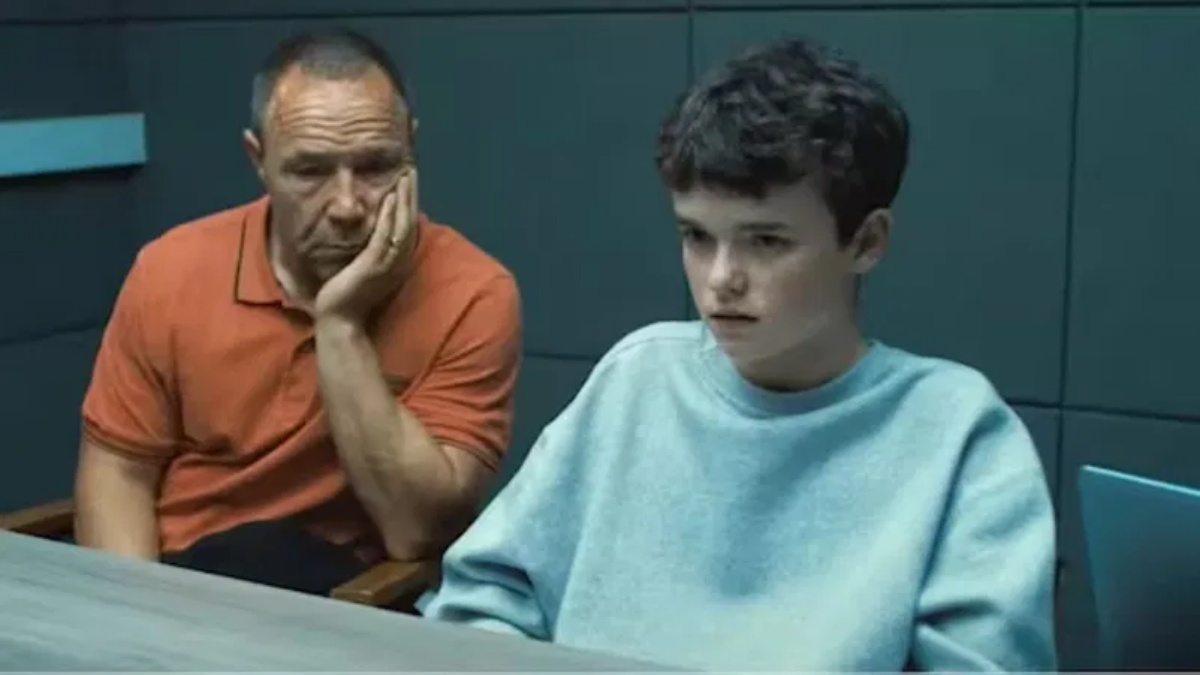
The grossly bad hit series pretending to blame online "incel culture" for violence by a few teenagers must be satire. It makes no sense otherwise.
How bad can anti-social-media lunacy get? Begin with comments by Stephen Graham, co-creator and star of Netflix’s all-the-rage United Kingdom series “Adolescence”:
“I’d read an incident in the paper … about a young boy … stabbing a young girl to death. Then … I saw on the news that … it happened again in a … completely different part of the country … both of those incidents really hurt my heart … What’s going on? … I’ll never understand it … to stab a young girl to death … What really stuck out … they are young boys … not men … killing young girls … And I knew we were going to be making a series.”
What the hell is Graham saying? That the large majority of murdered girls killed by grownups are unimportant, understandable, just don’t “stick out,” are unworthy of commemoration?
Graham exploits two cruel paradoxes. To manufacture shock value, he sensationalizes a 13-year-old murderer exploitable precisely because of the rarity of such cases. Then, to aggrandize his series as socially important, he misrepresents young knife killers as some burgeoning menace to British society, especially girls.
Related stories
The second paradox is the widespread (though scientifically debunked) insistence that the “teenage brain” is undeveloped, impulsive, driven by hormonal savageries. Then, sensationalists indulge shock and outrage when some teenager somewhere does something terrible, implying that violence is more expected (and therefore less worthy of notice) if committed by an adult with a supposedly mature, reasoning brain. Yes, that’s nuts.
The many fans of “Adolescence” gush fear and praise: “Deeply inspired by real-life issues, including rising knife crime among young people and the dangerous influence of online communities that promote harmful ideas”... “a powerful look at the real struggles facing young people today… a warning about the dangers of unchecked online influence and the growing problem of youth violence” … “what is happening to our young men these days, and what are the pressures they face from their peers, from the internet, and from social media?” … “terrifying”; “every parent’s worst nightmare” … “has parents talking” … “hitting people so hard” … “wake-up call”, the usual nonsense one can find in any decade.
UK Prime Minister Keir Starmer shoveled onto the pile: “‘Misfits’ and ‘young men in their bedrooms’ who are ‘accessing all manner of material online’ are now considered terror threats.” Wow. Does Starmer plan to rendition middle-school “bedroom terrorists” to El Salvador dungeons?
Meanwhile, the UK Parliament’s latest report through March 2024 declares: “The number of knife crime offences committed by children [under age 18] has been decreasing since the year ending March 2019, with children making up 20% of all knife crime offences in that year to 17% in the latest year.”
Further, among youth, “more than 99% of knife offences are for possession alone” – not bloodletting. “Black and Mixed ethnicity children are over-represented in knife offences” due to “a range social factors,” and “disparity in criminal justice practice.” UK agency scientists engage serious issues, not crowd-pleasing idiocy like their prime minister.
The vast, increasing majority of knife murders and mayhem are by grownup perpetrators, Parliament’s new report finds. So, why don’t documentarists engage that reality to explore important violence trends? Because anti-youth exploitation, not reality, suits sensationalists and demagogues.
The punchline
“Adolescence,” eagerly promoted as exposing the perils of online “incels and Andrew-Tate-style misogyny” supposedly driving young boys to violence, barely mentions the toxic “manosphere” of women-hating male rejects and resenters at all.
Of “Adolescence’s” 200 minutes (it seems longer), maybe 5 minutes talk about incel and manosphere sites, and then only obliquely. When asked, the 13-year-old killer declares repeatedly that he liked women, doesn’t like porn or misogynist sites, and only felt antagonized by the victimized girl as an individual “bully bitch.”
Of course, being said “bully bitch” who ridiculed the boy online as sexually undesirable and to his face when he asked her out nowhere justifies him stalking and fatally stabbing her, captured by a first-episode urban camera (“Adolescence” offers zero suspense). But that’s not the question the series deals with.
Rather, “Adolescence” portrays a boy who believes he is “ugly” and suffers severe bottled-up anger. He flies into sudden, scary rages, screaming and throwing things so convincingly his co-actor was genuinely frightened on set — ones strikingly like those of his father’s bicycle- and paint-hurling tirades against kids and store personnel (we’re told dad once furiously ripped down a shed) and grandfather (who brutally beat the father). The boy insists his father never beat him; the issue is a family cycle of untreated mental illness.
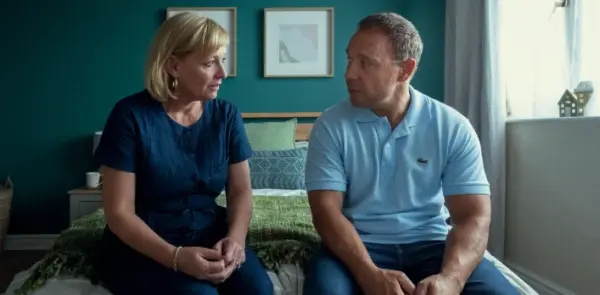
An elephant-sized clue that “Adolescence” is really satirical misdirection pops up in its self-described “heart-wrenching” finale, in which the mother declares to the father that their lad “has a terrible temper, but so have you.” Hardly profound, but we’ll take it! That’s the only real clue “Adolescence” offers explaining the why-why-why of the boy’s knifing.
Unfortunately, it’s not a clue anyone wants to contemplate. The parents then reassure each other (even as the father reveals he was violently whipped by his own father) that intergenerational rage-tempers couldn’t possibly explain their boy’s violence. Just a tragic coincidence. Viewers are invited to sympathize. Mission accomplished. None of the commentators mention this glaring development.
“Adolescence” selectively invokes parental cruelty and mental illness as causes of the father’s rages but dismisses them as an explanation for the boy’s, an artistic license privileged by a fictional script not bound by inconvenient realities attending a real incident. Still, why spring such a mammoth series-ending complication unless “Adolescence” intends to inform its audience that they’re simplistic dumbasses for rushing to blame social media?
Another clue is that “Adolescence” features hours of excruciatingly slow, nonsensical questionings of the boy and other teens by comically inept police and psychologists, wallowing in dead-end dialogue and tear-jerking tunes that drive viewers to their own anger: “GET TO THE POINT!” The larger goal of “Adolescence’s” scripted inertia could be: wake up, naïve viewer, all this pointlessness (like easy social-media-blaming ideology) is getting you nowhere.
Meanwhile, back in the USA…
So far, Graham and cohorts keep insisting the female-hating “manosphere” they barely address in their series must be what is seducing young boys, creating a “worldwide” crisis of misogynist violence. Praise for “Adolescence” from U.S. commentators is universal, lavish, and as routinized as programmed AI content.
“Teenage boys are in crisis,” recites a typical U.S. commentary. “…The world for kids today looks a lot different than it did for their parents… the hit Netflix series ‘Adolescence’ captures just how vast that difference is.”
Incredible. Yes, indeed, “the world for kids today” is vastly different than their parents’ world. “Young men these days” are far LESS inclined to murder and violence (C’mon Brits, knives? Yank mayhemers favor Glocks and AKs), and far LESS at risk of violently victimizing girls, than boys were when their parents were growing up.
- In 1993, in the pre-social-media adolescence when innocent Super Mario Brothers ruled, 3,600 U.S. boys under age 18 (including 213 age 13-14) were arrested for murder and 298,000 for violent crimes. Back then, teenaged boys murdered twice as many teenaged girls as they do today.
- In 2023, in a teen boy population 2.6 million larger, 95% of whom are connected to social media sites accessing far more violent fare (Doom, Postal, Grand Theft, Manhunt… and the vengeful manosphere), 1,200 boys (including 130 age 13-14) were arrested for murder and 99,000 for violent crimes.
That is, an American teenaged boy today is 70% less likely to commit murder and violence than in his parents’ generation.
Yet, no commentator I can find asks: If social media and incel culture are driving boys to kill, why did killing by boys plummet as social media proliferated? In 2023, the FBI reported just 7% of homicides involved a person under age 18, down from 11% in 1993.
Figure 1 presents the most objective homicide trend by boys ages 13-14 from Gen X to Gen Z adolescence. The dotted line is the standard regression incorporating all years of data into a single trendline that prevents cherry-picking only those years that validate some advocate’s case.
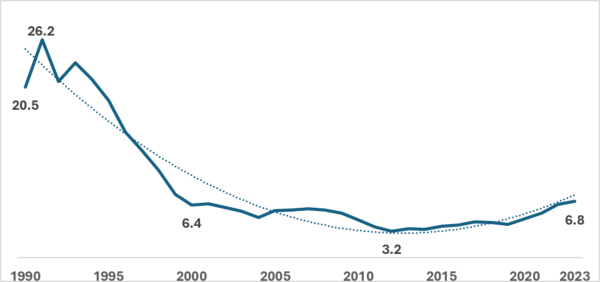
From 1990 to the low point, 2012, homicide rates by boys ages 13-14 (the FBI’s combined tabulation) fell by 24 annual homicides per 100,000 population. That homicide plunge occurred during a period when boys’ internet, social media, and cellphone access soared from zero to over 90%, along with violent online content.
Then, from its 2012 nadir to 2023 – a time including the COVID pandemic, when all ages’ homicides rose – 13-14-year-old boys’ homicide rates rose by 3.6 per 100,000 population, an increase just one-seventh the level of the previous decrease. (Alarmists selectively compare years like the latter two to claim that violence by teens is “increasing.”) The recent trend occurred during a time when teenagers’ social media access remained stable.
Are teen girls more endangered by teen boys? Just the opposite.
- In 1993, 223 U.S. girls ages 12-17 were murdered. Of these (pro-rating the unknowns), 65 were murdered by suspects under age 18, 106 by those age 18-24, and 52 by those age 25 and older.
- In the most recent year tabulated by the FBI for a much larger population, 128 U.S. girls age 12-17 were murdered – down 50% by rate. Of these, 28 were murdered by teens (down 66%), 47 by young adults (down 61%), and 53 by adults ages 25 and older (down 10%).
The real homicide danger to girls remains American grownups (overwhelmingly men). The most recent FBI tabulations show 70% of the known murderers of girls age 12-14 are adults; twice as many are 25 and older than under age 18.
Officials’ message to kids: Bigotry is OK if the target is powerless.
No filmmaker would title a show “Senior Citizen” based on 64-year-old Las Vegas massacrer Stephen Paddock’s gunning down of 473 people in 15 minutes (a toll in 10 minutes that leaves all shootings by teen boys that year in the dust). Or title a series on serial-murderer David “Son of Sam” Berkowitz, “Judaism.” Such demographic-libelings rightly would be condemned as hate speech.
Yet, filmmakers and commentators routinely generalize extremely rare barbarisms like a knife murder to “adolescence”? Are we grownups trying to teach youths that collective bigotry is okay – required, even – if the targeted group is powerless?
Two populations with irreconcilably different mindsets can no longer occupy the same country, as Trump’s lawless cruelty and Democrats’ capitulation is about to show us. More Videos
“Adolescence” distracts from far more important realities
Violence is a public health tragedy whose seriousness should not be cheapened by frivolous treatments like “Adolescence” and facile social-media-blaming. We have much better information on what drives the violence by youth that does occur.
In the UK, cases of child cruelty, overwhelmingly inflicted by parents, doubled from 2017 to 2023; whether this is a real increase or an artifact of notoriously unstable domestic crime data is not clear. In both the UK and US, drug and alcohol abuse casualties in the 25-64 age group raising children and teens have skyrocketed over the last decade.
In the U.S., 13-year-old boys who report histories of psychological and violent abuses by parents and household adults are 2 to 3 times more likely to take weapons to school, carry guns, and get into fights. Those truly concerned about kids who kill focus on the abused fraction, not all of “adolescence” and “young men in their bedrooms.”
“Adolescence” is so bad that it only makes sense as a parody of an adult culture gone so badly wrong that it chases chimerical social-media bogeys to avoid facing its own real crises. Surely (on April 1?), Graham will spring forward to smirk, “April Fool! I just wanted to see how many gullible social-media-obsessives would fall for any hint that ‘Adolescence’ might be about incel culture.” Whatever the motive, the fawning reactions tell us all we need to know.
Comments

Powered by RoundtableAn AI/DeFi-powered Enterprise Media Operating System. Learn more at Roundtable.io.© Roundtable 2026. By using this site you agree to the Terms of Use and Privacy Policy