
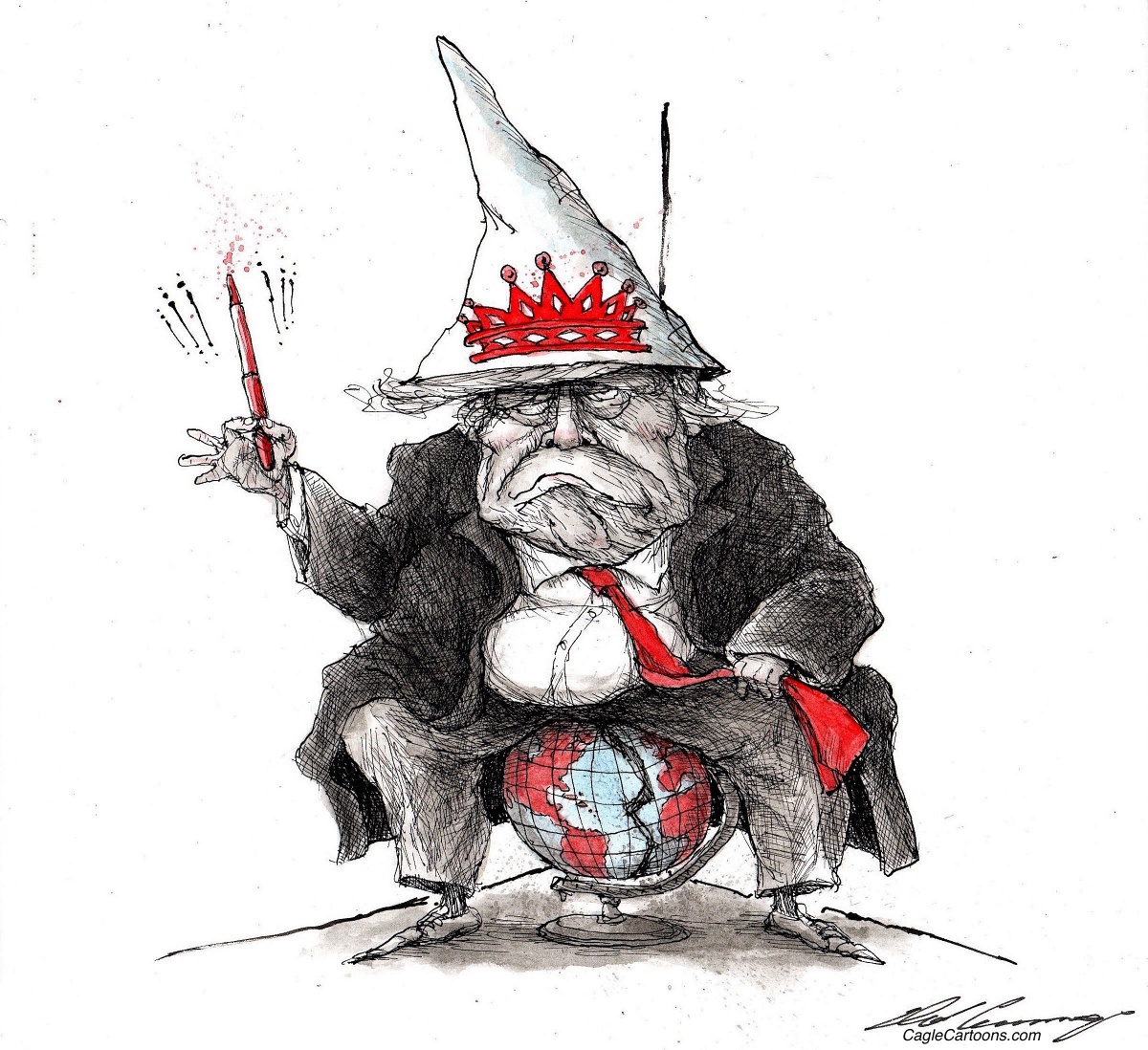
Cagle Cartoons: Dale Cummings


Jul 16, 2025 7:38 AM
Updated Jul 16, 2025 7:40 AM
How can a president “take care that the Laws be faithfully executed” if he acts in violation of those laws?
It really is worse than you imagine.
According to the legends, Robin Hood fought prince John while the ‘true’ king, Richard I, the Lionheart was off fighting a crusade. Richard returned, replacing his younger brother, prince John and everyone lived happily ever after. Or so the stories go.
In reality, Henry II, Richard and John’s father lived until July 1189. When he died, Richard, the eldest brother, ascended to the throne. When Richard I died in 1199 prince John stepped up to be Richard’s successor. He continued Richard’s system of extreme taxation to fund foreign wars, and continued his father, Henry II’s efforts to expand royal control over the various feudal lords and bishops who owed him allegiance.
This was the “High Middle Ages” when feudal society was being further disrupted by the growth of permanent cities to replace seasonal market towns, and the growth of craft guilds with guild rules. Feudal lords and their subjects were used to hundreds of years of rule by the most powerful, who changed often. Law was what the most powerful said it was. There were no statute books, no case records, or anything which made law in one feudal holding the same as it was in other holdings. Richard and John’s father, Henry II, had started to change this.
Related stories
King John’s taxes and his efforts to exert authority over his fractious vassels led to revolts and more fighting. In 1215 the English barons and king John decided to make peace. They negotiated a document called the Great Charter - Magna Carta - which imposed on king John restrictions on how he could act as king. That was in June, 1215.
King John was never regarded as a man of his word, and he immediately asked Pope Innocent III, in Rome, to annul the Magna Carta, even though Innocent III and king John had been at war with each other just a few years earlier. Innocent III annulled Magna Carta in August, 1215, just ten weeks after it had been agreed.
But Magna Carta never left the English or world imagination. It was the first time that feudal lords and a king had agreed that the king, the head of state to whom all others owed loyalty, could be limited by a writing. Rather than deposing a king by defeating him in battle, the English barons agreed to work with their king in an entirely new, non-feudal way.
You might think that asking the Pope to annul the agreement took away any meaning from the agreement. But instead, it reinforced the agreement’s power. Essentially both the king and his barons acknowledged:
- That an agreement could bind the king; and
- That an even higher power, the Pope, could decide, by written decree, whether the agreement was valid.
Viewed from any angle, Magna Carta set an example of peaceful limiting of the power of feudal lords. It has served as a model for that concept for people around the world since 1215.
Although the Pope annulled Magna Carta, it stuck in people’s minds. King John died in 1216 (as did Innocent III). The new king’s regents reissued Magna Carta when John died, and again in 1217, and again in 1225. Magna Carta was made part of English statuary law in 1297, and has remained law since. Although each revision since the 1216 edition has modified earlier ones, the underlying concept that the king is not absolute in his powers has remained and grown stronger over centuries.
It grew much stronger during the English Civil Wars of the 17th century - which were not at all civil. In the Glorious Revolution if 1688, England declared that Parliament, which had not even existed in 1215, was superior authority to the king. This was in large measure due to the legal writings and political work of Edward Coke (1552-1634), and William Blackstone (1723-1780).
As a judge, Coke essentially invented what we now call “Common Law” by writing reports of cases that he sat on. Blackstone, a century later wrote Commentaries on English Law. Coke’s and Blackstone’s writings on law were found in the libraries of all of the colonists who fought over the question of loyalty to the English king or revolution to separate the colonies from English rule.
Our Constitution is not modeled on Magna Carta, neither the 1215 version nor any of the later versions. But it was, and is inspired by the underlying concept that governance of a nation should be by the rule of laws, not by the whim of a king sitting above all other law. Article VI of the Constitution provides:
“This Constitution...shall be the supreme Law of the Land; and the Judges in every State shall be bound thereby, any Thing in the Constitution or Laws of any State to the Contrary notwithstanding.”
The very next paragraph of Article VI says:
“all executive and judicial Officers, both of the United States and of the several States, shall be bound by Oath or Affirmation, to support this Constitution.”
Thus the president, the chief executive officer of the nation is bound by the limits of the Constitution - “the supreme Law of the Land.” And even extremist right wing lawyers have argued for interpreting the Constitution to mean what the Founding Fathers thought it meant.
But on July 1, 2024, in the appropriately named case of Trump vs. United States, six ReTrumplican ‘justices’ of the United States Supreme Court ruled that a president is not subject to the laws of the nation or to the Constitution itself. Writing for the court, chief justice John Roberts wrote;
“We thus conclude that the President is absolutely immune from criminal prosecution for conduct within his exclusive sphere of constitutional authority.”
Only a few pages earlier, Roberts had acknowledged that Article II of the Constitution requires that the president must “take Care that the Laws be faithfully executed.”
On the very next page of his opinion, John Roberts says:
“the President’s authority to act necessarily “stem[s] either from an act of Congress or from the Constitution itself.”
How can a president “take care that the Laws be faithfully executed” if he acts in violation of those laws? If this sounds familiar to baby boomers, it is because the same linguistic game was offered to us during the Vietnam War: “We had to destroy the village in order to save it.”
Functionally, this reverts the United States to the days of pre-1215 England. The King is above the law. He can ignore the law simply by proclaiming that he is breaking the law as part of his official duties. With such a declaration, the king becomes immune even from Congressional oversight or question.
John Roberts then goes on to say:
“When the President exercises such authority, he may act even when the measures he takes are “incompatible with the expressed or implied will of Congress.” The exclusive constitutional authority of the President “disabl[es] the Congress from acting upon the subject.” [citation omitted]
If you haven’t figured it out yet, what this means is that IF Democrats or Independents sweep the 2026 midterm elections and then try to use their impeachment power to overturn any of Donald Trump’s High Crimes and Misdemeanors, 6 ‘justices’ of the Court have already decided that, no matter what degree or seriousness of evidence is offered, Congress will be barred “from acting upon the subject”!
‘Justice’ Clarence Thomas agreed with the Court’s opinion, but wrote a separate opinion arguing that the attorney general had no authority to appoint a special counsel to persecute the Donald. But that doesn’t matter, he concludes, because, as he says:
“In this case, there has been much discussion about ensuring that a President “is not above the law.” But, as the Court explains, the President’s immunity from prosecution for his official acts is the law,”
essentially recapitulating Pope Innocent III’s annulment of Magna Carta, but this time annulling the Constitutional provision that the president must uphold and enforce the law and swear obedience to the Constitution.
‘Justice’ Amy Barrett also filed an opinion agreeing that the president is above the Constitution. But she wrote to further emphasize the Court’s decision that if, by some unwelcome fluke, a president is charged and brought to trial, the prosecution will be barred from presenting relevant evidence against the president.
This of course further immunizes the president from the law. If he can be prosecuted for bribery, which is listed as an offence in the Constitution, the Court has decided that evidence of the bribery must be excluded! Amy Barrett also agreed with ‘justice’ Thomas that a charged president should be allowed to argue, pre-trial that the prosecutor was improperly appointed.
It really is worse than you might have imagined. The Trump vs. USA decision in 2024 was just a preface to 2025's decisions by the same Court in Trump vs. CASA and other cases that colonial laws do not mean what they say, if they limit the Donald’s actions, despite the arguments that right wing Originalists might make.
The Donald recently announced that he plans military actions in New York City and Washington D.C. There seems little hope that the John Roberts Court will limit any such actions, regardless of what laws or the Constitution say.
Comments

Powered by RoundtableAn AI/DeFi-powered Enterprise Media Operating System. Learn more at Roundtable.io.© Roundtable 2026. By using this site you agree to the Terms of Use and Privacy Policy