


Dec 13, 2022 2:00 PM
We need to think more creatively about what striking – symbolic and material disruption – looks like in 2022, and during an ongoing pandemic.
What is a strike? Is it a mass show of visible people power, or a disruption of profit-making wrought by workers withholding labor? And what are “good working conditions?” and which workers get to decide?
These classic questions are given new resonance amidst the landmark five-week long strike of academic workers at the University of California where disability justice and the racialized and gendered structure of labor are explicitly on the bargaining table.
Building on momentum from a wildcat strike at UC Santa Cruz in 2019-2020, which generalized a demand for Cost of Living Adjustment (COLA) for academic workers living in some of the most expensive cities in the US, UC academic workers began the largest academic labor strike in US history on November 15.
The strike began with a wage floor of 54K and COLA intended to lift students out of rent burden. If won, the wage demands alone threaten the structure of the “sped-up” neoliberal academy, whereby the majority of instruction and academic work is done by poorly compensated precarious academic workers and graduate students, the highest-salaries reserved for administrators.
Related stories
Equally significant, the strike began with a slate of social justice demands, among them:
- an access needs clause that would remove burdensome medical documentation barriers to disabled workers’ needs to access work and school equitably,
- a community safety article that seeks to limit police presence on campus,
- substantive childcare subsidies, an article seeking COVID specific public health protections, including lifting an illegal UC ban on asking students to mask, and
- a waiver for a non-residential tuition fee that disproportionately impacts international students.
And yet, three weeks in, a slim majority of all three unit bargaining teams (BT) rapidly conceded on COLA, wages (43K down from 54K) and most of the working conditions articles devised by rank and file. Their argument for settling lies on a theory of power that focuses on the waning visibility of the picket line and a mystical conception called “peak power” which imagines that the symbolic power of 98% of members voting for a strike was supposed to shock UC labor relations into concessions. Unsurprisingly it did not.
On December 2, the UC passed Academic Student Workers (2865) and Student Researchers United (SRU) an offer without COLA, and negligible raise (34K), and almost none of the working conditions articles.
Notably, the historic “access needs” clause was taken off the table by the SRU and 2865’s slim majority, as was NRST and public health; the university further refuses to pay for student worker dependent healthcare coverage, although dependent coverage is already guaranteed for postdocs and faculty.
Meanwhile, Postdocs and Academic Researchers reached a tentative agreement. And while half the bargaining teams and the vast majority of active rank and file organizers spent the weekend expressing commitment to a long strike centered around grade-withholding and simmers of a no-vote the 2865 BT walked back their apparent willingness to accept the UC’s offer.
They have now entered pre-mediation with the UC. Their plans to get a better contract still rely on performative escalation tactics, like sit ins and occupations – themselves public health liabilities amidst an ongoing airborne pandemic.
Strikes Are About Withholding Labor
But strikes are about withholding labor – which the university needs to function, maintain accreditation, pay exorbitant salaries to administrators – and which Academic workers have. To put it bluntly, UC, like any employer, will only feel pressure to change its tune if labor makes it too expensive to function.
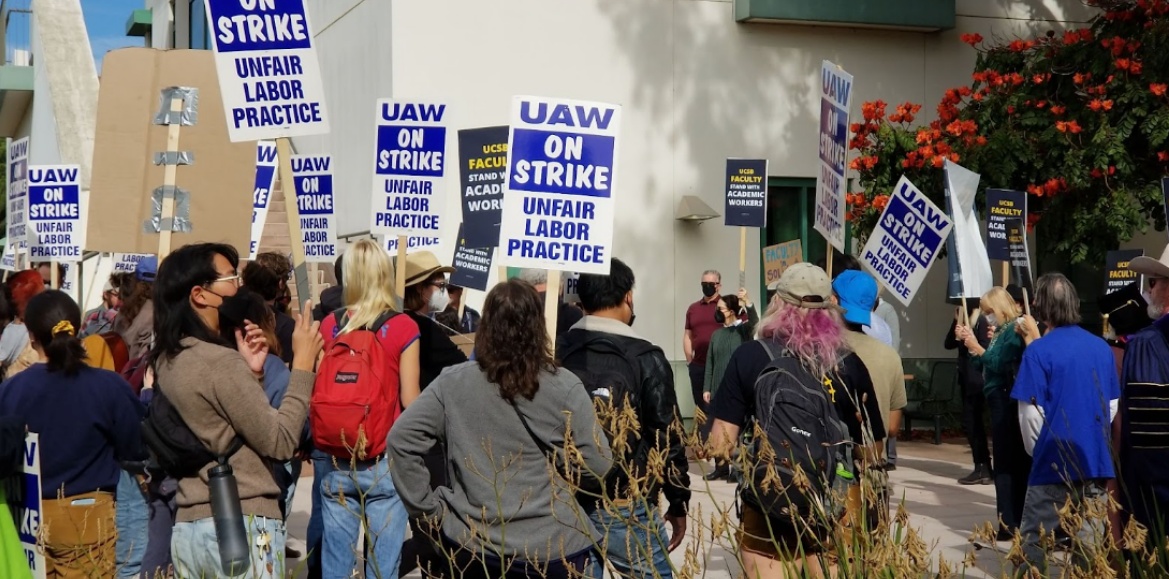
Symbolic displays of power, such as UAW’s fixation on the mass picket line, are limited and potentially problematic. First, disabled students, student parents and others emphasize in-person pickets are inaccessible.
With fixed shifts in crowds of chanting people, no mask mandate, and no testing amidst high COVID transmission, multiple workers have contracted COVID at the picket. This not only self-sabotages picket participation, but endangers the lives of disabled and elderly workers, household and community members more broadly.
During a surge in severe respiratory and other viruses driven in part by COVID’s ability to damper our immune systems, and a resulting strain on healthcare facilities, this endangers all participants, the wider community, and the strike’s sustainability.
Second, an emphasis on in-person picketing excludes exactly those rent-burdened students who cannot afford to live near campus. As class is articulated by gender, race, and ability, the most marginalized students are thus those most unable to show up.
As the last decade of uprisings in the Arab world and other places have shown (anyone who’s had their picture taken at a protest knows), a fetish of the “masses” has its own set of problems: repression, surveillance, sexual harassment, discouragement when the long physical protest becomes difficult to maintain, along with a hyper and masculinist focus on physical clashes with state power.
In a settler colonial context like the US, I would add to this the decolonial critique of Eve Tuck and Yang: present-day “occupations” take place on already occupied land, which social movements need to substantively engage with.
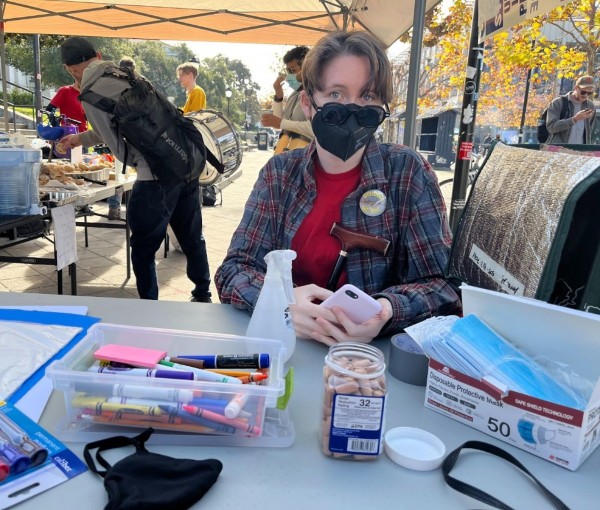
Certainly a physical picket can have substantive economic impacts: picketing at points where delivery drivers can result in economic disruption. But unless other unions have agreed to honor a picket, the no-strike clause in most US union contracts makes sympathy strikes a contract violation (why unionized UC lecturers still must teach and grade).
A focus on the potential snowballing impacts of a picket line is no substitute for adaptive political strategy that matches the shifts of an economic landscape increasingly characterized by speculation and financialization.
Striking Beyond The In-person Picket
We need to think more creatively about what striking – symbolic and material disruption – looks like in 2022, and during an ongoing pandemic. The 2019 wildcat strike already has some answers: the “online picket” became key to the grade strike. That is, by deleting grades from the online tracker system, without which scabbing becomes much more complicated (wildcat SC strikers eventually won a temporary $2500 “housing” stipend per quarter).
If we begin with the principle that strikes entail withholding labor, then the possibilities of what a strike looks like are endless. In 2020, for example, with logistics workers calling for walkouts on May 1, some speculated half-jokingly that those working from home were already part way to a mass labor stoppage.
But social reproductive theory shows there is rigor in this claim: part of the appeal of the Feminist Strike is the way it imagines isolated uncompensated reproductive laborers (including, say mothers and other gendered caregivers) being on strike together, separately in our own homes.
For those of us who cannot picket in person, like me – a parent of two young children, living in a multigenerational household with disabled and otherwise vulnerable people, also geographically-far from the physical picket line – the virtual picket line has been a magical space of coordination, solidarity and invention.
The UAW official remote picket entails texting and calling coworkers to check in about the strike. Bargaining takes place on zoom so we can show up and protest UC’s bad offers. And cross-UC rank-and-file coordination is done largely through signal chats, hybrid meetings and virtual rallies.
Disabled workers and others have likewise implemented exciting accessible political education on the remote shifts, such as exchanges with other academic workers currently or recently on strike (Colombia, New School) and created a “state-wide” disability justice union space, worlds away from labor bro unionism.
As a communique from the UC Santa Cruz bargaining team recently upheld: the power is not with the bargaining team, it’s with your coworkers. Look out, not up.
Third, the visible picket line further invisiblizes the gendered labor of behind the scenes person to person care-driven work that is necessary to sustain a strike — what Angela Davis called the “Housework of the movement.” Without this organizing work – which includes talking to, but also taking mutual care of each other, as economic and psychological effects of striking takes its toll – without which any labor movement is simply spectacle. By forcing physical attendance as a marker of its success, the UAW BT majority simultaneously undermines the withholding of labor itself.
Finally, such performative organizing distracts attention from the real power: withholding labor here in the form of grades. Grades are the precious commodity which the University needs to keep charging tuition. Walter Benjamin once called aestheticization of politics to refer to fascists' commitment to public and symbolic expressions of protest in place of material change. Certainly it appears that the current UAW administration prefers this romantic spectacle of people power, to substantive wins.
UC Strike in Context of Business Union vs. Social Movement Union Tensions
The UC strike should be seen in the context of elections aimed to restructure the UAW International leadership, and in the context of the broad climate of rising labor organization and the institutionalization of bureaucracy and at times corruption in place of worker power that has marked US labor unions for the last 50+ years.
It is equally inseparable from the Democratic Party (including the majority of the “progressive” members) squashing railroad workers’ necessary and just demand for 15 days of paid sick leave.
That is, the significance of the UC Academic Worker strike is not in the “white collar” professional suffering, as the New Yorker argued. It is in the real threat of a rank and file movement that would transform the feudal structure of academic labor and compensation, the ways these are articulated by race, class, gender, ability, and in the status quo of business unionism itself.
It is no simple coincidence that wage and working conditions demands have been generalized in large part by those who undertook a largely-successful wildcat strike.
If we do win a cost of living adjustment, or online and other access needs without medical documentation, the right to in-class masking, cops off campus or even substantive childcare subsidies, this threatens the largely immobile status quo balance that institutional unions and the Democratic Party have solidified.
That strikes are contagious is nothing new. This idea forms the basis of Rosa Luxembourg’s theory of the mass strike. If our ambitious equity coalition does win, it would certainly inspire similar demands and possibilities at other workplaces, in and outside the academy. Let’s hope that we do.
Thanks to Heather Ringo for important edits to this text.
Comments

Powered by RoundtableAn AI/DeFi-powered Enterprise Media Operating System. Learn more at Roundtable.io.© Roundtable 2026. By using this site you agree to the Terms of Use and Privacy Policy