


Dec 20, 2022 10:37 PM
Updated Dec 21, 2022 3:05 AM
Our UC strike began with historic equity demands, we can still win them
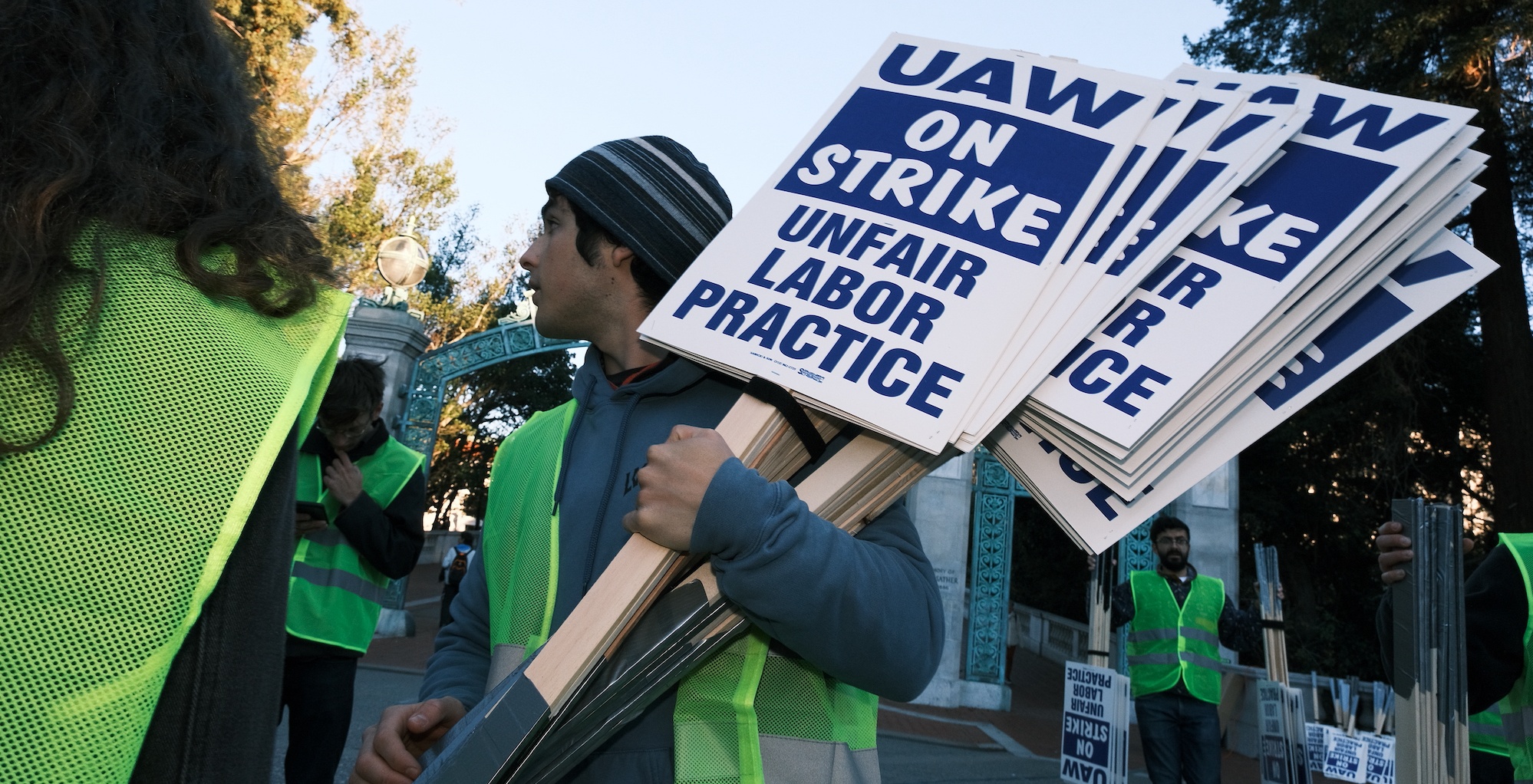
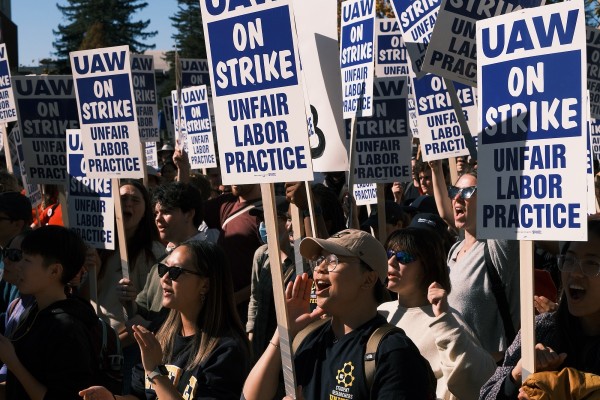
Six weeks ago, our Academic Worker unions – UAW2865, UAW SRU and UAW5810 – began a strike.
Starting on Monday, December 19, we are being asked to vote on a Tentative Agreement (TA). Against the vocal protests of thousands of union members, a slim majority of our bargaining teams rushed to make concessions to our employer, repeatedly telling us that our “peak power” had passed, was insufficient to win us fair working conditions, that this contract, insufficient improvement, was the best we were going to get.
We disagree. Inspired by our colleagues at the New School and Columbia, whose long strikes won them better contracts, we will be voting no on this TA, and continuing to organize for a contract that enshrines fair and equitable working conditions for all.
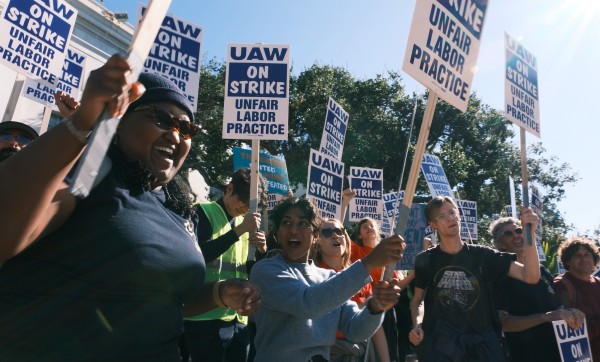
Our strike has repeatedly been called historic: 98% of 48,000 workers voted to authorize the strike, and it is the largest academic strike in US history. But the significance of our strike goes far beyond its size: it is in the slate of social justice and equity demands, written and proposed by poor, Black, Brown, Indigenous, disabled, parent, caregiver, and international workers whose perspectives have often systemically been excluded from US labor movements and history. Each one of the articles, from community safety, to Non-Resident Supplemental Tuition (NRST) remission, to access needs, to public health, to childcare subsidies and dependent healthcare remission should be understood as “working conditions” demands to ensure that marginalized workers are able to complete their work and education more equitably.
Related stories
Underscoring these intersectional demands is the cornerstone of our movement: a $54K wage floor and guaranteed Cost of Living Adjustment (COLA). With UC campuses in some of the country’s most expensive cities, COLA and a living wage are essential to lift us out of rent burden, and to make higher education accessible. As we learned during the wildcat strikes of 2019 and 2020, COLA is not a demand that the UC is incapable of giving. They simply do not want to. By committing to a “no” vote, we reject the UC’s notion of artificial scarcity, reaffirm our commitment to a historic contract, and to each other.
Our wage demands are historic because they threaten the feudal structure of compensation on which the neoliberal University relies. That is, the majority of instructional work is done by precarious and low-paid workers, with high salaries reserved for administrators, real estate and speculative ventures. As graduate students, we are told to accept poverty level wages – graduate student Teaching Assistants currently make about $23,000 a year, pre-tax, for a standard appointment – for the duration of our degrees.
This structure is justified by the increasingly false promise that a higher degree is a guarantee of academic employment, made increasingly impossible by the very wage structure that pays us poverty wages. This promise is exacerbated for those of us with disabilities, with dependents or other caregiving roles – all articulated by race, class, and gender. Whereas our original wage demands would have paid $54,085 in base wages over 9 months, the TA offers only $25,000 for the coming year for an appointment of the same length, a $850 annual improvement over the $24,150 the UC offered going into the strike.
Our slate of equity-focused working conditions demands similarly seek to make the academy more accessible. At the start of our strike, we demanded a full waiver for non-resident supplemental tuition. The non-resident tuition fee waiver adds $15,000 a year to international students’ tuition. The current TA would codify an already-existing informal NRST waiver for three years after advancing to candidacy. But this does not help PhD students in the two to four years it can take to advance to candidacy, and it does not help Master’s Degree students at all.
We are demanding a full fee waiver for all. We decided as a union long ago that it wasn't fair to "pay to work" and that is why we fought so hard for and won the resident tuition and fees. This same principle should apply to Non-residents too - it is both about equity and about changing how the UC views International Students as "cash cows" rather than individuals with robust intellectual contributions to make.
We demanded childcare subsidies of $6000 a quarter and $9000 a semester to student parents who otherwise must put our wages towards the exorbitant cost of childcare. The current TA raises the childcare stipend from $1100 a quarter to $1350 a quarter now, and then by $25 for the next three quarters. This $250 raise is enough for an extra day and a half of childcare per quarter. It does little to ease the gendered burden of social reproductive labor, which continues to bar women and gender-nonconforming people from equitable access to career paths.
We demanded full dependent healthcare coverage. The TA contains a clause promising healthcare to children under 12, for single parents who make more than $49,000 – the threshold for Medi-Cal. They are proclaiming this logical trick as a victory, though it applies to almost none of us, and does nothing for our uncovered spouses or other dependents over the age of 12.
We demanded public health protections for vulnerable workers, amidst an ongoing pandemic seeing 300+ deaths a day in the US from COVID and pediatric hospitals overwhelmed with flu and RSV, in part because of COVID’s underpublicized long-term impacts on our immune systems. Specifically, with multiple studies showing the inefficacy of one-way masking, we asked the UC to lift a ban on instructors asking students to mask, which federal courts have repeatedly deemed illegal. We asked for ventilation upgrades, continued access to Free Fast PCR tests, and contact tracing. For context, none of this is unreasonable: most of these will be mandated by California’s new Occupational Safety and Health as of 2022. The bargaining team majority refused to even present our article to the UC.
We demanded support for access needs: disabled students should have access to what they need to safely and equitably complete their work and education, without having to submit costly and humiliating medical documentation - a burdensome barrier that the UC imposes on disabled students, which is not stipulated by the ADA. Workspaces should be proactively developed to be accessible, rather than treating accessibility as an afterthought and deferring to the discretion of the UC as to what is “reasonable.” Instead, the TA essentially recapitulates the reasonable accommodations article in our current contract, Article 23.
We demanded community safety, that the UC would defund police budgets, refrain from contacting police, and tell students if local, state, or federal law enforcement will be on campus. The UCPD has been and continues to be part of the state violence apparatus that targets Black, Indigenous, disabled, and other marginalized workers. Police pose a threat to the safety of workers who belong to historically marginalized communities, and there is no reason for the University of California to have a $155 million annual budget for its own police force.
These wins would not only set historic legal precedent for workers across the country, but would significantly improve the quality of life of tens of thousands of UC workers in the very near future.
In the months leading up to the strike, in its official materials, the UAW used our equity demands and our stories to promote the strike. The UAW’s Fair UC Now website features videos of students who speak about living in their cars, donating blood for rent or going through humiliating exams to meet access needs. These highly publicized working conditions demands are likely a big part of why the UAW was able to report that 98% of votes cast were in favor of the strike.
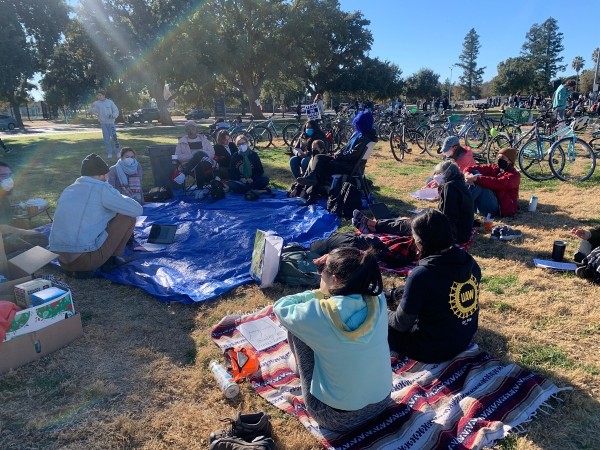
Yet not even a week into our strike, the UAW staff and Bargaining Team’s slim majority began to tell us that our strike had lost power. They based this on the UC not making immediate concessions (even though our disruption to the academic calendar by then was minimal), and on smaller numbers than they had imagined on the visible picket line.
As we’ve repeatedly argued, strikes are about withholding labor, and costing the employer money: in the case of academic labor, this means a grade-strike, pickets honored by Teamsters and other unions that disrupt deliveries of helium and other materials that enable the day-to-day functions of labs, and additional means that jeopardize the University’s accreditation and ability to charge tuition (its raison d’etre, so to speak).
Further, as we’ve argued, by clinging to a visible narrative of the strike’s power, they exclude the very workers, and belie the fact that thousands of workers were and are on strike, withholding our labor, but not attending the physical picket. By centering pickets as the primary site of evaluating power, thousands of caregivers, disabled, and commuting workers’ power was minimized and not accounted for.
Our power lies in our continued ability to withhold our labor. Withholding our labor past the grading deadline is what got us even these meager concessions from the university so far. But our strike can do much more.
In an open meeting Friday morning where the Bargaining Team majority presented its TA, many of us who wished to speak against the TA were passed over, while we heard repeated students arguing for it.
A familiar refrain was “I make twenty-two thousand dollars a year, this contract will change my life, I am sorry that it won't help other students, but I need it now.” This was repeated, almost as though it had been distributed as a talking point by Brightline Communications—the expensive PR firm contracted by the UAW.
Talking points or not, this familiar comment echoes the inter-peer competition that is purposefully structured into the inequitable false narrative of academic and scholarly success. This competition undermines true solidarity, the support and uplifting of the most marginalized workers.
Despite the real power of our strike, with this Tentative Agreement, we are being asked to throw each other under the bus, in the interest of our own academic careers, a situation that the neoliberal academy entrenches, pretending that there is no alternative. But there are always alternatives when we work together and when we dream of more.
Our strike’s horizon is the alternative: an academic worker contract built with and through solidarity and collective action, and striving towards equity for all academic workers.
Join us in voting no and continuing the fight.
By Mary Jirmanus Saba, Janna Haider et al.
Mary Jirmanus Saba, UCB 2865
Janna Haider, UCSB 2865 Bargaining Team
Adam Moore, UCD SRU
Duane Wright UCD 2865
Gloria Denise Ligunas, UCM SRU Bargaining Team
Hannah Freund, UCR SRU Bargaining Team Alternate
Hasan Alkhairo, UCSF SRU Bargaining Team
Heather Ringo, UCD 2865
Maddie Williams, UCSD 2865 Bargaining Team
Mai Nguyen Do, UCR 2865 Bargaining Team
Mark Woodall, UCM 2865 Bargaining Team
Nick Cruz, UCM 2865 Bargaining Team
Omari Averette-Phillips, UCD 2865
Riley Collins, UCSC SRU Bargaining Team
Sarah Abusaa, UCD 2865 Bargaining Team Alternate
Zaynab Mahmood, UCI 2865
Alauna Wheeler, UCM SRU Bargaining Team
Comments

Powered by RoundtableAn AI/DeFi-powered Enterprise Media Operating System. Learn more at Roundtable.io.© Roundtable 2026. By using this site you agree to the Terms of Use and Privacy Policy