
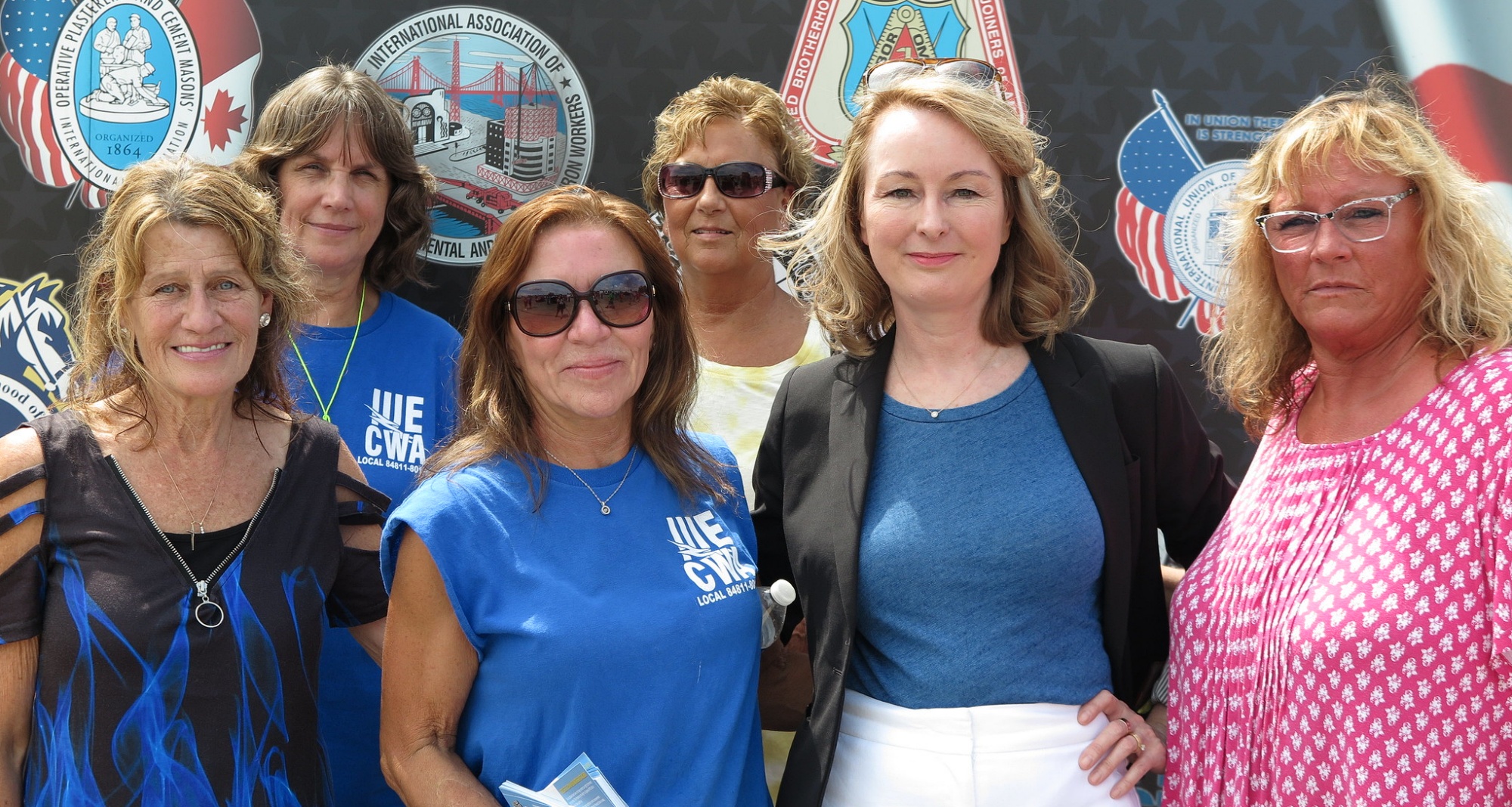
Flickr: IUE-CWA Local 84811 workers rally to save jobs at Hufcor in Janesville, Wisconsin AFL-CIO


Oct 6, 2022 9:47 PM
Hufcor stands as a perfect metaphor for this especially rapacious form of corporate power.
Real, live vultures have been quite literally scavenging on old bits of food as they circle around the old loading docks at the stripped, forlorn Hufcor factory in Janesville, Wis. factory, whose 160 workers have been victims of OpenGate, an LA-based “private equity” firm practicing “vulture capitalism.”
Hufcor stands as a perfect metaphor for this especially rapacious form of corporate power as private equity firms spread their wings across the economy and dig in their talons. OpenGate, headed up by wanna-be celebrity CEO Andrew Nikou, followed the now-familiar private-equity game plan of purchasing a company, pulling out as much profit as possible, and selling off parts of the ailing original firm, leaving workers and communities wrung out and cast aside.
Last fall, OpenGate shut down the Hufcor plant in Janesville which for
a remarkable 120 years had been a community fixture, profitably producing folding doors. (The accordion-style doors are used by schools, convention halls, and hotels, among other venues).
Related stories
Once OpenGate snapped up by OpenGate in 2017, OpenGate’s new regime heightened tensions and ended a relatively amicable relationship between management and the workers of IUE-CWA Local 84811 (part of the Communication Workers’ industrial division). One source of friction was the outsiders coming in to videotape workers as they carried out their routines, which in retrospect was an integral part of OpenGate’s plan to conduct production elsewhere.
The shutdown vaporized 160 union jobs paying in the range of $20.92 an hour.
As it closed down production, OpenGate began rapidly shipping off the jobs to a new low-wage plant in Monterrey, Mexico.
But the OpenGate geniuses who promoted the new plant in Mexico neglected to consider the severe disruption of the supply chains so closely connected to the Janesville location. Hufcor’s web of suppliers did not mesh with the Monterrey operation located 1,337 miles away from the original factor. Other forms of mis-management abounded at the hands of OpenGate in Monterrey.
The outcome: less than one year after the shutdown and shift of jobs to Mexico were completed, Hufcor arrived in bankruptcy court in Rock County Wisconsin. Hufcor owes suppliers and customers about $44 million with just $5 million in assets.
If the usual script plays out, Hufcor’s creditors will be paid pennies on the dollar from Hufcor’s paltry assets. Under the legal rules under which private equity now operates, OpenGate and its leading partners will walk away owing virtually nothing to the creditors, suppliers, and workers. OpenGate and Nikou and its other general directors take no hit at all. Instead, the suppliers and customers will receive mere pennies on the dollar from the $5 million in assets and whatever the split-up remnants of Hufcor can bring on the market.
The Hufcor scenario reflects the growing threat to workers and communities posed by the private equity industry, an increasingly important sector of the US economy. The term “private equity” itself is a strategic re-branding of the ‘leveraged buy-outs’ which gained momentum—and wide infamy for job destruction in the 1980’s, noted Carter Dougherty, communications director of the Americans for Financial Reform, a watchdog and advocacy group. “There are more private equity firms than there are public corporations listed on the major public exchanges,” said Dougherty. Private equity purchased $1.2 trillion in 2021, and they have an additional $3 trillion in ‘dry powder’—capital which they can use to buy up more firms.”
So, we can anticipate a rising wave of Hufcor-style collapses faced by workers and communities. Many will hit small and medium-sized firms in Janesville-sized towns, and will fail to capture the media attention and public alarms that they should generate.
The Hufcor tale begins in Los Angeles, 1,800 miles away from Janesville. That’s where OpenGate operates its North American office from the 30th floor of a shimmering Century City office tower in LA, boasting a portfolio of $5 billion. Also, clearly a source of evident pride for OpenGate is its European headquarters, centered in an elegant Paris office displayed lovingly in the firm’s web-page video. OpenGate declares that its mission is to “create transformative value” in the firms it purchases and then manages.
However, the “transformative value” highlighted in the video has often been measured instead by the shutdowns of its acquisitions, as with Hufcor. OpenGate’s PR firm spokeswoman Meredith Bishop insisted that the Hufcor transfer of jobs to Mexico was vital “to ensure Hufcor’s survival and long-term viability.”
But Hufcor workers quickly recognized that it was actually their own long-term survival at stake given the paucity of family-supporting jobs in the Janesville area. The union put up several months of high-profile resistance, with rallies in Janesville and Los Angeles, picketing, videos, and electronic signs to spread the word about the looming shutdown’s impact in Janesville to workers, the community, and suppliers. The union also won the support of numerous elected officials, like Wisconsin Gov. Tony Evers, and numerous civic leaders. While the shutdown eventually went forward, the union’s warning left a permanent warning about private equity in the minds of many Wisconsin citizens.
At Hufcor and elsewhere, OpenGate’s self-described “human touch,” “trust,” and commitment to “transparency” has turned out to mean workers kept in the dark until their jobs suddenly disappeared in a puff of smoke. In several cases, workers showed up to work only to find the operation shuttered and a printed notice that their jobs had been terminated. The federal WARN Act requires advance notice of 60 days when an operation is being closed, but this is frequently ignored by OpenGate.
At the Golden Guernsey Dairy in Wisconsin, for example, workers experienced a shutdown without absolutely any advance notice in 2013. It took eight years of tenacious legal fighting by the Teamsters union and finally action by state Attorney General Josh Kaul in order for workers to receive the full back pay of $1.1 million that they were owed.
.
Currently, the former Hufcor workers face a difficult future because of an ongoing shortage of family-supporting jobs nearby. Janesville was already in distressed condition before the Hufcor move, still reeling from the impact of a massive GM plant closing in 2008 which killed off an estimated 9,000 jobs. (The story of the shutdown and its broad, lingering social effects in the city of 64,000 are chronicled in Amy Goldstein’s An American Story and Brad Lichtenstein’s PBS movie As Goes Janesville )
One Hufcor worker experiencing the shutdown’s meaning is Local 84811 member Michelle Hilzik who put in 23 years at Hufcor, and while her husband invested 37 years there. For them, finding good-paying work anywhere close to the Hufcor level remains a permanent struggle. After going three low-wage jobs in three months in a futile hope for something better, she explained, “I don’ t wants anyone to go through what we have,” she said, her voice breaking slightly.” We could have lost our home. What happened was not fair and not fun. We’re both working, but we have no health insurance.”
Hilzik found herself studying private equity firms when she returned to school under Trade Adjustment Assistance benefits the union won after the closing. “I felt like I was reading my own story again and again,” after reading numerous stories about workers facing the loss of jobs after private equity firms plundered their firms and then threw them out of work.
OpenGate’s record, in addition to Hufcor and Golden Guernsey, would easily fit into a textbook on the most unscrupulous conduct by private equity firms abandoning of workers and communities include while remaining immune from any accountability:
- The Penny saver in Brea, CA, where 678 workers lost their jobs without any notice. The final paychecks of many workers bounced.
- Hamilton Scientific in Reynosa, Mexico, Wisconsin, and Texas. Lawsuits were filed in Texas over WARN violations. The Reynosa operation gained media attention as it allegedly had already been overrun by a Mexican drug cartel reportedly connected with “El Chapo” Guzman when OpenGate purchased it.
- Fusion Paperboard in Connecticut. Fusion Paperboard was shut down by Opengate just a few months into a three-year union contract and failed to repay $2 million in Connecticut state subsidies.
But armed with the legal immunity afforded the titans of private equity, general partners of these firms Andrew Nikou are operating in a different universe.
Nicou hangs out in rarified circles, reflecting an apparent desire to network with big celebrities in both the boardroom and Hollywood. He has poured dollars into philanthropic projects that connect him with widely-known CEOs Elon Musk and Larry Page, co-founder of Google, and entertainment star Pharell Williams. Nikou reportedly considered setting up an “Apprentice”-style reality TV show. His own Andrew Nikou Foundation once proclaimed itself a vehicle to “can improve lives of people who are disconnected and oppressed”—obviously not referring to the disconnected victims of its maneuvers.
In response to the conduct of players like Nicou and his colleagues across the nation, operations like OpenGate are now generating a significant social movement. Forces from labor, consumer, and socially-conscious investor groups are gathering behind the Stop Wall Street Looting Act aimed at finally requiring accountability for private-equity firms which maximize profits while incurring virtually no risk because of their immunity from any meaningful regulation.
The “Stop Wall Street Looting” measure would establish a set of stringent protections for the public from private-equity directors who have no accountability or responsibility for the debts incurred by the firms they own. Private-equity directors are also lightly taxed due to the “carried interest loophole” (preserved at the insistence of Sen. Kyrsten Sinema D-AZ), who benefits heavily from financial industry donors).
Achieving accountability from private-equity firms is central to the Stop Wall Street legislation. “We need to adjust liability laws, and include general partners of private-equity firms so that they can be held financially liable for their actions,” explained AFR’s Dougherty.
Sen. Elizabeth Warren, who has been a key force behind the proposal, captured the basic rationale behind the Act: "For far too long, Washington has looked the other way while private equity firms take over companies, load them with debt, strip them of their wealth, and walk away scot-free -leaving workers, consumers, and whole communities to pick up the pieces.”
But given the enormous financial leverage enjoyed by the financial industry, an end to debacles like Hufcor will depend on electing committed Democratic majorities in both houses on Nov. 8.
Comments

Powered by RoundtableAn AI/DeFi-powered Enterprise Media Operating System. Learn more at Roundtable.io.© Roundtable 2026. By using this site you agree to the Terms of Use and Privacy Policy