
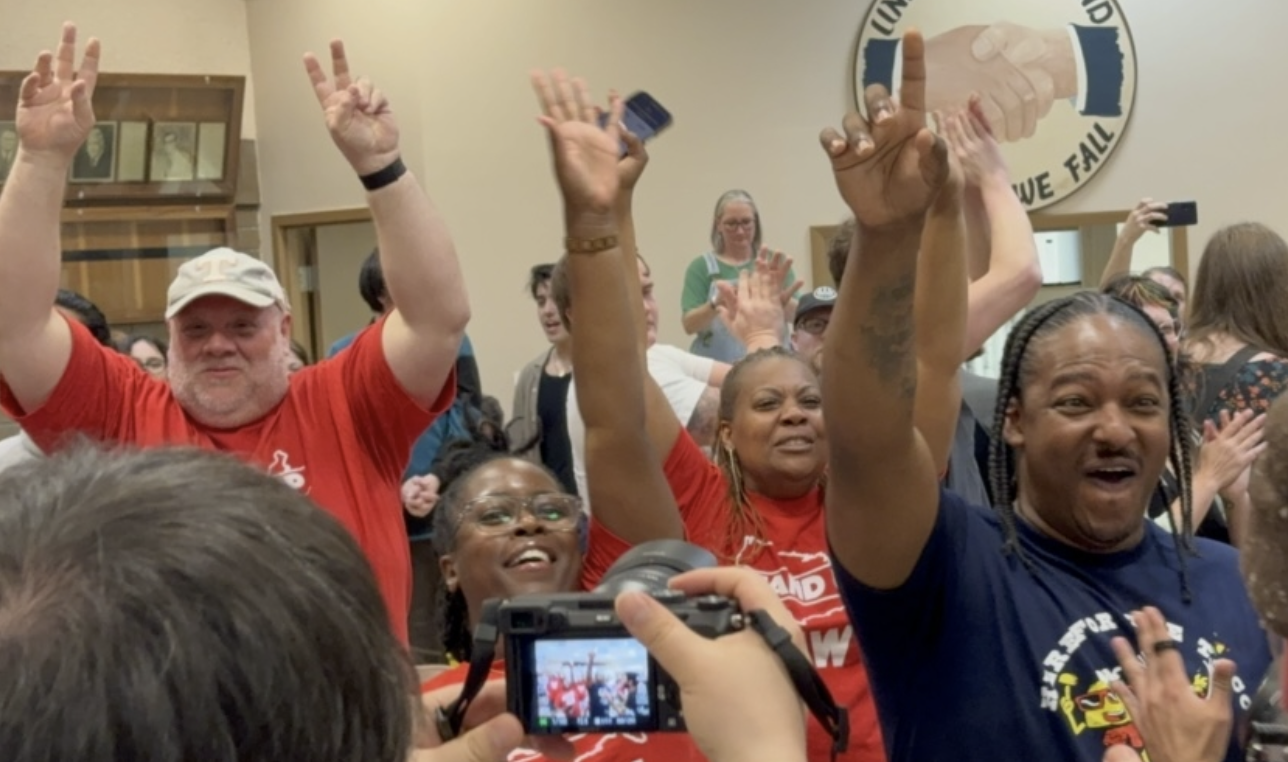
At the first Southern auto plant to organize in decades, Volkswagen in Chattanooga, Tennessee, 5,000 workers won a union in April by a decisive 73 percent. (Photo: UAW)


Strikes and Organizing Scored Gains
Dec 30, 2024 2:18 PM
When Trump takes office, expect attacks on immigrant workers, public employee unions, safety regulations, climate protection, and the very idea of labor law.
Union workers broke open the cookie jar in 2024, after years of stagnant wages and rising prices. With strikes and the threat of strikes, workers did more than forestall concessions: They gained ground. Union workers in the private sector saw 6 percent real wage rises for the year.
Just the fear that workers would organize drove up wages at non-union employers like Delta Airlines, Amazon, and Mercedes.
Meanwhile, unemployment rates of around 4 percent made strikes easier to maintain. For instance, many Boeing workers were able to get side jobs during their 53-day strike this fall. Relatively plentiful jobs have also made it easier for workers to organize new unions, since the threat of getting fired is less daunting.
Nearly 28,000 school employees in Virginia and 10,000 nurses in Michigan joined unions in the two biggest organizing victories of the year. At the first Southern auto plant to organize in decades, Volkswagen in Chattanooga, Tennessee, 5,000 workers won a union in April by a decisive 73 percent.
Related stories
Even our current weak labor laws and safety enforcement are on Trump’s chopping block. Expect attacks on immigrant workers, public employee unions, safety regulations, climate protection, and the very idea of labor law.
But even with a union, working conditions are often abominable. Speed-up and long hours make work risky and wear us out.
And storm clouds are on the horizon. Even our current weak labor laws and safety enforcement are on Trump’s chopping block. Expect attacks on immigrant workers, public employee unions, safety regulations, climate protection, and the very idea of labor law.
Wage Gains—Finally
After a strike that shut down production in the Pacific Northwest, Boeing Machinists bagged a 38 percent general wage increase over four years. A three-day port strike netted 20,000 Longshore (ILA) workers 61 percent over six years. It was the first East Coast-wide longshore strike since 1977.
Continuing the uptick in strikes since the onset of Covid, 2024 is on track for as many strikes as 2022, though it didn’t match the huge walkouts of 2023 in Hollywood, at Kaiser, and at the Big 3. Johnnie Kallas of the Cornell Labor Action Tracker reported 34 strikes in manufacturing through November.
Workers gained just by threatening a strike. At Daimler Truck in North Carolina, 7,400 workers chanted “Tick tock” as the contract deadline approached. They defeated tiers and won a 25 percent increase, with more for lower-paid workers.
After a vigorous contract campaign and 99.5 percent strike vote, American Airlines flight attendants (APFA) secured an immediate 20 percent pay increase, back pay from their 2019 contract expiration, and boarding pay for the first time. (Most flight attendants aren’t paid till the aircraft door closes.) Southwest flight attendants (TWU) won big wage gains; United flight attendants (AFA) voted 99.9 percent to strike, and may still do so. Airline workers have to navigate a lengthy obstacle course sanctioned by the Railway Labor Act, if they want to strike.
Teacher strikes yielded gains for teachers and students. In Massachusetts, where reformers lead the statewide union, but strikes are illegal, teachers in several districts struck anyway. They won more student services, time to plan classes, and raises for the lowest-paid aides—60 percent in 10 schools in Andover in January.
Gains from 2023’s strikes raised expectations for 2024. Unions that pushed sub-par contracts on their members faced revolts. Machinists leaders at Boeing backpedaled furiously when a contract they recommended was voted down by 95 percent in September. Letter Carriers are organizing a vigorous “vote no” campaign after union leaders submitted a contract with 1.3 percent annual wage increases.
Employers often coughed up pay but fought union demands on overtime, staffing, automation, and the moving of work. Longshore workers, for example, suspended their strike with a big pay promise, but job-killing automation issues remained unresolved, with negotiations ongoing.
The strike threat at Daimler Truck, and the strike at Boeing, did extract contractual promises on where work would be done. But enforcement may require additional job action. Stellantis has so far broken its promise to the Auto Workers to reopen its Belvidere, Illinois, assembly plant—a condition of ending the UAW’s 2023 Stand-Up Strike. Auto workers are debating how to enforce that demand, and many Stellantis locals have taken strike votes.
In the Daimler contract, workers won a renewed promise of a guaranteed daily truck output, to dispel fears that the work would be moved to Mexico—a threat the company deployed regularly in negotiations.
At Boeing, the new contract promises to locate production of the next passenger jet in the Puget Sound area. But the work will likely start after the contract expires, and union leaders expect it may require another strike to enforce the agreement.
Despite big strike leverage, Boeing workers didn’t get a ban on mandatory overtime, though they can no longer be forced to work two weekends in a row. “I don’t think that people should be required to work more than 40 hours a week to keep their jobs,” said Boeing Machinist Mylo Lang.
Continuing 2023’s trend of defeating solidarity-crushing tiers at UPS and the Big 3 automakers, tiers were eliminated at Allison Transmission and Daimler Truck, while solar Ironworkers in California were able to end tiers in a multi-year effort to make commercial solar installation a union job.
Reformers Spur Organizing
Reform movements and new leadership in the Auto Workers and Teamsters led to big investments in new organizing. In February, the UAW announced it would spend $40 million to organize non-union auto and battery plants through 2026.
In October, the Teamsters announced they had added 50,000 members in the two years since new leaders took office. The Teamsters have made organizing Amazon a priority, and the Staten Island Amazon Labor Union voted to affiliate in June, as ALU-IBT Local 1. The New York Times reported that the Teamsters have committed $8 million toward organizing Amazon as well as access to their $300 million strike fund.
Amazon warehouse workers in California and New York have been marching on their bosses, demanding recognition. Newly organized Teamster drivers at Amazon have been setting up roving picket lines to disrupt operations until the company recognizes the union.
In these two unions, effective strike threats and dedication to organizing are no accident. They started with reform movements: Unite All Workers for Democracy in the Auto Workers and Teamsters for a Democratic Union in the Teamsters. More victories are coming down the pike: Rail Machinists (IAM District 19) elected reform leadership in 2024, as did New York City teacher retirees (UFT), a 70,000-person chapter. Up next are reformers in the Food and Commercial Workers (UFCW), Theatrical and Stage Employees (IATSE), Professional and Technical Engineers (IFPTE), and maybe soon the Letter Carriers (NALC), thanks to an insulting contract offer pushed by the leadership.
Comments

Powered by RoundtableAn AI/DeFi-powered Enterprise Media Operating System. Learn more at Roundtable.io.© Roundtable 2026. By using this site you agree to the Terms of Use and Privacy Policy