


Aug 22, 2018 9:34 PM
Updated Feb 10, 2022 10:55 PM
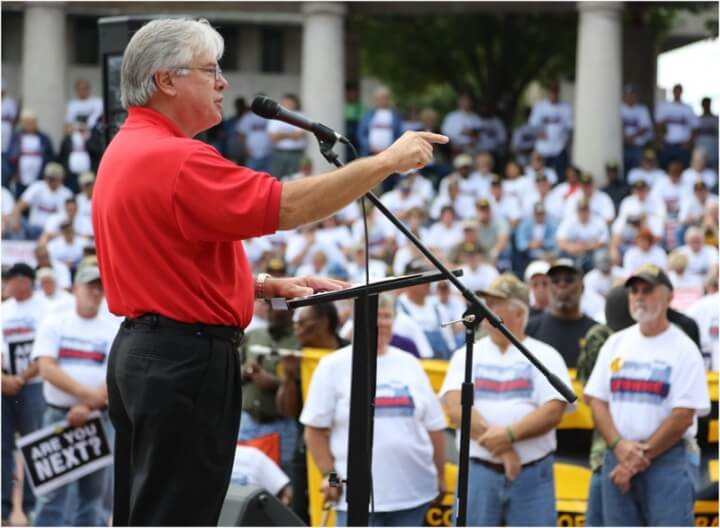
Berry Craig: Unions hope the voters elect enough pro-union Democrats to significantly reduce the anti-labor GOP bulge in both Missouri houses.
Missouri voters nixed the Show Me State’s “right to work law” by a 2-to-1 margin.
Despite the drubbing, anti-union Republicans could pass another RTW law when the legislature meets in January, warned Missouri AFL-CIO President Mike Louis.
The GOP enjoys super-majorities in the state House and Senate. It's doubtful that the Democrats can flip both chambers on Nov. 6.
“We know for a fact that some people will at least introduce [RTW] bills,” Louis said. “I think what’s to be seen is if those bills see the light of day or if they just die.”
Related stories
Mike Parson, Missouri's new Republican governor, evidently isn’t spoiling for another RTW fight. “For me it’s pretty simple, the voters spoke, loud and clear,” he said on This Week in Missouri Politics last Sunday.
“You didn’t miss what they said. So, for me it’s moving forward. Instead of right to work, I’m going to be talking about infrastructure; I’m going to talk about workforce development, things I feel like we need to move forward on.”
Parson confessed that he didn’t know what legislators might do about a RTW reprise. “That’ll be up to them. But for me, the voters spoke; I’m moving forward.”
"What he said was huge for us," Louis added.
Nonetheless, organized labor is keeping its powder dry and not resting on its laurels, however hard-won. Never had voters anywhere axed a RTW law at the polls.
Anyway, Louis also is skeptical that the Democrats can win either chamber this fall. The Senate is 25-9 Republican; the GOP runs the House, 118-45.
Unions hope the voters elect enough pro-union Democrats to significantly reduce the anti-labor GOP bulge in both Missouri houses.
But unions hope the voters elect enough pro-union Democrats to significantly reduce the anti-labor GOP bulge in both houses.
"We won 99 counties out of 114," Louis said. "There are a lot of state reps. and state senators we can go to and say, 'Hey, you claimed all along [RTW]...was what the people want. This is what you ran on, and yet your counties in your district voted against it' by whatever the numbers show. Our lobby team will have that in hand.
"So, a big part of this now is going to be on the shoulders of our lobby team."
The GOP Missouri legislature passed RTW in February 2017, a month after the GOP Kentucky legislature, cheered on by Republican Gov. Matt Bevin, put the Bluegrass State in the RTW column.
The Kentucky State AFL-CIO and Teamsters Local 89 are suing to overturn RTW. The case is in the state supreme court.
In Missouri, unions and their allies organized a successful petition drive to put the RTW bill before the voters. (That tactic wouldn't work in Kentucky; the state constitution doesn't permit voters to overturn laws passed by the legislature.)
"Working people made our voices heard at the ballot box today and overturned “right to work,” Louis said in an election night statement. "It’s a truly historic moment. Thousands of hardworking men and women in Missouri talked to their neighbors, friends and co-workers. We owe them this victory.
"Together, we knocked on more than 800,000 doors, made more than 1 million phone calls and talked to working people on more than 1,000 different job sites across the state. Tonight we celebrate, but tomorrow we’re getting back to work. We’re going to take this energy and momentum and build more power for working people in Missouri."
In addition, opponents of Prop A far outspent RTW supporters. "The labor-backed group We Are Missouri poured over $15 million into the campaign," wrote Dave Jamieson in The Huffington Post. "The two largest groups on the other side of the issue, Freedom to Work and Missourians for Freedom to Work, spent a combined $3.2 million, according to the Missouri Ethics Commission."
Even so, money alone didn't beat Prop A, according to Louis. Basic kitchen table economics turned the tide, he said.
The vote no campaign emphasized U.S. Census Bureau statistics that showed that workers make an average of $8,740 less per year in RTW states than in non-RTW states. The idea was to prove that RTW really means what unions say it does, "the right to work for less."
Elected in 2016, Republican Gov. Eric Greitens pushed hard for RTW. In 2015, the legislature failed to override a veto by Gov. Jay Nixon, a Democrat.
Parson took over as governor after Greitens resigned in disgrace in June. He faces a felony charge and potential impeachment stemming from an investigation into claims that he tried to evade the state's campaign disclosure laws and attempted to blackmail an ex-paramour.
Parson, too, has been pro-RTW. Before he was elected Greitens's lieutenant governor, he was a state representative and state senator.
Louis said the state AFL-CIO is targeting about a dozen legislative seats that could be winnable--10 in the house.
"We have to be realistic. If we had millions and millions and millions, which we just spent, we could concentrate [on taking the legislature]...We have got to be pennywise and do the best we can with the amount of money that we're going to have."
But if the Democrats can narrow the GOP margins, "it at least creates a situation for debate," said Louis.
He said that like in the Prop A referendum, turnout will be crucial on Nov. 6. "We have really high percentages of union members who are registered voters. But we did run a voter registration plan [for the Prop A vote], more for friends and family to make sure the union households were registered, not just the members."
He hopes that increased registration will translate into higher turnout this fall.
But Louis cautioned that a referendum and a general election are different. "They're two separate entities, but that doesn't mean we're not going to use some of the valuable lessons learned--number one, who we target...a lot of it is going to be figuring out where we can get the turnout we need with union members and union households.

"But the key is how do we carry over the energy for the next two-and-a-half months?"
Berry Craig
Comments

Powered by RoundtableAn AI/DeFi-powered Enterprise Media Operating System. Learn more at Roundtable.io.© Roundtable 2026. By using this site you agree to the Terms of Use and Privacy Policy