


Mar 22, 2026 3:18 AM
Updated Mar 22, 2026 11:00 PM
Each time I see a Waymo I think, Wwhy are we sitting by like houseplants and allowing this to happen?
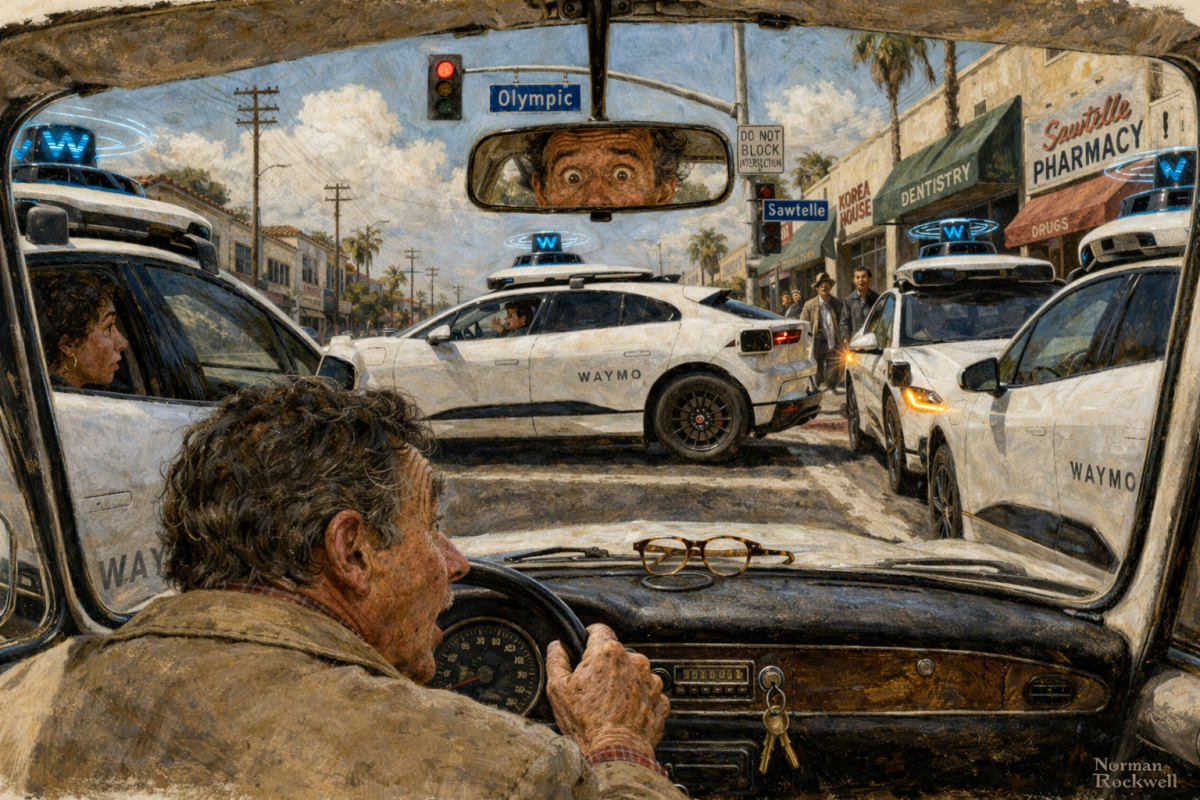
A few weeks ago, I was driving east on Olympic Boulevard and stopped for a red light at Sawtelle. It was early afternoon, traffic was light, and I was the first car in the middle of three through lanes. As other cars stopped around me, I absent-mindedly surveyed them and was a little creeped out to see that I was hemmed in by Waymo taxis. I looked ahead just as another white Waymo crossed Olympic right to left. Across Sawtelle, facing me in the left-turn lane, two more Waymos waited in tandem, blinkers blinking, roof-mounted reverse zoetropes spinning, recording who knows what, sending it who knows where.
To the Cloud we think, automatically now. The Cloud: so gauzy, so diaphanous, so everywhere and nowhere, so innocuous a name for so famished an energy sink, so voracious a data suck. The stream spewing out its nether end iscurated by who knows who, used for who knows what. Each Waymo sports 23 sensors: 13 high-res cameras for 360°,long-range and peripheral vision, six all-weather imaging radars for gauging speed and distance, and four lidars for 360° coverage and 3D mapping. These log everything, including license plates. And all that data—also an innocuous, neutral term—is made available to the government generally and law enforcement specifically. If my license plate is read in two or more locations in a day—increasingly likely as more Waymos are released into the wild—they know my travel patterns, my schedules, my destinations. Privacy, anyone?
Data-mining is an apt metaphor. Data is aggregated, then refined into ever-more-you-specific packages. We are simultaneously raw material, finished product, and consumer, for sale to entities who will then sell us to ourselves. Not creepy enough? Amazon and GrubHub are “trialing” delivery by drone. Their drones carry sensors similar to Waymo’s. Not only will they know what we consume and when, they’ll document everything they fly over during every delivery. Growing a few more plants in your yard than is legal? Skinny-dipping in your hot tub with your swinger neighbors? The drones will log it and send it to The Cloud. This corporate surveillance will reveal unprecedented details of our lives to anyone who sees a way to profit from it. Shingles cracked? Rattan ratty? Don’t be surprised if a pop-up offers to sell you a roofing service or new outdoor furniture. As I waited at that AI-managed red light, in my mind’s ear I heard, beneath its eerie theme, Rod Serling droning the intro to The Twilight Zone.
Corporations developing and promoting AI—Meta, Anthropic, Microsoft, Google/Alphabet, Amazon, OpenAI, others you haven’t heard of (and won’t)—are investing billions in machine-learning all there is to know and then packaging and selling it to anyone with the means to buy it. They’re spending billions more to self-power data-centers in which they store and process that data, pouring money into not only familiar energy tech—geothermal, hydro, and solar—but also in SMRs (Small Nuclear Reactors). As is so much corporate malevolence, this is being green-washed: We’re an environmentally and socially responsible company. Our goal is to decrease pollution, to lessen the strain on the grid, to lower electric costs, to make the world better. We’re doing this for all of us. But once data-centers are off-grid, corporations that Citizens United put beyond accountability will be beyond scrutiny. They’ll be doing it to all of us. Each time I see a Waymo I think, in this order: That technology is amazing! Another job gone. This is a truly awful idea. Why are we sitting by like houseplants and allowing this to happen?
Related stories
It’s clear why corporations that transport goods or people want to dump drivers: driverless cars and other automated forms of production don’t ask to be paid, form unions, or generate lawsuits by assaulting passengers. Employees are a PITA (Pain In The Ass) on many levels.
Where have all the workers gone?
Long time passing
This looks to be the last generation of cab drivers. Driving cabs is a decent-paying job that anyone—even the highly educated—can do. Immigrants who in their countries of origin had advanced degrees that weren’t accredited here could, via driving taxis, support families, buy homes, and put kids through college. Driving a taxi, limo, or ride-share is a quintessentially American job: What you earn is limited only by how many hours you put in, how hard you’re willing to work.
But people-driven taxis are slated to go the way of buggy whips. The demise of the buggy-whip industry was used for years in intro-Econ classes to illustrate how technological change—the coming of the auto—hurt one sector of the work force but benefitted the economy overall. No one will argue that the auto industry and its ancillary services—the petroleum industry, gas and service stations, auto-parts stores, traffic-light suppliers, driving schools, road building, etc—vastly eclipsed the economic impact from the loss of buggy-whip jobs (albeit not the impact on the individuals who lost buggy-whip jobs).
In the context of AI-driven production, the buggy-whip example—limited disruption in the wake of new technology—is faulty. While a large, diversified economy absorbs the loss of one product category, AI-caused job losses will knee-cap the entire job market, sparing no segment. AI can or will soon be able to perform any job: process tax returns, give legal and medical advice, manage supply chains, sell burgers and fries. AI-guided robots will replace all factory workers and cab drivers. What were originally called “driverless” cabs now are now dubbed “robotaxis.” There is no job, field, career, or profession—law, art, accounting, programming, planning, plumbing, carpentry, medicine, marketing—that AI won’t be able to perform more efficiently, i.e., at lower cost. This is neither sci-fi nor chicken-little panic. It’s happening now: Amazon, Meta, and Block (formerly Square, Jack Dorsey’s online payments company) have laid off scores of thousands of employees, citing AI-engendered “efficiencies.” And it’s just the start.
It’s particularly disturbing to see how meekly those who have most benefitted from the revolutionary notion that we can shape our world to serve us have abandoned that notion. Seduced by the instant gratification of the post-World War II consumer economy, hordes of Americans have passively accepted a reversal in the fundamental expectation of citizenship in a democracy: We no longer hold it both a gift and responsibility to adapt our world to our liking. Instead we unquestioningly adapt to the world that corporations choose to present us with.
Karl Marx observed that capitalism eventually transforms everything into a commodity. That’s the real reason that ultra-capitalists, who prefer us passive and pliant and have worked hard to make us so, have demonized Marx and his ideas and framed discussion of his thinking as blasphemy: Marx pointed out that we didn’t have to be passive and pliant. Yet here in our republic’s 250th year, we are choosing to be, choosing to sway like motile corn stalks in the capitalist winds.
Like pillage and rape, human bondage, free labor, was long considered a perk of conquest. In fact it was often a driver of conquest; for many millennia, two-legged beasts of burden were considered far superior to and more valuable than their four-legged counterparts. It is only recently, in political years, that slavery has been illegal, though some countries—North Korea, Eritrea, Mauritania, and others—still condone it. The spread of liberalism, by insisting all people had the rights 1) to be paid for their labor, and 2) to decline to work for someone, redefined that calculus.
But now, after 250 years, we are choosing to turn what should be civil discussion, debate, and dialectic into a faux-existential battle, threatening a death match over liberalism vs. royalism, capitalism vs. socialism/communism. Post-FDR and throughout the Nordic and other socialist-leaning societies we see that capitalism can have a humane face, that a hybrid mixing of capitalist and socialist ideas can exist and prosper while benefitting an ever-broader portion of humanity. There will always be anti-social individuals for whom there is no enough, but collectively we have the power to control that. If we don’t—if we choose not to—then the fault lies not in our systems but in ourselves. Isms—socialism, communism, feminism, capitalism—run by humans will always be imperfect (because, well, humans), sometimes glaringly so, but when they are, we have shown that it is possible, through reason and good faith, to modify those systems to soften the hard edges. It’s never the isms, it’s always the ists.
Though those for whom enough is not enough have cast communism—with Marx as its face—as the enemy, capitalism’s true enemy—its real target—is and has always been liberalism. This becomes ever more obvious with the capitalist-driven spread of illiberal-infused populism. Since the end of slavery, capitalists have sought ways to deemphasize human workers, for example replacing taxi drivers and factory workers with robotaxis and robots. This is the true agenda of corporate-sponsored AI. The great displacement theory that terrified the misguided marchers of Charlotte should have had them chanting Robots will not replace us. What remains unclear is who, other than the already rich, is going to take those robotaxis and buy all those ever-more-efficiently-produced products when no one has a job?
From zombie employees to ghosts
I first saw zombie workers as a child in 1950s Manhattan. I knew something was off but couldn’t grok the implications. Manhattan, with its tall-building skyline, was once the symbol of the modern city replete with the skyscrapers without which the modern city couldn’t function. But those skyscrapers couldn’t function without elevators. Recent gens may not know that early elevators were operated by humans (who had/have a union). The first elevators were used to move heavy machinery. As the technology was refined, it spread to passengers who boarded the elevator cars and requested a floor to which the operator delivered them.
As a child I witnessed the last phase of the shift from operator-run to automatic—robotic—elevators. In the 1950s, newer buildings were built with them; to save money, owners retrofitted older buildings with them. This is my earliest memory of a business offloading an employee expense onto consumers, a practice that, thanks to AI, is now pervasive: Anytime we fill out an online registration or type in a credit card number instead of talking to a human, we’re enabling a company to use fewer human employees.
During the transition from operator operated to automatic, elevator passengers could operate them by pressing buttons, but office buildings—banks, law firms, stock exchanges, department stores—that chose to project an aura of luxury and service continued, for a time, to employ zombie operators; passengers would still call out desired floors and the “operators” would press the appropriate button. In office buildings, they would pick up extra money in the form of tips by running errands for tenants. In department stores, these zombie operators would call out the contents of floors as the elevators reached them and the automatic doors opened. Over time, as building owners sought savings, those zombie workers faded into ghosts.
It’s Waymo than a bad idea
Waymo is in talks to secure $15 billion in funding from its parent, Alphabet, and venture-capital firms, with plans to expand across the U.S. and beyond. Over 2500 vehicles are now operating in the U.S.: 600+ in LA County, 800+ in San Francisco, 400+ in Phoenix, 100+ in Austin, and an undisclosed number in Atlanta, where Waymo is partnering with Uber. A competitor, Amazon’s Zoox, is operating in Las Vegas and parts of San Francisco. Other firms, including Tesla, are entering the market.
Jobs disappear one job at a time, one business at a time, each one immeasurable against the GNP. Snowstorms, blizzards, whiteouts are an agglomeration of single, small, ephemeral flakes, each one harmless. Tule fog is an agglomeration of harmless droplets of water. Climate change happens one light switch, one degree of AC, one automobile commute at a time. In the small town where we moved from Manhattan and where I went to high school, we used to burn leaves in the fall. No one gave it a second thought. But eventually, amid much grumbling—it’s just one smoke plume in a big atmosphere—it was outlawed; as the population grew, the number of individually insignificant fires produced significant air pollution, choking asthmatics and darkening the skies: It’s just one burning leaf, just one snowflake, just one raindrop. Just one job.
We can do something about robotaxis and robots and AI decimating jobs. We can make policies that prioritize jobs over efficiency, that make workers more important than investors. But unless we do something about the coming, AI-produced jobpocalypse, we will see unemployment on a scale that will make the Great Depression look like an economic pothole. We are, or could be, in control of creating and enforcing policies that manage this. That’s what democratic government is for. The world doesn't have to be something that happens to us; it can, through democratic government, be something that happens for us. But I’m not optimistic. We’ve been reduced—with our cooperation—to passivity. What exciting features will the next iPhone provide?
Comments

Powered by RoundtableAn AI/DeFi-powered Enterprise Media Operating System. Learn more at Roundtable.io.© Roundtable 2026. By using this site you agree to the Terms of Use and Privacy Policy