
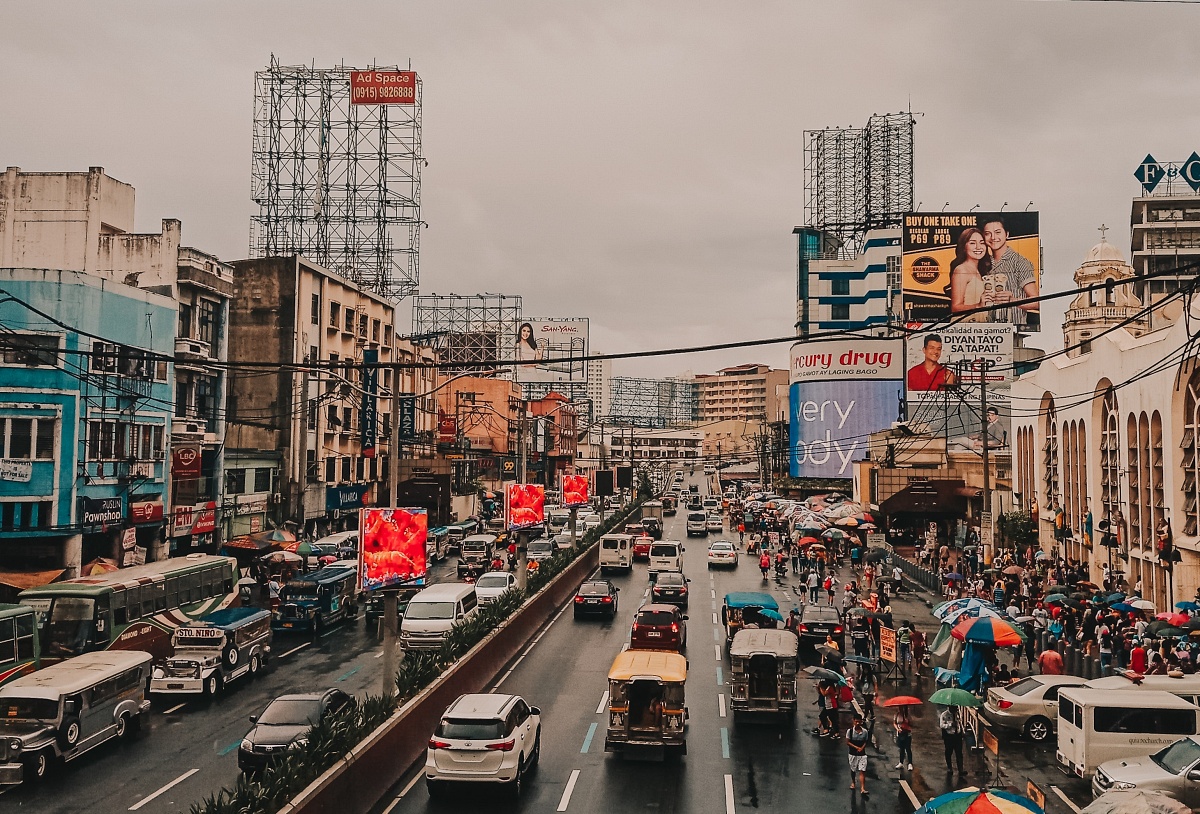
Photo by Marfil Graganza Aquino


Aug 20, 2023 1:00 PM
Under the Philippine Labor Code, it is illegal to join a union and wages are even lower in the regions outside of Manila.
Trade union activist Mylene Cabalona spoke to 100 young Filipinos and local union activists in Long Beach and LA August 12 +13, about the struggle of Filipino workers for higher wages, unionization, and better working conditions. The meeting also discussed organizing solidarity with strikers in LA.
She is an organizer for call center workers, President of the BPO [Business Process Outsourcing] Industry Employees Network (BIEN). The meeting was sponsored by a wide range of Filipino groups including BAYAN and the Philippines-U.S. Solidarity Organization (PUSO).
“US businesses are offshoring the business because here in the client country, the global south, due to minimal labor costs and poor working conditions. They make contracts with individuals and local companies.”
The Philippines has $14 trillion USD in debt, 3 million unemployed, 20 million living in poverty with 8% unemployment.
Related stories
“The labor unions that do exist are also under attack while fighting for wages and benefits and there's no job security and compliance with health and safety; especially during the pandemic with the companies not providing any support when you get COVID. COVID is already an occupational hazard in the Philippines.”
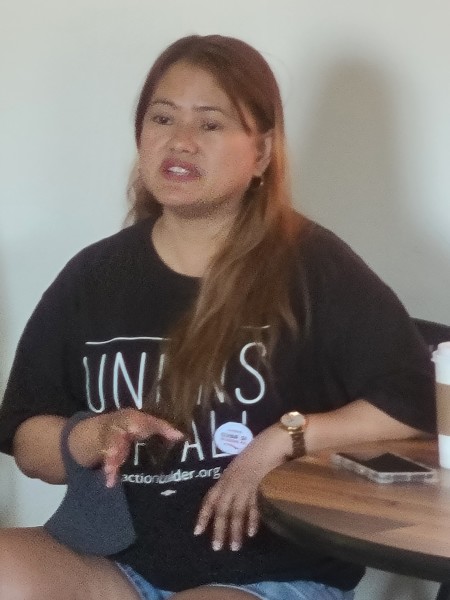
She told the youthful rapt crowd in both venues that “In the Philippines there is a misleading thought that when you work in the business process or for Apple or other call centers that you are in a better position than someone that works in a different industry because you’re working in a location that has air conditioning, a computer and you speak English (of course). You have to follow a script and your salary is just below the minimum wage. The minimum wage is about 600 pesos a day or roughly $10 to $13 a day. I'm getting around 15000 pesos which is around $300 a month.”
Under the Philippine Labor Code, it is illegal to join a union and wages are even lower in the regions outside of Manila. “We handle the calls for AT+T, Expedia, US airlines, CitiCorp and others. Because of my unionizing efforts I have been labeled a terrorist, others have also been red-tagged (and are arrested, or disappear or are visited by a local “Red Squad” of the police (who receive $150 million a year from the US government), frame-ed up on firearms charges…” In response workers have organized work stoppages, pickets, and “Flash Mob Protests.”
She reported that in the Philippines the “call center industry makes $35 billion US dollars profit a year and comprises 1.7 million workers. “Imagine no union; how are people able to protect themselves when they can't even bargain, they can’t join a union. We have at this time 71 Union organizers/ activists who that been killed. Not one of the killers have been brought to justice.” Call centers are the largest industry in that country.
Joining the discussion was Melissa Dogoldogol, a shop steward with UNITE HERE 11, a local with 15,000 members, at a prestigious LA hotel “We have had rolling walkouts to advance our issues for better healthcare, a balanced workweek with free time for our personal lives, and so workers don’t have to work two jobs.” Many of the workers are without documents so they suffer wage theft so they really need a union, she added. Mary from SEIU #2015 added that “One issue in the contract talks is to stop companies from using E-Verify to check on immigration status.”
Megan, a local health care worker and activist in BAYAN said that “I make $17/hour which is not enough to live on in LA; management dismisses our concerns and we get no respect in our efforts to care for our patients…the CA Department of Public Health only cares about how the hospital looks on paper.”
An aspect of the meeting in Long Beach was an educational component on the history of US colonialism and military bases in the Philippines, including the recent military exercises (12,000 US troops and 5,400 FilipinosNYT) as a deterrent to labor unionization and whipping up anti-China sentiment. {The US has 750 bases in 80 countries-MF}.
A February 1, 2023 New York Times article reported that “The US is increasing its military presence in the Philippines, gaining access to four more sites.” This is the first time since the 1990’s that US soldiers are based there- even though it is against their constitution for foreign troops to be based there.
Both meetings warmly received activists from the LA Hands Off Cuba Committee who invited participants to a Medical Aid for Cuba Concert August 27. BAYAN is a supporting organization of this committee dedicated to ending the US blockade of Cuba.
Filipino organizations and their allies are gearing up for protests in San Francisco Nov. 11-12 against the Asia Pacific Economic Cooperation, APEC, a governmental forum of 21 economies in the Pacific Rim. The organizations state that APEC advances US economic and political interests in the region at the expense of workers lives and the environment. For more information contact [email protected] or LINKTR.EE.ILPS.US
Comments

Powered by RoundtableAn AI/DeFi-powered Enterprise Media Operating System. Learn more at Roundtable.io.© Roundtable 2026. By using this site you agree to the Terms of Use and Privacy Policy