
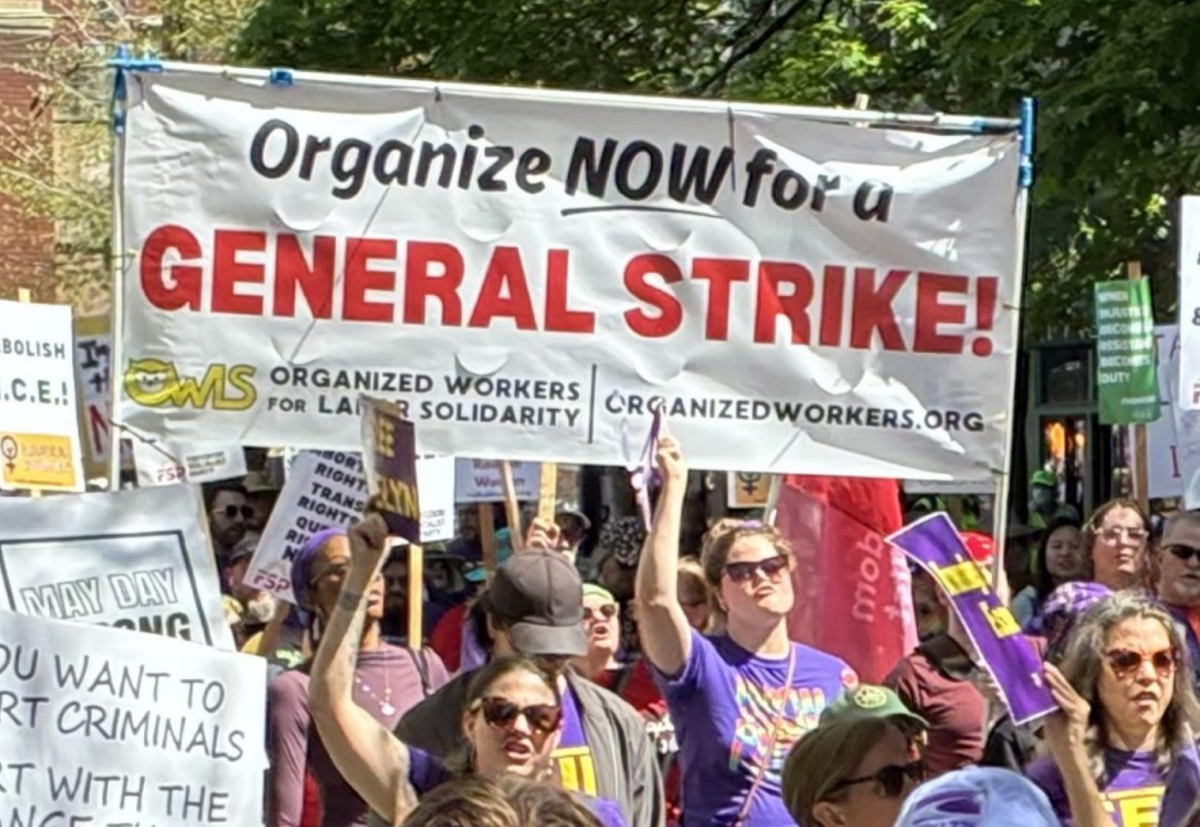
In Seattle, members of Organized Workers for Labor Solidarity (OWLS) join a large crowd in a May Day march. PHOTO: Doug Barnes / FS


Jul 26, 2025 1:51 PM
Workers have the power to shut down production and the profit pipeline of the billionaire class; labor and community united can stop Trump’s march toward war and fascism.
The U.S. working class is in motion. In the time from January to July, weekend protests by thousands of people have ballooned into massive marches of millions.
And in cities from Los Angeles to New York, flash points are causing sparks to fly and spread.
Unions are starting to bring their discipline and weight to battles over free speech, immigration, federal workforce cuts, and more. This was evident when the California president of Service Employees International Union (SEIU), David Huerta, was arrested during workplace raids by agents of Immigration and Customs Enforcement (ICE). Labor’s response was swift and strong. (See “Los Angeles ignites: from raids to resistance.”)
But mass protests alone won’t stop Donald Trump’s wrecking ball. Neither can the courts, where all roads lead to the Supremes. And Congress is part of the problem.
Related stories
While U.S. capitalism rapidly devolves, ordinary working-class folks won’t stand by as critical programs and services get the DOGE. People want to know what is next. What will reverse this descent into austerity and war or fascism?
Historically in such times of crisis, workers have turned to their greatest power, by withholding their labor in mass strikes. And this is what is needed now.
Workers’ greatest power
A general strike involves shutting down many industries, public and private, from transportation to finance. It can include workers running essential services for public benefit. Such strikes are typically started by unions but joined by the vast majority of workers — unionized or not. Students and community, families, neighbors, and the unemployed also play a pivotal role.
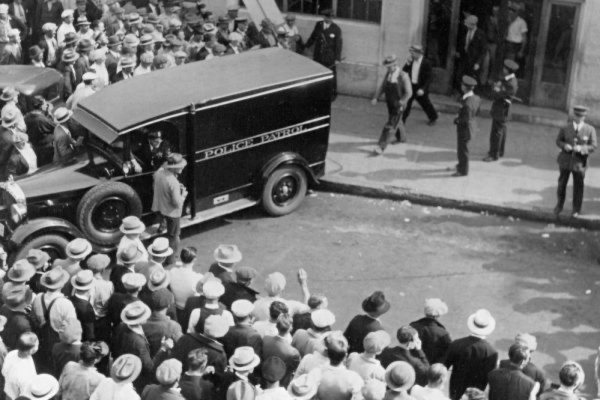
History shows how one struggle can widen. This happened in 1934, when dockworkers in San Francisco/Oakland were attacked by police. The whole labor movement responded with a citywide strike.
General strikes can last one day or many. From 2019 to 2021, India, France, and Haiti were all rocked by work stoppages to protest spiraling prices and attacks on labor and civil rights.
Walkouts can evolve into a struggle for workers’ power as happened in the Russian Revolution. Or they can force reforms as labor did in the U.S. during the 1930s through general and sit-down strikes. This led to the National Labor Relations Act and birth of the modern U.S. labor movement.
In 2025 U.S. workers have come full circle. Decades of reliance upon the Democratic Party and capitalist labor laws have weakened labor’s muscle.
But Trump’s juggernaut is awakening a sleeping giant; the mood is warming toward strikes, and even the possibility of initiating a labor party.
Don’t mourn, organize
Organizing for a general strike is a concrete next step that workers can take to push back against imperialist war and encroaching fascism. It’s also a way to build solidarity and class consciousness for the battles that assuredly lie ahead.
To gain traction requires support from some international unions or high-profile leaders. Sara Nelson, president of the Association of Flight Attendants (AFA-CWA), is one North Star. In March, she declared the labor movement has “very few options but to join together to organize for a general strike.”
Nelson’s call was in response to the Department of Homeland Security stripping workers in the Transportation Safety Administration of their collective bargaining rights.
Rank-and-filers can amplify her urgent appeal by bringing resolutions to their unions, and to county and state labor councils to coordinate solidarity.
Members can ask their unions to establish education committees; coordinate workplace trainings on how to defend coworkers during ICE raids; and mobilize members for labor and community protests.
Labor organizations can be urged to form united fronts for mutual defense of unions and communities that are under attack, including immigrant workers, refugees, communities of color, public-worker unions, women, and transgender people.
Forming caucuses within unions is a great way for rank-and-filers to organize and educate on the shop floor. For example, Purple for Palestine, a national caucus within SEIU, has moved the international union on support for Palestine. Through uniting around a program, caucuses can amplify ideas and demands by distributing educational statements, organizing for union meetings, developing strategies to win over coworkers, and defending free speech.
Crisis brings opportunity
The Democratic Party has served as a conservatizing brake on labor. This pattern was on full display in 2022, when former President Joe Biden blocked a national railroad strike. But this summer, two labor leaders resigned from the Democratic National Committee. American Federation of Teachers (AFT) President Weingarten left the DNC on June 5. President Saunders of the 1.3-million-member public-sector American Federation of State, County and Municipal Employees (AFSCME) called his departure a move to meet the urgency of the moment. “These are new times. They demand new strategies, new thinking, and a renewed way of fighting for the values we hold dear,” he said.
This new independence could open opportunities for labor bodies to initiate town halls or assemblies where workers and unions can discuss how to build labor’s power, including through strikes and independent political action.
Shut it down!
At every level, from rural towns to big urban areas, workers are demonstrating a readiness to leap forward. Associations of gig drivers are contesting the power of companies like Uber and Lyft. Baristas are taking on Starbucks. Unionized grocery workers are preparing to strike their giant employers. Federal workers are uniting across unions to defend their jobs and stop privatization.
In Washington state, Organized Workers for Labor Solidarity (OWLS) is campaigning for a general strike. One member of the cross-union labor group has worked with others in her local to send a resolution from Office and Professional Employees Local 8 to the Washington State Labor Council 2025 Convention. It calls for labor and progressive forces to “take whatever actions are necessary up to and including a general strike to protect free speech, all workers’ rights, our democracy and the Constitution.”
Labor has the power to turn the tide in its favor. As sung in the beloved union anthem Solidarity Forever: “In our hands is placed a power greater than their hoarded gold, greater than the might of armies, multiplied a thousand-fold.” There’s no time to waste.
Comments

Powered by RoundtableAn AI/DeFi-powered Enterprise Media Operating System. Learn more at Roundtable.io.© Roundtable 2026. By using this site you agree to the Terms of Use and Privacy Policy