


Feb 9, 2025 4:25 PM
Congress and Democrats cannot avoid “doing business,” at least to some extent, with Trump. But they should remain faithful to their principles.
One Merriam-Webster dictionary definition of blustering is “speaking loudly and aggressively,” and it gives as an example “a blustering bully.” That three-word descriptive phrase sounds about right as applied to our current president, whether considering his immigration/deportation (I/D) or other proposed polices.
Whether that’s true or not, his announced I/D plans were one of the reasons that he defeated Kamala Harris in our recent presidential election. A late October YouGov poll indicated that by a 49 to 35 percent margin potential voters thought he would handle immigration better than Harris.
Before examining those plans, however, it should prove helpful to analyse first the negotiating style of the man who wrote—or perhaps more accurately commissioned the ghost-writing of—The Art of the Deal (1987). After examining his style, we’ll move on to his announced I/D ideas, then review U. S. immigration history, and finally argue for more enlightened immigration policies than Trump’s tempestuous tirades.
First, it should be noted how The Art of the Deal begins: “I DON’T do it for the money. I’ve got enough, much more than I’ll ever need. I do it to do it. Deals are my art form. Other people paint beautifully on canvas or write wonderful poetry. I like making deals, preferably big deals. That’s how I get my kicks.”
Related stories
Thus, President Trump thinks he’s a great deal-maker. In a 2019 essay by MIT professor Thomas Kochan he sums up Trump’s negotiating style in five points and advises business negotiators how to deal with Trump-like negotiators:
- Trump“generally assumes he is in the dominant power position.” Kochan warns negotiators from forming “coalitions with those who behave like him because the coalition would be highly unstable.”
- Trump “seeks and values admiration and personal gratification, a behavioral trait that makes him vulnerable to overvaluing small concessions when combined with deferential (authentic or feigned) demonstrations of respect.”
- “He shows little interest in relationship building. Each negotiation is treated as a one‐off transaction, not an episode that anticipates repeat negotiations that might benefit from relationship building. This means that he cannot be trusted to maintain a relationship if circumstances change in ways that suggest to him that the other party will no longer serve his immediate interests.”
- “He is abusive to those who disagree with him on substantive issues. He often turns to personal attacks and implies the other parties are weak or berates their character. This perhaps is Trump’s most visible and consistent negotiating persona. . . . Those who turn negotiations into personal attacks risk being excluded from participating in events that call for putting differences aside, perhaps by demonstrating commitment to some deeper shared values.”
- “He appears to have few reservations about negotiating with individuals or organizations of questionable ethics.” Dealing with such people makes one more susceptible to blackmail.
Kochan’s summation of the best way to deal with the Trump negotiating style? “Avoid doing business with others like him–trust is essential to enforceable and stable business [and most other] transactions.”
Politics, of course, is not the same as business. And Congress and Democrats cannot avoid “doing business,” at least to some extent, with President Trump. But they should remain faithful to their principles—let’s be generous here and presume that at least some politicians have them.
Four of my previous articles on LA Progressive, beginning in 2011, and an early February 2025 email from Sen. Bernie Sanders contain suggested elements for hammering out compromises with the Trump administration. But given his negotiating style and our progressive principles, perhaps little real compromise is possible. If so, only one word sums up what our approach should be—resistance.
Before coming to such a conclusion, however, let’s examine past developments. My 2011 article argued against the stance of Republican House of Representatives Speaker John Boehner, who (with Obama as president) expressed his dislike for the word “compromise.”
In support of my position, I quoted John Kennedy’s Profiles in Courage: “We should not be too hasty in condemning all compromise as bad morals. For politics and legislation are not matters for inflexible principles or unattainable ideals. . . . Legislation, under the democratic way of life and the Federal system of Government, requires compromise between the desires of each individual and group and those around them.”
And I mentioned JFK’s brother Edward Kennedy (1932-2009) as one of the most effective compromisers the Senate had ever witnessed. As conservative Sen. Orrin Hatch (Utah) said about him: “We did not agree on much, and more often than not, I was trying to derail whatever big government scheme he had just concocted. We did manage to forge partnerships on key legislation, such as the Ryan White AIDS Care Act, State Children’s Health Insurance Program, and most recently, the Edward M. Kennedy Serve America Act. Ted was a lion among liberals, but he was also a constructive and shrewd lawmaker. He never lost sight of the big picture and was willing to compromise on certain provisions in order to move forward on issues he believed important.”
My next article dealing with compromise—“Can Progressives Compromise With President Trump And His Followers?”—was in December 2016, a month after Trump (and Republican majorities in both congressional houses) had been elected. The essay quoted at length from one undeniable progressive, Sen. Bernie Sanders, who stated:
Clearly there is no working with a president who believes in, or will bring forth, programs or policies based on bigotry, whether it is racism, sexism, homophobia, or xenophobia, and there can be no compromise on that. There can be no compromise on the issue of climate change, which is a threat to the entire planet.
But if Trump is prepared to work with me and others on rebuilding our infrastructure and creating millions of jobs, on raising the minimum wage, on passing Glass-Steagall [to prevent commercial banks from engaging in risky investment schemes], on changing our trade policies—yes, I think it would be counterproductive on issues that working-class Americans supported and depend upon if we did not go forward.
In other words, no compromise on policies that reflect bigotry or threaten our climate, but yes to Trump and/or Republican policies—presuming some such might be forthcoming—that would advance the common good.
Three years later, in my "A Tough Progressive Balancing Act: Passion, Tolerance, and Compromise," I wrote of the difficulty, but necessity, of balancing a passion and commitment to certain issues with a willingness to compromise on details—as long as the type of principles Sanders wrote about in 2016 are not violated.
About a year ago, however, my "Trump the Anti-Dialogue and Anti-Compromise Candidate" indicated that “achieving compromise solutions depends on a quality that seems as foreign to Trump as does the virtue of humility—a willingness to engage in honest dialogue.”
And that brings us to Bernie’s early February 2025 email. Unlike in 2016, he no longer writes “If Trump is prepared to work with me and others. . . .” Like many of us, he seems to realize what a forlorn hope that now is. Instead here are some of his words:
Trump‘s policies are designed to make the very richest people in this country even richer. . . . This country, under Trump, is moving rapidly toward authoritarianism. The rule of law and our Constitution are being undermined. Just a few examples: in violation of the Constitution and federal law, Trump attempted last week to suspend all federal grants and loans. That means he blocked funding for Medicaid, Head Start, community health centers, homeless veterans programs, etc., etc. Tens of millions of Americans, including some of the most vulnerable people in our country, were impacted by that decision. . . . Trump is intimidating the media with lawsuits. . . . Trump pardoned the January 6th insurrections who injured 174 police officers at the Capitol. Now, he is investigating the FBI agents who helped bring these violent criminals to justice. His goal: condone violence and turn the FBI into a national right-wing police agency. . . . We must vigorously oppose Trump’s efforts at mass deportation. . . . We must vigorously oppose the absurd “drill baby drill” doctrine, which will only make an incredibly dangerous climate situation worse.
Bernie’s mention of “lawsuits” reminds us of another aspect of Trump’s approach to exercising power—looking for ways to bend the law to his advantage. In early February 2025, ABC News reported on a Trump order that would “exclude the children of undocumented immigrants from birthright citizenship.” The article stated that “members of the Trump administration spent months crafting” the “executive order with the understanding that it would inevitably be challenged and potentially blocked by lower courts.” (The Maryland judge in the case ruled against Trump, stating that "the denial of the precious right to citizenship will cause irreparable harm," and that it "conflicts with the plain language of the 14th Amendment.")
Although, as in the above case, some judges have ruled against him—and such future rulings remain a great progressive hope—in the over 4,000 legal cases he and his businesses were involved in from 1973 until he was elected president in 2016, some judges also have reflected conservative or reactionary biases, including Supreme Court justices.
Although according to The Center for Biological Diversity website, that organization won 9 out of every 10 resolved cases of the 266 lawsuits it filled against the Trump administration during its first term, the Salon website recently indicated that many judges also have their pro-Trump prejudices. It declared that “experts warn that whether judges choose to buy into the Trump administration's view of history comes down to whether ‘conservatives take history and tradition seriously’ and what wins judges want to give the new administration.”
Besides attempting to end birthright citizenship for children of undocumented immigrants, Trump has vowed “to finish construction of a wall along the 1,900-mile-long U.S. border with Mexico” and “outlined plans to carry out mass deportations at a historical scale, removing [some 13] millions of undocumented people.” Trump also said he would . . . “[be] barring entry to people from Muslim-majority countries, separating families at the border, requiring immigrants to remain in Mexico while their asylum cases are processed and halting programs for refugees.” More recently, he indicated that if he “had the legal right”—most experts think he does not—to send undocumented migrants who committed a crime to El Salvador’s notorious “megaprison,” he would “do it in a heartbeat.” (El Salvador’s president has offered to take such undocumented migrants.)
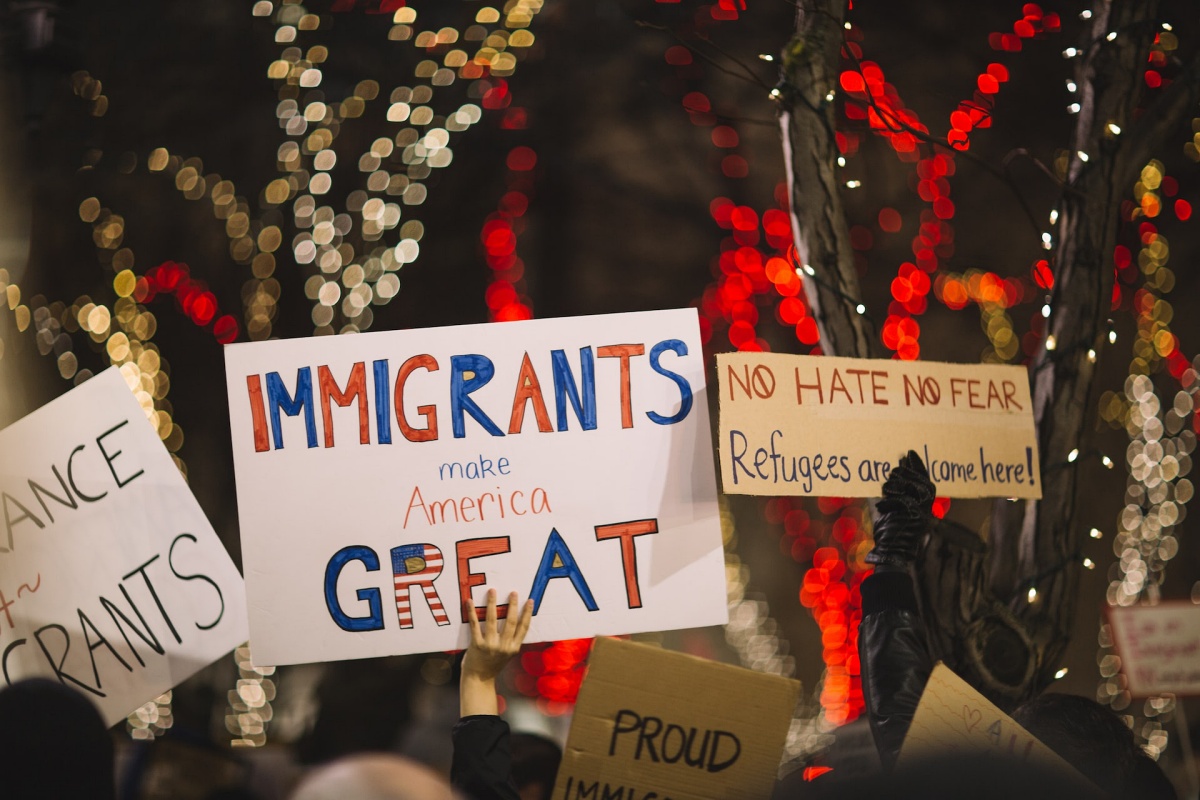
Prior to the Trump administration’s removal in 2018 of the words describing the U.S. as "a nation of immigrants," the United States Citizenship and Immigration Services included them in their mission statement. Those same words were the title of a 1958 essay later expanded into a book by Senator (later President) John Kennedy (JFK). And in his farewell address to the nation (January 2025) President Biden used the phrase. Except for the Native American “Indians”—most of whom we wiped out—almost all of us are immigrants or the descendants of immigrants—or in the case of most Black Americans descendants of slaves.
In JFK’s A Nation of Immigrants, he provides some approximate immigration numbers (as of some sixty years ago). Overall the book estimates that “more than 42 million immigrants have come to our shores” since 1776; from Great Britain and Ireland over 4 and a half million each; from Germany about 6.8 million; from the Russian Empire/USSR about 3.3 million, some “40 percent of them Jews” (See here for Hitler’s policies contributing to a fortuitous U. S. increase of prominent Jews); from Austria-Hungary and later each of the two parts of that former empire, about 4.3 million; from Scandinavia about 2.5 million, and from Italy about 5 million. Various other countries such as France, Poland, China, Japan, and Greece each contributed well less than one million each.
Updating the immigration numbers from JFK’s day, we witness these numbers (as of 2020): overall, about “50.6 million people in the United States—a bit more than 15% of the total population of 331.4 million—were born in a foreign country. The number of immigrants in the U.S. has increased by at least 400% since 1965. The population of immigrants in the United States is incredibly diverse, with nearly every country in the world represented among U.S. immigrants. Mexico is the leading origin country for U.S. immigrants, accounting for more than 11 million, roughly 25%, of all immigrants in the United States.”
If it seems that there was an immigration ethnic bias prior to JFK’s presidency, there was. During the few decades both before and after 1900, more darker skinned peoples from southern and eastern Europe began arriving in greater numbers, and nativist sentiments against them increased, as it did against Asians. In 1882 a Chinese Exclusion Act was enacted that provided a 10-year ban on Chinese laborers immigrating to the United States. In 1924, Congress passed the Immigration Act, containing an Asian Exclusion Act, almost banning Asian immigrants, and a National Origins Act, limiting European immigrants but favoring those from northern Europe. As Jill Lepore has written, the purpose of these new laws “was to end immigration from Asia and to curb the admission of southern and eastern Europeans, deemed less worthy than immigrants from other parts of Europe.”
Flash forward about a century and President Trump reflects a similar bias. Witness his 2018 remark, "Haiti? Why do we want people from Haiti [and Africa] here? Why do we want these people from all these shithole countries here? We should have more people from places like Norway."
But at least from the days of abolitionist Frederick Douglass (1818-1895) there have been those who opposed such thinking. As early as 1867, he declared that he would favor Chinese immigration and invest them “with all the rights of American citizenship.” Historian Lepore has commented that Douglass’s idea about “a citizenry made better, and stronger, not in spite of its many elements, but because of them” was “a strikingly original and generative idea.”
JFK’s A Nation of Immigrants, states that “the contribution of immigrants can be seen in every aspect of our national life. We see it in religion, in politics, in business, in the arts, in education, even in athletics and entertainment. There is no part of our nation that has not been touched by our immigrant background. Everywhere immigrants have enriched and strengthened the fabric of American life.’’
In 1965 JFK’s successor, Lyndon Johnson, signed The Immigration and Nationality Act, which “abolished quotas, opening the doors to ‘those who can contribute most to this country—to its growth, to its strength, to its spirit.’” It “focused on immigrants' skills and family relations with citizens or U. S. residents.” (As a result of the Act, “family reunification” soon became the dominant form of legal migration to the USA.)
In 1981, even the conservative President Reagan issued a “Statement on United States Immigration and Refugee Policy.” He began it by saying, “Our nation is a nation of immigrants. More than any other country, our strength comes from our own immigrant heritage and our capacity to welcome those from other lands.” And in 1986, he signed legislation that granted a pathway to citizenship to almost 3 million undocumented immigrants.
For a variety of reasons, one of the most dominant being the complexity of the issue (and it is complex and would require compromises), not much was done, positive or negative, in succeeding decades. But Trump advanced the question to near the front of political issues. In mid 2015, when announcing his presidential campaign, he said, “When Mexico sends its people, they’re not sending their best. . . . They’re sending people that have lots of problems, and they’re bringing those problems with us. They’re bringing drugs. They’re bringing crime. They’re rapists.”
By 2018, with Trump as president and when a new edition of JFK’s A Nation of Immigrants appeared with a Introduction from Joe Kennedy III (JFK’s grandnephew), the young man wrote about how he was hearing similar anti-immigrant voices as JFK wrote about: “Immigrants will flood our cities and towns. They will take our jobs. They will threaten our culture. They aren’t from here. They aren’t like us.”
And he mentioned that immigrants “showed up at our border terrorized, desperate, and afraid. And in an act of unimaginable brutality, our government responded with terror of its own—taking infants and toddlers out of their families’ arms. This is the human wreckage of American immigration policy. This is the trauma and torture that dark forces of nativism, supremacy, and prejudice have brought to bear in a land that staked its name on brighter, better things: equality, dignity and freedom.
In early 2024, after being defeated in a presidential run in 2020, Trump discouraged a possible bipartisan Congressional compromise—more favorable to Republican immigration concerns than Democratic ones—because he thought he could benefit more from a “no deal” in his ongoing campaign for a return to the White House.
The day after the 2024 presidential election the Marshall Project ran a piece entitled “Trump’s Immigration Lies Paid Off at the Polls.” It declared, “As Trump made thousands of false statements connecting unauthorized migrants to crime and other social problems, polls showed growing support among voters for reducing immigration.” (See here for Trump’s addiction to lying.) Trump’s politics of fear had worked, had gotten him reelected.
But as various other leaders have argued, that type of politics is no way to lead. In her book Leadership: In Turbulent Times Doris Kearns Goodwin argues that the four presidents she focuses on—Lincoln, both Roosevelts, and Lyndon Johnson—were “at their formidable best, when guided by a sense of moral purpose, they were able to channel their ambitions and summon their talents to enlarge the opportunities and lives of others.” No wonder that various polls reflecting the views of scholars about the success or lack thereof of our various presidents rank Trump near the bottom.
Less than a year ago, I wrote about the six dead or presumed dead migrant workers killed when a ship crashed into a support pillar of Baltimore's Francis Scott Key Bridge, sending the workers into the icy river below. And I indicated that none of the six men matched Trump’s 2015 words about many coming across our southern border being “criminals, drug dealers, rapists, etc.” Closer to the truth, I added, would be words that reflected that they “were like millions of immigrants before them, seeking the American dream and willing to work hard at jobs many native-born citizens do not want in order to achieve it.”
Also closer to the truth would be historian Lepore’s words about Douglass’s thoughts on immigration, that we could become a “citizenry made better, and stronger, not in spite of its many elements, but because of them.”
Comments

Powered by RoundtableAn AI/DeFi-powered Enterprise Media Operating System. Learn more at Roundtable.io.© Roundtable 2026. By using this site you agree to the Terms of Use and Privacy Policy