
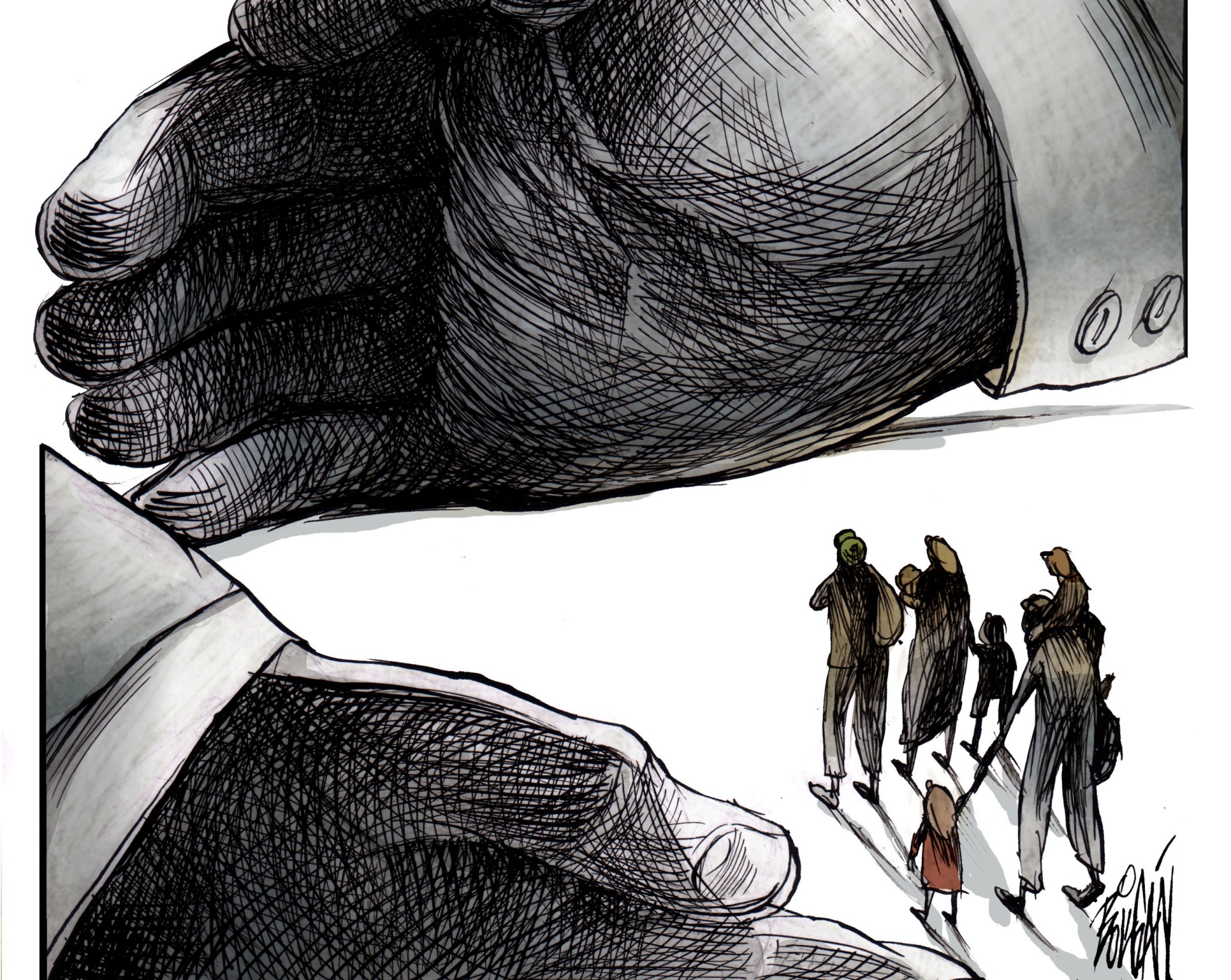
Illustration by Angel Boligan on Cagle Cartoons


Regional drivers of migration must be dealt with in the coming years. But the US will only have a workable system when it uproots its recurring problem of nativism.
Sep 6, 2024 3:28 AM
Regional drivers of migration must be dealt with in the coming years. But the US will only have a workable system when it uproots its recurring problem of nativism.
For generations, millions of poor immigrants flowed through American ports and across boundaries without needing to show a passport or visa. They came from Ireland, Russia, Italy and other lands. The clearance process at Ellis Island took only a few hours.
The gates to New World were slammed shut, or nearly so, when Congress passed the US Immigration Act of 1924. The law set quotas based on national origin, which reduced immigration from eastern and southern Europe and halted it from Asia.
The measure also established a federal administrative system for enforcing quotas. A couple of days after President Calvin Coolidge signed it, the US Border Patrol was established to prevent Europe’s tired and poor from entering through a side door, by way of the Mexican border.
Amid other Roaring Twenties factors like the Ku Klux Klan and Ivy League admissions limits on Jews, the belief that the genetic makeup of a nation’s population could be improved underlay Congress’s approval of the immigration act, along with the post-WWI mood of isolationism.
Related stories
Known as eugenics, later embraced by Adolf Hitler, this pseudoscientific belief resonated among America’s predominantly Protestant ruling elite, who fretted about poverty-stricken foreigners, particularly the multitudes of Yiddish speakers from Eastern Europe and Roman Catholics from Italy filling New York and other cities.
Amid the Democratic convention in Chicago, questions of immigration enforcement and border patrols still lay at the heart of one of the biggest issues in the Trump-Harris race. And fear mongering as if from 100 years ago can be heard in both major parties but especially from Donald Trump.
Though his first and third wives were Eastern European immigrants, the GOP nominee claims that undocumented aliens (who, notes former Democratic labor secretary Robert Reich, actually paid $97 billion in local, state, and federal taxes in 2022) are “poisoning the blood of our country.”
Since 2022, more than 28,000 migrant asylum seekers sent by Texas have ended up in New Jersey, stirring some notes of acceptance. But Trump’s racial vehemence registers at higher decibels, echoing U.S. Rep. Albert Johnson (R-WA), cosponsor with Sen. David Reed (R-PA) of the 1924 Immigration Act, who decried the “stream of alien blood” pulsing through American life. Like others, Johnson was influenced by prominent early 20th century nativist Madison Grant, who wrote The Passing of the White Race, a manifesto asserting immigration was the cause of crime, corruption, and genetic contamination.
Given the economic benefits that derive from immigration, it was no accident that Mexicans were untouched by the so-called “Johnson-Reed Act”—farming interests could continue using their cheap labor. If a migrant farm hand misbehaved, the US Border Patrol had in its ranks the former members of the notoriously unaccountable Texas Rangers, a patrol headed as of 1950 by Harlon Bronson Carter, a future NRA leader freed on a technicality after his conviction in 1931 for shooting to death a Mexican youth.
Employers’ use of unauthorized Mexicans in California and Texas “was winked at because of the great need,” Bill O’Dwyer, ex-New York City mayor after WWII, recalled of his service in the early 1950’s as US ambassador to Mexico. “And sometimes Immigration got active, arresting and herding the braceros” —seasonal agricultural workers from south of the border— “into camps to be carried across the frontier, where they were left to shift for themselves…[with] no attention to their housing, food, or health.”
Pressured by farmers and businessmen, President Dwight Eisenhower in 1954 launched Operation Wetback, allowing the Border Patrol for the first time to use military hardware to chase the Mexican-born back across the southern border, many of them U.S. citizens or already on the path toward naturalization. U.S. Attorney General Herbert Brownell argued that the targets were “displacing domestic workers, affecting work conditions, spreading disease, and contributing to crime rates.”
But Brownell’s claim was based on “loose thinking, senseless jargon and … pompous jumble,” to borrow the words of then-House member Emanuel Celler of New York when the sweeping Immigration Act of 1924 was debated in Congress.
Although in recent times Tucker Carlson, a modern Madison Grant, called for a return of Operation Wetback on a national scale, the urge for such a crackdown abated after the Eisenhower years. There was the signing of a superseding immigration act by Lyndon Johnson in 1965, which hastened America’s ethnic and cultural diversification, and there was another, in 1986, when Ronald Reagan approved amnesty for some 3 million undocumented arrivals.
Despite high levels of deportations under Democrats Barack Obama and Joe Biden, people still make the dangerous trek across the Mexican border to escape poverty, violence, extreme heat or, in Venezuela currently, social and political upheaval.
Regional drivers of migration must of course be dealt with in the coming years, no matter who ends up as the next president. But the US will only have a sensible and workable immigration system when it reckons with and uproots its recurring, now 100-year-old problem of nativism.
Comments

Powered by RoundtableAn AI/DeFi-powered Enterprise Media Operating System. Learn more at Roundtable.io.© Roundtable 2026. By using this site you agree to the Terms of Use and Privacy Policy