


Feb 5, 2025 4:59 PM
Updated Feb 10, 2025 12:54 AM
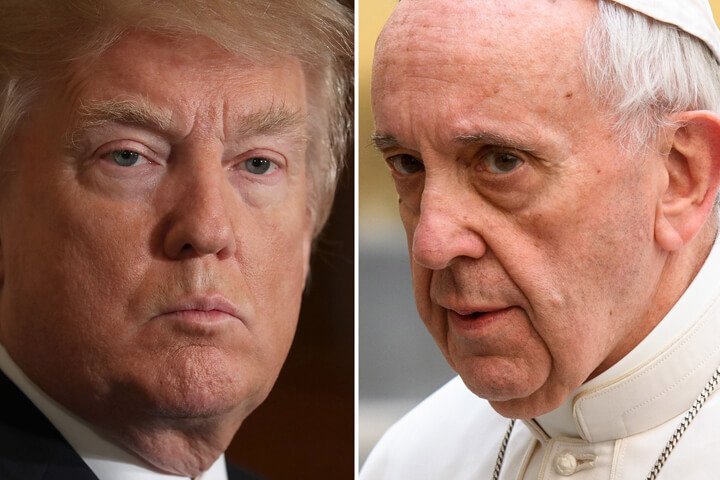
The support of a majority of U.S. Catholics for Trump indicate that many Catholics are more inclined to support our new president than take seriously their pope’s warnings.
President Donald Trump has the overwhelming support of most Evangelical Christians, and in the 2024 election he even gained a 20 percentage point majority among Catholics in the presidential vote. But the head of the Catholic Church, Pope Francis, has sharply criticized Trump’s policies and plans on at least two issues—climate change and immigration. Regarding the pope’s first criticism I’ve already written, so here we’ll concentrate on the second, especially his very recent comment that Trump’s plan to mass deport undocumented immigrants was a “disgrace.” That remark was made in a television interview the day before Trump’s 2025 inauguration.
The immigration differences between Trump and Pope Francis (the son of immigrants to Argentina himself) are nothing new. In 2016 the pope implicitly criticized the then-candidate Trump by saying “A person who thinks only about building walls . . . and not building bridges, is not Christian. This is not in the Gospel."
In September 2019, on the Catholic Church’s 105th World Day of Migrants and Refugees, the pope introduced on the Vatican’s St. Peter’s Square a 20-foot-tall bronze sculpture depicting 140 migrants and refugees from different historical periods. They included Jews fleeing from Nazi Germany and, more recently, Syrians and Africans fleeing from war, poverty, and famine. And he also preached a sermon.
In it, Francis said that “wars only affect some regions of the world, yet weapons of war are produced and sold in other regions that are then unwilling to take in the refugees produced by these conflicts. Those who pay the price are always the little ones, the poor, the most vulnerable... Our response to the challenges posed by contemporary migration can be summed up in four verbs: welcome, protect, promote, and integrate. . . . If we put those four verbs into practice, we will help build the city of God and man. We will promote the integral human development of all people. We will also help the world community to come closer to the goals of sustainable development that it has set for itself and that, lacking such an approach, will prove difficult to achieve.”
Related stories
The following year (2020), in his encyclical “Fratelli Tutti: On Fraternity and Social Friendship,” Francis acknowledged that “ideally, unnecessary migration ought to be avoided” and that richer countries ought to help enable poorer ones to provide a “dignified life” for all their citizens. But until such improved conditions came into being, Francis thought that better-off nations were “obliged to respect the right of all individuals to find a place that meets their basic needs and those of their families, and where they can find personal fulfilment.”
To that end, he provided examples of policies governments accepting migrants and refugees should enact or oversee, including providing paths to “full citizenship”:
Increasing and simplifying the granting of visas; adopting programmes of individual and community sponsorship; opening humanitarian corridors for the most vulnerable refugees; providing suitable and dignified housing; guaranteeing personal security and access to basic services; ensuring adequate consular assistance and the right to retain personal identity documents; equitable access to the justice system; the possibility of opening bank accounts and the guarantee of the minimum needed to survive; freedom of movement and the possibility of employment; protecting minors and ensuring their regular access to education; providing for programmes of temporary guardianship or shelter; guaranteeing religious freedom; promoting integration into society; supporting the reuniting of families; and preparing local communities for the process of integration.
Not only would such policies help newcomers from other lands, but the pope emphasized that “the arrival of those who are different, coming from other ways of life and cultures, can be a gift” to the countries that accept them. While realizing that preserving differing cultures is important and valuable—“a country that moves forward while remaining solidly grounded in its original cultural substratum is a treasure for the whole of humanity”—Francis also insisted that “cultures should be encouraged to be open to new experiences through their encounter with other realities, for the risk of succumbing to cultural sclerosis is always present.” Like John Kennedy (JFK, later our first Catholic president) in his 1958 book A Nation of Immigrants, Francis has long believed that immigrants can enrich and strengthen the country to which they come.
Shortly before his 2025 “disgrace” comments, Francis had indicated that his commitment to immigration had not wavered since his 2020 encyclical. For in early January 2025, he named a strong supporter of immigrant rights to be the next Catholic archbishop of Washington, DC—Cardinal Robert W. McElroy, previously bishop of San Diego. The cardinal, who possesses a doctorate from Stanford University in political science, almost immediately rejected Trump’s immigration proposals, stating that proposals for a “wider, indiscriminate, massive deportation across the country” would be “incompatible with Catholic doctrine.”
By the time of the cardinal’s remarks, Trump had made it clear that such plans were exactly what he had in mind. Already in 2015, while campaigning for the presidency, he had railed against illegal immigrants, declaring that the Mexican government was forcing their most unwanted people into the United States, e.g., “criminals, drug dealers, rapists, etc.” In 2018, as president, he stated, “Haiti? Why do we want people from Haiti [and Africa] here? Why do we want these people from all these shithole countries here? We should have more people from places like Norway.”
In the second half of that year and throughout 2019, some 5,500 children of parents trying to enter the USA illegally were separated from their parents, many of whom were then deported without their children.
About six weeks before his second term was about to begin, Trump outlined his updated immigration plans to NBC’s Kristen Welker. He began by saying, “We’re going to do something with the border, very strong, very powerful. That’ll be our first signal—first signal to America that we’re not playing games. We have people coming in by the millions, as you know, and a lot of people shouldn’t be here. Most of them shouldn’t be here. But we have jails being emptied into our country. We have mental institutions from all over the world being emptied into our country.”
As the interview continued, Trump spoke like he frequently does, resorting to untruths—as the 2020 book Donald Trump and His Assault on Truth: The President's Falsehoods, Misleading Claims and Flat-Out Lies stated, “Donald Trump, the most mendacious president in U.S. history . . . . [is] not known for one big lie—just a constant stream of exaggerated, invented, boastful, purposely outrageous, spiteful, inconsistent, dubious, and false claims.” Among new falsehoods was his claim that among illegal immigrants there were “13,099 murderers released into our country over the last three years. They’re walking down the streets. They’re walking next to you and your family. And they’re very dangerous people.”
Another false claim was that Venezuelan gangs, “the worst in the world,” were in Colorado “taking over apartment complexes and doing it with impunity.” When Welker challenged him with the “local police say that is not the case in Colorado,” he responded with, “Oh, it’s totally the case.” (At least in the Welker interview, he didn’t repeat the trumped-up claim he had made during the presidential debate in September—one later amplified by Vice President-elect JD Vance—that in Springfield, Ohio illegal Haitian immigrants were eating local dogs, cats and other pets.)
When asked if he planned to deport everyone who had come to the USA illegally, he responded, “I think you have to do it.” In the first few days of his new presidency, Trump issued a slew of orders aimed at proceeding with just that—mass deportations. Fortunately, Marjorie Cohn, in her “Trump’s Overwhelming Blitz on Immigration,” has summarized these orders, so that they need not be detailed here. She also indicated that a U.S. District Court judge had “temporarily blocked Trump’s order [to eliminate birthright citizenship], calling it ‘blatantly unconstitutional.”’
There is little doubt that many of Trump’s other immigration orders will be challenged in the courts, but whether the judicial system as a whole—including the Supreme Court—remains faithful to the constitution or displays an absence of backbone is yet to be determined. (An article on the Salon website recently declared that “experts warn that whether judges choose to buy into the Trump administration's view of history comes down to whether ‘conservatives take history and tradition seriously’ and what wins judges want to give the new administration.”)
But another possible impediment to Trump’s deportation plans is the sheer magnitude of it. According to the American Immigration Council, there were “roughly 11 million people who as of 2022 lacked permanent legal status and faced the possibility of removal.” In addition, in 2023 and early 2024, there were “2.3 million people who have crossed the U.S. southern border without legal immigration status” but who remained in the U.S.
That same council estimates that a “total of . . . at least $315 billion”—“a highly conservative estimate”—is what it would cost to deport the number of undocumented immigrants suggested by Trump. In her interview with Trump, Welker hints at the problem when she states, “You [would] need 24 times more ICE detention capacity just to deport 1 million people per year, not to mention more agents, more judges, more planes. Is it realistic to deport everyone who’s here illegally?”
Moreover, as I indicated in an essay of April 2024, rather than many coming across our southern border being, as Trump once said, “criminals, drug dealers, rapists, etc.,” the following would be closer to the truth: “Many are seeking the American dream and willing to work hard at jobs many native-born citizens do not want in order to achieve it.” Like JFK and Pope Francis indicated, immigrants are more likely to enrich our country than degrade it.
In his “disgrace” comments, the pope also added that Trump’s immigration deportation plans would be wrong “because it would make poor wretches, who have nothing, pay the price of the (world’s) inequality. That’s not right; this is not how you solve things.”
Yet the appointment of the Trump-supporting conservative Catholic Brian Burch to be the next U.S. ambassador to the Holy See does not bode well for any reconciliation of the pope’s views on immigration with those of Trump. The support of a majority of U.S. Catholics for Trump—and the criticism of Francis by Catholics like New York Times conservative columnist Ross Douthat—indicate that many Catholics are more inclined to support our new president than take seriously their pope’s warnings about such matters as immigration and climate-change policies.
This inclination reminds me of the subtitle of Rick Shenkman’s 2016 book—Political Animals: How Our Stone-Age Brain Gets in the Way of Smart Politics.
Comments

Powered by RoundtableAn AI/DeFi-powered Enterprise Media Operating System. Learn more at Roundtable.io.© Roundtable 2026. By using this site you agree to the Terms of Use and Privacy Policy