
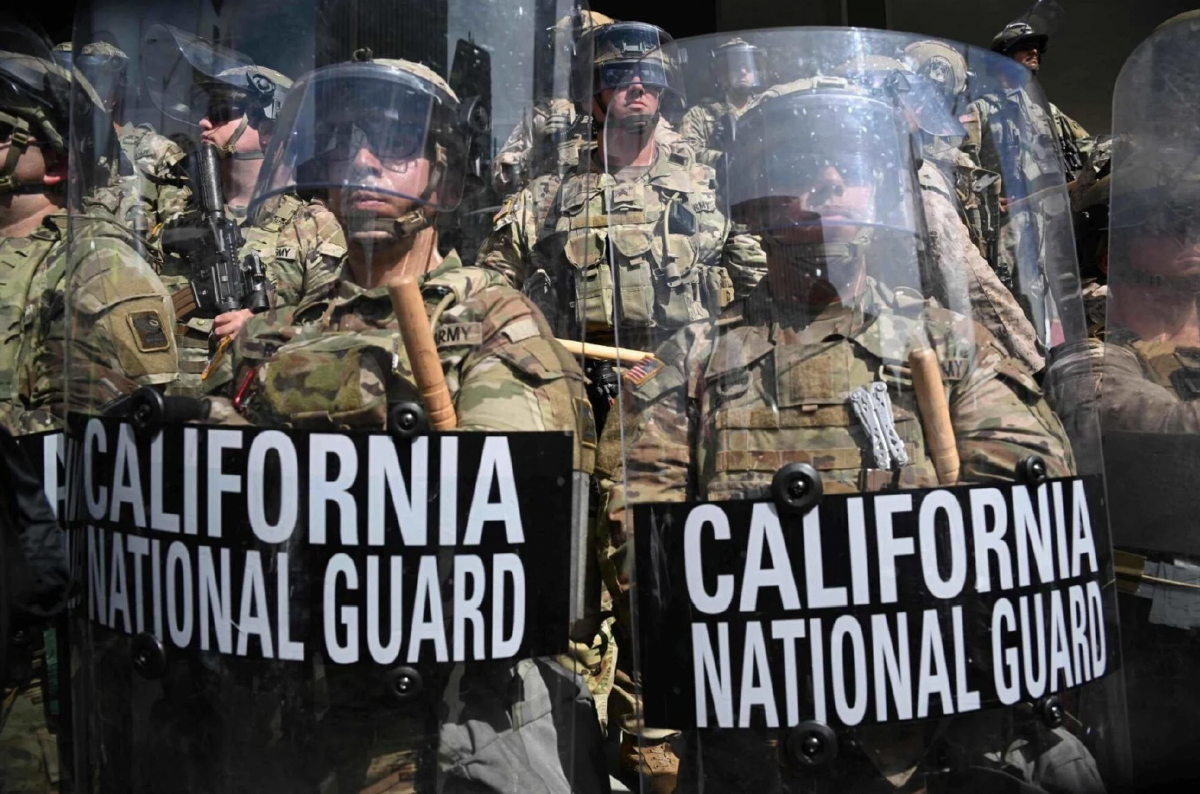
Keith Birmingham/Orange County Register file photo


Oct 29, 2025 4:32 PM
The more a society glorifies its military, the less it invests in the institutions that make peace possible: education, health care, housing and the arts.
When Prime Minister Mark Carney recently called for Canada to increase its defence spending to meet NATO targets, his remarks were framed as pragmatic.
A responsible nation, we are told, must modernize its military, project strength andshoulder its share of global responsibility. But beneath this rhetoric of prudence lies a dangerous illusion, one that echoes the authoritarian drift of the United States, where glorification of military power and rise of a war culture have merged with a politics of lawlessness to hollow out democracy from within.
In the United States, authoritarianism has not arrived with marching boots alone; it has taken shape through a politics of fear, cruelty and vengeance, rather than reason or justice. The state’s moral authority has collapsed into the spectacle of organized violence, police assaulting citizens, political opponents targeted through weaponized law, and the military recast as the last bastion of national virtue. The rhetoric of “law and order” now masks criminal rule, transforming legality into repression and turning justice into its opposite.
Canada should look southward not as a model of security but as a warning. When the machinery of state violence becomes normalized, when “strength” becomes the only language of politics, law itself becomes hostage to power and civil liberties and democratic culture fade away.
Related stories
Carney’s proposal, though couched in the technocratic language of fiscal responsibility, risks reproducing this moral inversion. It recasts democracy as a ledger of weapons systems and GDP ratios rather than a living practice of justice and care. That logic of “security through force,” already visible in Canada itself, manifests in Ontario’s proposed Bill 33, which would expand police presence in schools under the guise of safety, revealing how the language of law and order now serves as a Trojan horse for militarizing public spaces and shaping young people through fear rather than civic trust.
It is a disturbing echo of the U.S. pattern, where policing and punishment replace pedagogy, trust and care. Canada’s real deficit is not military, but moral: a failure of imagination about what genuine security means in an age of planetary crisis, staggering inequality and the degradation of civil society.
The glorification of the military as the ultimate measure of national virtue is part ofa broader cultural pedagogy. It teaches citizens to conflate violence with strengthand obedience with patriotism. In the United States, this pedagogy replaces democratic idealism with a celebration of military force. Increasingly, that same logic now seeps quietly into Canadian public life through the language of “readiness,” “deterrence” and “national unity.” Yet the more a society glorifies its military, the less it invests in the institutions that make peace possible: education, health care, housing and the arts.
If this logic takes root unchecked, Canada risks trading civic imagination formilitarized conformity and obedience as the ultimate measure of citizenship.
Canada must refuse this trajectory. It must resist the seductive logic that equatesvirtue with violence and credibility with combat readiness. To follow Washington’s path is to accept the militarization of everyday life, the normalization of surveillance and the corrosion of civic trust. Already, the vocabulary of “security” dominates our political imagination, while the language of justice, equality and compassion is pushed to the margins. Democracy cannot survive when fearbecomes its organizing principle.
What Canada needs is not a new arsenal, but a new democratic imagination, one that builds the social foundations of freedom: equitable schools, a free press, care for the earth and diplomacy rooted in solidarity, not domination.
Carney is right to worry about Canada’s place in a dangerous world, but wrong to think more weapons will make it safer. The danger we face is not only external aggression but internal decay, the slow, quiet transformation of democracy into a security state. To guard against that fate, Canada must reject the war culture that now defines American life and reaffirm the principle that the health of a democracy is measured not by its capacity to wage war, but by its courage to imagine justice,
Comments

Powered by RoundtableAn AI/DeFi-powered Enterprise Media Operating System. Learn more at Roundtable.io.© Roundtable 2026. By using this site you agree to the Terms of Use and Privacy Policy