


May 9, 2026 5:12 PM
Updated May 17, 2026 9:48 PM
The seeds of resistance that were planted in southern soil were saturated with the blood, sweat and tears of Mary Reynolds and all others who were enslaved.
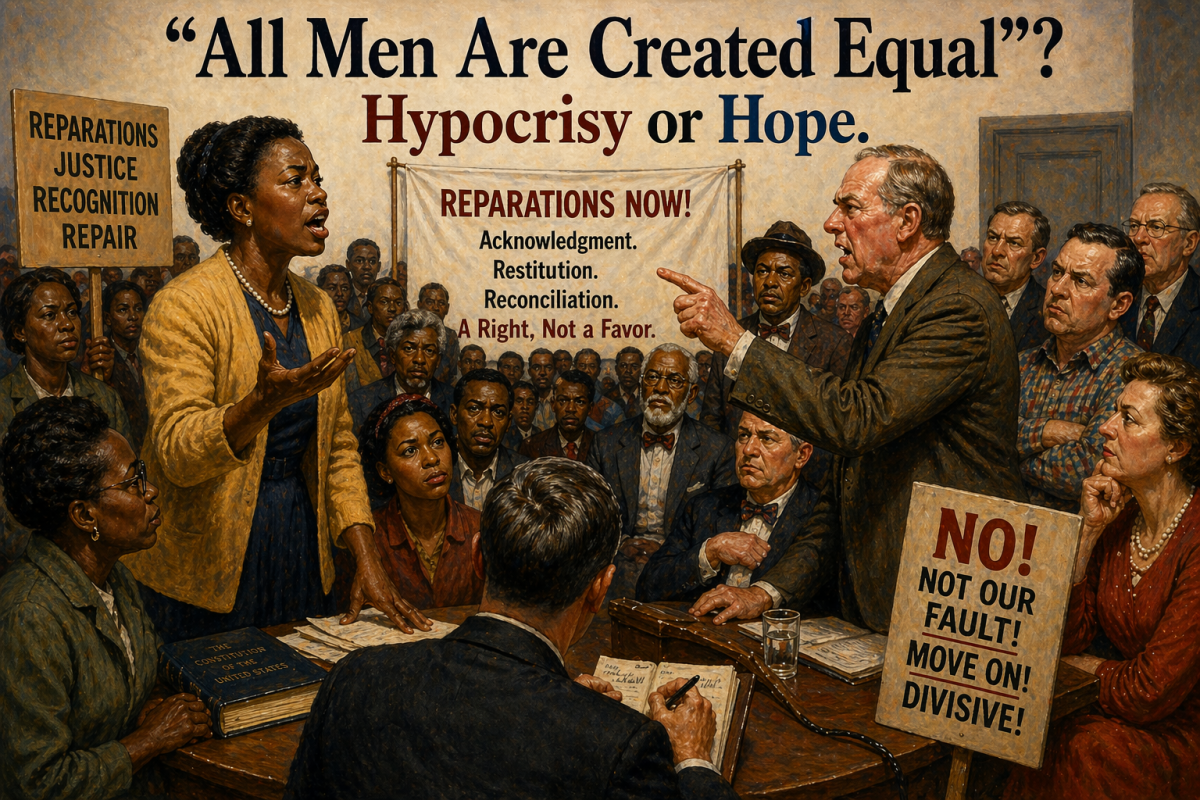
“All Men Are Created Equal”? Hypocrisy or Hope Series
Right-wing forces may try to purge evidence of this country’s most horrible sins from school curricula, museums and libraries, but the ancestors of the oppressed refuse to be silenced. They whisper uncomfortable truths that are echoed in the harsh reality lived by their descendants. If you listen carefully, you cannot only hear but feel the pain of ancestors like Mary Reynolds, a formerly enslaved woman who, as she pondered her life said:
“Slavery was the worst days ever seen in the world. I got the scars from beatings on my old body to show to this day. I saw worse than what happened to me. I saw them put the men and women in the stock with their hands screwed down through holes in the board and their feet tied together. Solomon the overseer beat them with a big whip and master looked on. The slaves better not stop in the fields when they hear them yelling. The conch shell blew before daylight and all hands better get out for roll call or Solomon bust the door down and get them out. It was work hard, get beatings and half fed. They brought the food and water to the fields on a slide pulled by an old mule. Plenty of times there was only a half barrel water and it was stale and hot, for all of us on the hottest days. Mostly we ate pickled pork and corn bread and peas and beans and potatoes. There never was as much as we needed. The times I hated most was picking cotton when the frost was on the bolls. My hands would get sore and crack open and bleed. We prayed for the end of beatings and for shoes that fit our feet. We prayed that we could have all we wanted to eat and especially for fresh meat. What I hated most was when they’d beat me and I didn’t know what they beat me for.”
The seeds of resistance that were planted in southern soil were saturated with the blood, sweat and tears of Mary Reynolds and all others who were enslaved. As those seeds began to germinate, they yielded a glorious history of struggle. It is this aspect of life in America that must be honored on its 250th anniversary rather than the myths of gallant, square-jawed white men who “tamed” a wild frontier. The historical facts about what such men did cannot be denied when even the country’s official records contain damning accounts like the Congressional testimony of John S. Smith regarding the Sand Creek Massacre of 1864 that resulted in the deaths of more than 500 Cheyenne and Arapaho:
Related stories
Question. Were the women and children slaughtered indiscriminately, or only so far as they were with the warriors?
Answer. Indiscriminately.
Question. Were there any acts of barbarity perpetrated there that came under your own observation?
Answer. Yes, sir; I saw the bodies of those lying there cut all to pieces, worse mutilated than any I ever saw before; the women cut all to pieces.
Question. How cut?
Answer. With knives; scalped; their brains knocked out; children two or three months old; all ages lying there, from sucking infants up to warriors.
Question. Did you see it done?
Answer. Yes, sir; I saw them fall.
Question. Fall when they were killed?
Answer. Yes, sir.
Question. Did you see them when they were mutilated?
Answer. Yes, sir.
Question. By whom were they mutilated?
Answer. By the United States troops.
The lies the U.S. tells about itself and that have been repeated ad nauseum for generations, have been a coping mechanism. They have been necessary for the consolation of a tortured national soul that thrashes about wildly in a diseased carcass that drifts inexorably toward national spiritual death. The ember of hope that smolders within the country burns only because of a semblance of a conscience that resists suppression. America’s original sins have likewise been repeatedly forcibly suppressed, but because of the ember of conscience and the resistance of the oppressed, they unexpectedly bounce back to the surface like a beach ball suddenly released by a submerged swimming child. Enormous efforts have been made to deny, dismiss, ignore and falsify the sinful history of the U.S. Yet, the country continues to writhe in spiritual agony. Worse still, the nation doesn’t know why. Like pretty much everything, the answer is found in the good book. Leviticus says:
“The Lord said to Moses: ‘If anyone sins and is unfaithful to the Lord by deceiving a neighbor about something entrusted to them or left in their care or about something stolen, or if they cheat their neighbor, or if they find lost property and lie about it, or if they swear falsely about any such sin that people may commit— when they sin in any of these ways and realize their guilt, they must return what they have stolen or taken by extortion, or what was entrusted to them, or the lost property they found, or whatever it was they swore falsely about. They must make restitution in full, add a fifth of the value to it and give it all to the owner on the day they present their guilt offering.’”
The U.S. has stolen a lot – territory, human beings, labor, natural resources, and even basic human dignity. The sin of the larceny has been compounded by care-free enjoyment of it not only by the thieves, but also by their descendants who, not convincingly protest: “I can’t be responsible for the sins of my ancestors.” Oh, but they can, and they must, if ever their souls are to be at peace.
In First Century Palestine, those who collected purported taxes on behalf of the Roman Empire were essentially extortionists who not only unjustifiably took money from the poor for Rome but who also demanded additional amounts that they pocketed for themselves. Jesus’ engagement with one of these criminals named Zacchaeus inspired him to proclaim: “Look, Lord! Here and now I give half of my possessions to the poor, and if I have cheated anybody out of anything, I will pay back four times the amount.” Imagine the tremendous emotional and spiritual burden that was removed from this man. The U.S. can experience the same type of spiritual liberation if ever it can summon the courage to not only return that which it has taken, but to also make whole those who have been wounded.
Inevitably, musings of this kind are interrupted by those who insist that restitution and reparations are “impractical.” They ask rhetorically: “What? Do you expect that we will give all the land back to the Indians, including everything we built up? And what about the Africans? Should we bankrupt the U.S. treasury to pay for the uncompensated labor of their ancestors and the discrimination experienced by their descendants?” The answer is a resounding YES! And to that, the immediate response of the skeptics and cynics is: “Well that’s just preposterous!”
In the minds of many, the necessary remedy for the country’s spiritual misery is preposterous primarily because if it is effected, it will mean that many will be inconvenienced, or even have their lives turned upside down. Many believe this is outrageous because not only have the affected individuals not personally engaged in any of the historical crimes in question, but many also abhor the sins of their ancestors and are confident that they would not personally have committed such acts if they had lived in years past. In sum, they believe they are innocent.
Whether the beneficiaries of historical crimes who do nothing to redress those offenses are “innocent” is a debatable proposition. But if it is assumed for the sake of discussion that they are guilt-free, where do they stand relative to the historical victims? The victims were innocent in the truest sense of the word. Africans never asked to be kidnapped and enslaved. The First Nations never asked to be targeted for territorial theft and genocide. Their fate went far beyond inconvenience. Life as they knew it changed completely. As just one example, in 1838, pursuant to the Indian Removal Act, the Cherokee, which had maintained a well-established, highly advanced nation in North Carolina for as long as anyone could recall, were forced to relocate cross-country. National Geographic described their ordeal:
“Confined in stockades through the summer of 1838, the Cherokee grew weaker and began falling victim to diseases, such as dysentery. Their forced march, the Trail of Tears, began in October under the watch of armed troops. They marched, poorly equipped, alongside caravans of wagons, for more than four months, through blizzards and bitter winter weather. Their varying routes covered 1,609 kilometers (1,000 miles) or so, traversing parts of Tennessee, Kentucky, Illinois, Missouri, and Arkansas. Others traveled over water along the Tennessee, Ohio, Mississippi, and Arkansas rivers, until they reached the eastern edge of present-day Oklahoma. At every stop along the trail, funerals and burials were held. The death toll from the internment camps, the migration, and its aftermath topped 4,000, out of a population of more than 16,000. They died of exposure to the elements, malnutrition, various diseases, and sheer physical exhaustion.”
When considered in the most frank and honest terms, resistance to the necessary remedy for these historical crimes amounts to an ugly manifestation of white privilege. It is to say: “It’s too bad that vast numbers of innocent people had their lives and entire civilizations destroyed, but I am enjoying the benefits of those horrible crimes, and if making things right requires me to surrender the life I have come to love, then that’s too high a price. Deprivation, suffering, and forced relocation are reserved for oppressed people of color from long ago who I neither encounter nor ponder. It’s certainly not the sort of experience that white people in this era should have to endure.”
Therein is the tragedy. While there is a perception that the remedy for the country’s original sins will be an intolerable burden, in truth it would be a welcome blessing. That’s because although the country routinely celebrates the founding fathers and the founding documents, there is also a grudging acknowledgment by those in learned circles that the founders and the products of their work were deficient in significant ways. Making whole the indigenous and African-descended communities would force not simply the dissolution of the country, but in a real way a re-boot of the U.S. entity. To start over need not involve a mere replication of what we have. It could be a new and reimagined nation sans the historical baggage that inhibits the realization of the country’s full potential.
When the founders assembled 250 years ago, they were likely excited by the prospect of creating a nation superior to any they had seen. It would be no less exciting to take another swing at nation building, but this time, to center the populations that were the victims of the last experiment. The process would necessarily begin with inquiries about whether indigenous populations are even on board with the idea of other communities remaining in this hemisphere, and if so, on what terms. It is after all indigenous peoples’ land, and it is imperative to consider what must be done to ensure that their role as lords of this hemisphere is protected. There must be inquiries as well into the safeguards needed to prevent the domination and oppression of minority populations. There would be an opportunity to plan for not only political democracy, but economic democracy as well.
Celebrating the country’s 250th anniversary by making historically oppressed peoples whole, dissolving the nation and creating a new one that is racially, politically, economically and socially just is the panacea for all that ails the U.S. But as we know, the country will react to the idea in much the same way a small child resists taking bad-tasting medicine. Unfortunately, a spoonful of sugar can’t make the medicine for a spiritually sick nation go down easily. It’s a shame because while the founding fathers were clever, we’re much better prepared to craft a fair and just nation.
Comments

Powered by RoundtableAn AI/DeFi-powered Enterprise Media Operating System. Learn more at Roundtable.io.© Roundtable 2026. By using this site you agree to the Terms of Use and Privacy Policy