


Jul 1, 2026 3:57 PM
Updated Jul 3, 2026 12:43 AM
From Thomas Paine and Frederick Douglass to today’s independent press, courageous journalists have exposed tyranny and armed ordinary people with the truth needed to resist Trump and defend democracy.
From Thomas Paine and Frederick Douglass to today’s independent press, courageous journalists have exposed tyranny and armed ordinary people with the truth needed to resist Trump and defend democracy. More Videos
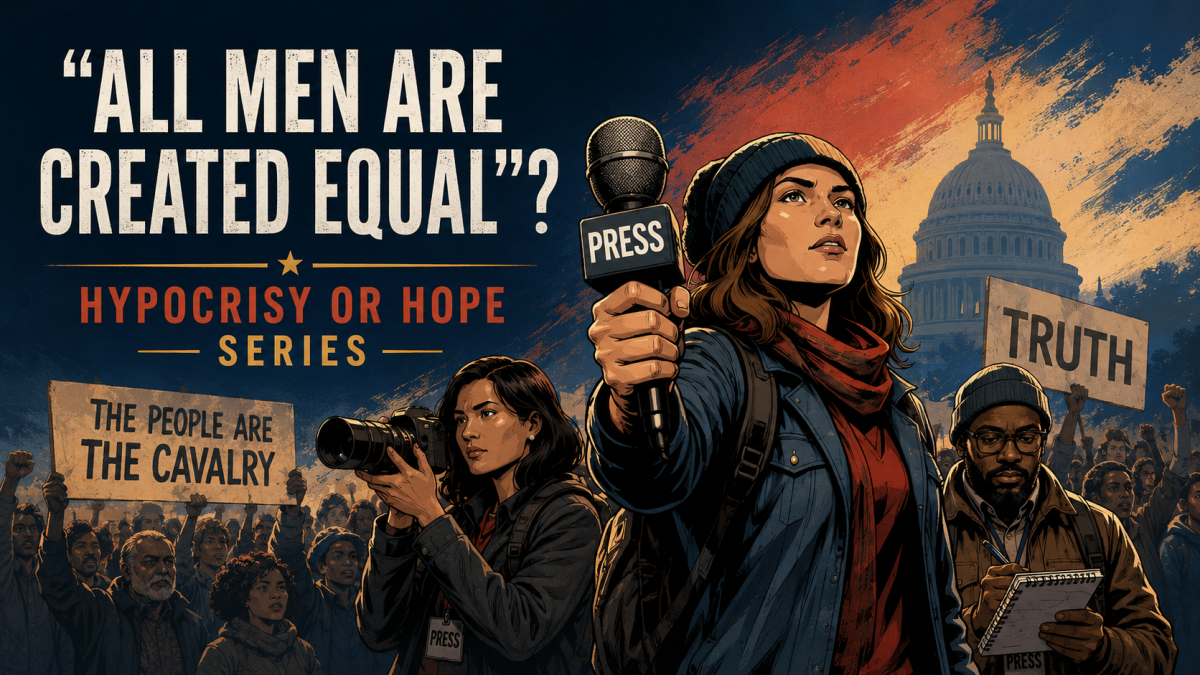
“All Men Are Created Equal”? Hypocrisy or Hope Series
As we enjoy the colorful fireworks on this Fourth of July, let’s remember the explosive political fireworks that brave revolutionary pamphleteers, writers, newspaper publishers, cartoonists, and other feisty purveyors of independent journalism have launched over the last 250 years. Today - and every day - we should celebrate their courageous voices amplifying the people’s tenacious struggle to oppose every tyrant we have faced from King George III to Donald Trump.
Persistently, and often at great risk, independent journalists have filled the void left by the weak, reticent, and compromised mainstream media who betray their solemn duty to serve as an open, and robust free press and instead, all too willing, serve as mouthpieces for the wealthy corporate interests funding, supporting, and electing the repressive forces in America.
On November 17, 1734, fifty-seven years before the First Amendment became part of the US Constitution, a 37-year-old German immigrant named John Peter Zenger was hard at work in his print shop in the colony of New York preparing to publish the latest issue of the New-York Weekly Journalwhen he was arrested. He was charged with the crime of libeling the colonial governor, William Cosby, and he was thrown in jail, where he would remain for 10 long months while awaiting trial.
Related stories
Zenger had been an apprentice for William Bradford, the first printer in New York, and briefly become Bradford’s partner publishing the New York Gazette. In 1725 Zenger set up his own print shop, and by 1731 he had published 21 books. In 1733, he was hired to print the New-York Weekly Journal, featuring anonymous articles written by critics of Governor Cosby, accusing him of rigging elections and committing other crimes.
Zenger’s trial began on August 4, 1735. He was represented by Andrew (not Alexander) Hamilton, a prominent colonial lawyer based in Philadelphia. The trial judge ruled that when someone is charged with seditious libel, truth is not a defense. Indeed, under prevailing English law, “The greater the truth, the greater the libel.” Seditious libel is one of the most nefarious ideas to ever plague freedom of speech and freedom of the press.
Faced with such a daunting challenge, Hamilton appealed to the jury’s sense of justice:
The question before the Court and you, Gentlemen of the jury, is not of small or private concern. It is not the cause of one poor printer, nor of New York alone, which you are now trying. No! It may in its consequence affect every free man that lives under a British government on the main of America. It is the best cause. It is the cause of liberty.
Unmoved, the judge instructed the jurors that the only question they had to decide was whether Zenger had published the New-York Weekly Journal. Despite the fact that he obviously had, the jury, after only brief deliberations, found Zenger “not guilty.” He was released from prison the next day. He returned to his printing business and published an account of his own trial, which was read throughout the colonies. When he died at the age of 48, his wife continued to publish the newspaper.
During the late 20th century an underground newspaper published in Madison, Wisconsin, was called Zenger. A ten-foot high limestone statue of Zenger is mounted on the brick wall of P.S. 18 in the Bronx in New York City. Today, Zenger News is a wire service owned and operated by working journalists dedicated to “independent journalism and the power of information.”
Zenger’s victory was only one verdict by one jury. It established no legal precedent. Nonetheless, it fed the growing spirit of independence and support for freedom of the press in America. In fact, one signer of the US Constitution would later write that the case of John Peter Zenger was “the germ of American freedom, the morning star of that liberty which subsequently revolutionized America.”
The revolutionary spirit we celebrate today was galvanized by English immigrant Thomas Paine, who arrived in Philadelphia in November 1774, He immediately went to work editing the Pennsylvania Magazine, and in short order he wrote a scathing condemnation of slavery. On January 10, 1776, he caused a sensation by publishing the 47-page pamphlet, “Common Sense.” Paine told his readers he was offering “nothing more than simple facts, plain arguments, and common sense.” He declared that the people “have every opportunity and every encouragement before us, to form the noblest, purest constitution on the face of the earth. We have it in our power to begin the world over again.” One historian has called it “the most incendiary and popular pamphlet of the entire revolutionary era.” It was read aloud in taverns and meeting halls throughout the colonies. Within a few months, by one account, he had sold more than 500,000 copies, making it America’s first bestseller.
In every era, dissatisfied with injustice and oppression, courageous men and women have used the power of the pen to begin the world over again.
Born into slavery around 1818 in Talbot, Maryland, Frederick Douglass escaped to freedom in September 1838. He became an outspoken abolitionist and in 1845 published his first autobiography. He went on to publish several abolitionist newspapers, including The North Star, Frederick Douglass Weekly, Frederick Douglass’ Paper, Douglass’ Monthly and New National Era. In 1849, Amelia Jenks Bloomer, a suffragist and temperance activist, began publishing The Lily, a newspaper for and by women.
In 1868, Elizabeth Cady Stanton and Susan B. Anthony began publishing The Revolutionnewspaper, with the motto “Men, their rights, and nothing more; women, their rights, and nothing less.” In 1912, Margaret Sanger published a controversial article “What Every Girl Should Know,” the magazine The Woman Rebel, the pamphlet Family Limitation, and the periodical The Birth Control Review. In 1889 Ida B. Wells-Barnett became editor and co-owner of the Memphis Free Speech and Headlight newspaper until it was destroyed by a White mob.
As the dark side of US industrialization spelled trouble for the poor and working class, the field of investigative journalism and muckracking emerged. In 1890, Jacob Riis used his writing and photojournalism in How the Other Half Lives to document the squalid living conditions of the urban poor in New York City's tenements. In 1904, Ida Tarbell wrote The History of the Standard Oil Company, exposing the ruthless and monopolistic business practices of John D. Rockefeller and declaring there “was born in me a hatred of privilege, privilege of any sort." That same year, Lincoln Steffens published The Shame of the Cities, revealing municipal corruption and political machines in cities like St. Louis and Minneapolis. In 1906, Upton Sinclair, who would later run for Governor on the End Poverty in California platform, wrote The Jungle, exposing the gruesome, unsanitary conditions of the meatpacking industry, leading to the passage of the Meat Inspection Act and the Pure Food and Drug Act.
I. F. Stone deserves special mention. Known for his radical and progressive views, Stone is best remembered for I. F. Stone's Weekly (1953–1971). His newsletter campaigned against McCarthyism and racial discrimination, and supported the Fair Play for Cuba Committee. In 1964, he was the only American journalist to challenge President Lyndon B. Johnson's account of the Gulf of Tonkin incident. In 1999, the New York University journalism department ranked I. F. Stone's Weekly 16th among the top hundred works of journalism in the U.S. in the twentieth century and second place among print journalism publications.
Along side these independent journalists, political cartoonists like Thomas Nast, Art Young, Paul Conrad, Theodor Geisel (Dr. Suess), Jules Feiffer, Herblock, Bill Maudlin, Pat Oliphant, Tom Tomorrow, R. Crumb, Garry Trudeau, and Matt Bors have used the graphic punch of their art to lampoon craven politicians and heap derision on corrupt corporate bosses.
Today, many powerful independent voices carry on the tradition of the outspoken journalists who have taken freedom of speech and freedom of the press seriously, including Heather Cox Richardson, Chris Hedges, Robert Reich, Matt Taibbi, Max Blumenthal, Amy Goodman, Jeremy Schill, Julian Assange, Christopher Armitage, Jay Kuo, Ta-Nehisi Coates, Terrence Goggin, Jeremy Faust, Olga Lautman, Julie K. Brown, David Tobis, Anat Shenker-Osorio, Elizabeth Cronise McLaughlin, and so many more, together with forthright publications such as The Nation, The Guardian, The Intercept, Axios, Al Jazeera, Crooked Media, Reader Supported News, Bulwark, Truthout, Scheerpost, Truthdig, and many more.
But none of these independent journalists, artists, and publications could have advanced the cause of peace, justice, and equality by themselves. As they have given voice to those struggles, they have been motivated by – and for – the people. Because of independent journalism, people have learned about injustices, oppression, and corruption that they have never seen on mainstream corporate media. They have discovered they are not alone. They have equipped themselves with information and arguments to carry into the public square and deploy at the kitchen table at home and the water cooler at work. They have located fellow activists and social justice organizations to help organize ever-growing movements for change. And they have subscribed to and supported an ever-growing list of publications, newspapers, magazines, blogs, and podcasts.
Most recently, many have taken advantage of the greatest public forum in human history, the internet, to exercise their own individual freedom of expression. Sometimes they spread truth and sometimes lies, but they can always be sure that they will be confronted by others who will respond, contradict, and continue the debate – unless those in power who are fearful, insecure, and eager to retain power at all costs, try to stifle that debate. The forces of censorship, both public and private, pose an ongoing threat to freedom of expression. We need to resist censorship as much as we need to promote and support independent journalism. Freedom of expression must be truly free from every form of censorship, direct and indirect, subtle and obvious, coercive and benign.
Today, one of the most independent voices of independent journalism is the one you are reading right now, LA Progressive. Launched on March 8, 2008, by husband-and-wife team Dick Price and Sharon Kyle, it began as an online publication for progressive readers in and around Los Angeles and soon developed a national—and eventually international—audience. Publishing almost 50 articles every week, with well over 100 regular contributors, LA Progressive practices advocacy journalism openly and unapologetically, believing journalism should not remain a neutral voice between democracy and authoritarianism, justice and injustice, or equality and oppression. During its strongest periods, LA Progressive receives more than 300,000 pageviews per month. Since its founding, it has reached tens of millions of activists, educators, students, attorneys, labor organizers, scholars, writers, public officials, and other politically engaged readers seeking to go beyond conventional political reporting by placing race, class, gender, labor, wealth, militarism, and political power at the center of public analysis.
In January, Sharon, Dick and I decided to recognize America’s 250th birthday with a special series we called All Men Are Created Equal: Hypocrisy or Hope? Since then, LA Progressive has published 24 illuminating and thought-provoking articles in this series, written by a talented group of independent thinkers, addressing that fundamental question from a wide array of perspectives.
James Madison feared that constitutional guarantees like freedom of speech and freedom of the press would be mere “parchment barriers.” To ensure that these freedoms remain alive and powerful, in 1944 Judge Learned Hand called on the “spirit of liberty” that is nurtured in “the hearts of men and women” as “the conscience and courage of Americans.” That conscience and courage has been harnessed by journalists whenever those in power, motivated by greed, racism, bigotry and hatred, have sought to oppress the people.
The article you are now reading, appearing on the Fourth of July, is the last in this special series. But it is hardly the last word LA Progressive, myself, these gifted writers, and other independent journalists will have to say about the contradictions and complexities embedded in the American Founding, the struggles that have ensued to keep the Declaration of Independence true to its promises, and the inspiring stories of courageous people refusing to be oppressed and yearning to breath free.
Comments

Powered by RoundtableAn AI/DeFi-powered Enterprise Media Operating System. Learn more at Roundtable.io.© Roundtable 2026. By using this site you agree to the Terms of Use and Privacy Policy