


Apr 12, 2026 10:43 PM
Updated Apr 20, 2026 4:27 PM
Despite having presidents of both major political parties since the late 1960s, none of them has been as anti-immigrant and anti-refugee as our current second-term president, Donald Trump.
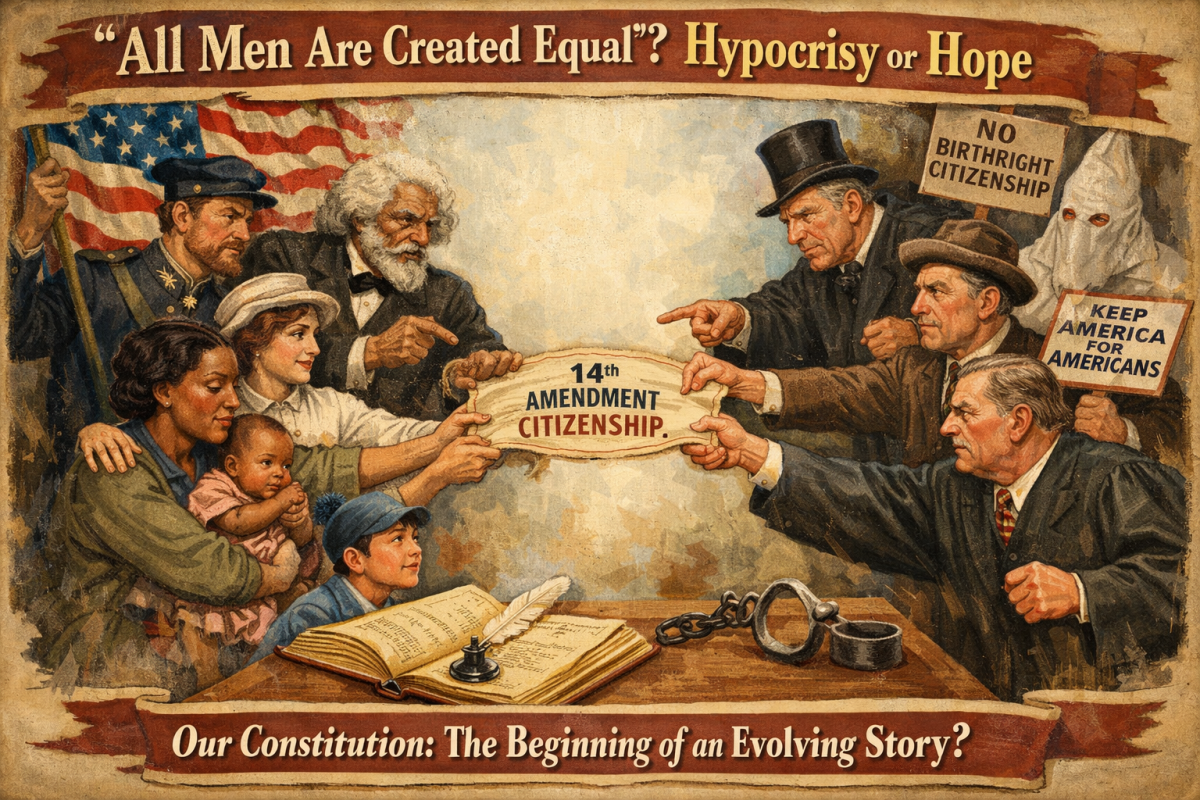
“All Men Are Created Equal”? Hypocrisy or Hope Series
Our current Supreme Court is sometimes divided into Originalists (Justices Samuel Alito, Amy Coney Barrett, Neil Gorsuch, Brett Kavanaugh, and Clarence Thomas) and proponents of a Living Constitution (Justices Sonia Sotomayor, Elena Kagan,and Ketanji Brown Jackson). Chief Justice John Roberts has denied being an Originalist, but often sides with the four who do so consider themselves.
In general, the Originalists think that law (for example, in the Constitution) should be interpreted based on “the original understanding at the time of its adoption.” But critics of their view, like Justice Kagan, think that the framers of laws (again as in the Constitution) realized “that life would change and that you were supposed to apply these principles...to circumstances that they couldn’t imagine.” That’s one reason that the Constitution provided for amendments to be made to it, and by the 15th and 19th amendments, racial and gender discrimination was prohibited, the first in 1870, and the second in 1920.
The Supreme Court split is mirrored in our political environment, where a divide exists between those who champion a static view that would mirror the dominance of white males, especially well-off ones, 250 years ago, versus those like Justice Kagan, who promote an evolutionary approach that would allow a continual broadening in the application of certain basic principles.
Related stories
Almost a decade ago conservative columnist Ross Douthat wrote a piece (after Donald Trump was elected president the first time) entitled “Who Are We?” He pointed out that many Trump supporters “see themselves more as settlers than as immigrants, identifying with the Pilgrims and the Founders, with Lewis and Clark and Davy Crockett and Laura Ingalls Wilder. They still prefer the melting pot to multiculturalism, assume a Judeo-Christian civil religion.” And they shun the view that we are “a nation destined to welcome foreigners.”
Back in 2016, the year Trump was first elected president, writer George Saunders’ “Who Are All These Trump Supporters?” summarized the situation well. He wrote that Trump’s followers were united by what he called “ usurpation anxiety syndrome—the feeling that one is, or is about to be, scooped, overrun, or taken advantage of by some Other with questionable intentions. In some cases, this has a racial basis, and usurpation anxiety grades into racial nostalgia, which can grade into outright racism.”
A big part of that fear is the projection that non-Hispanic Whites will become a minority in the USA by 2045. A significant amount of the appeal of the MAGA (Make America Great Again) movement is confronting this fear. The desire to go back to a pre-Affirmative-Action time (before the 1960s), when non-Hispanic white men still felt dominant.
Now that we are in the midst of the 250th year since 1776, however, it is time to reconsider our history, to review where we were two and a half centuries ago, and whether we have been—and should be—an evolving or static society.
It was not until mid 1778 that the U.S. Constitution was ratified. Because there was no agreement on a national standard for voting, states were left free to regulate voting laws. In most cases, voting remained in the hands of white male Christian landowners—Native Americans, almost all Blacks, and women could not vote. According to the Reagan Library, “Not only did this exclude [enslaved and almost all] free African-Americans from voting, but lower-class Whites as well. During the subsequent eras of Jeffersonian and Jacksonian Democracy...populist political movements advocated for the removal of these voter restrictions [on White men]. These movements proved to be successful...The final state to remove the property requirement was North Carolina in 1856.”
Although racial discrimination was outlawed in 1870, following the Reconstruction Era (1865-1877) many southern states found a way to prevent African Americans from voting by means of “state constitutions and laws, poll taxes, literacy tests . . . and outright intimidation.” An era of southern segregation was ushered in, and it was not until the Voting Rights Act of 1965 was passed that Black voting rights were greatly extended—thus, from 1964 to 1969, the "percentage of black registered voters increased almost tenfold in Mississippi and more than threefold in Alabama."
Although Benjamin Railton in Of Thee I Sing: The Contested History of American Patriotism (2019) has argued that two definitions—an exclusionary one and an inclusive one—go back centuries, it was primarily the former that predominated until 1870. It excluded almost all Blacks, women, and Native Americans. Nevertheless, there were more isolated voices and a few exceptional cases.
Railton mentions J. Hector St. John de Crèvecoeur Letters from an American Farmer (published in several editions in the 1780s) as a book that reflects his “progressive engagements...with African American and Native American communities” and offers “a genuinely and broadly inclusive vision of this new American community, one that can indeed feature ‘individuals of all nations.’”
In an earlier (2014) piece, Railton also cites the case of “Moroccan Muslims in Revolutionary South Carolina.” Their presence led to the 1790 state passage of a law—the Moors Sundry Ac—that recognized them as “‘white,’ thus exempting them from laws governing free or enslaved African Americans.”
As indicated above, an amendment to the Constitution outlawed gender discrimination, allowing women to vote in national elections from 1920 onward. But Native Americans had longer to wait. According to a Library of Congress website, “The Indian Citizenship Act of 1924...was passed by Congress in 1924 and admitted Native Americans born in the U.S. to full U.S. citizenship.” Nevertheless, “even with the passing of that citizenship bill, Native Americans were often prevented from participating in elections, because the Constitution left it up to the states to decide who has the right to vote. Native Americans suffered from some of the same mechanisms and strategies that kept African Americans from exercising the right to vote” prior to 1964.
Another group that was excluded from citizenship even more than Native Americans was that of any Chinese immigrants. By the Chinese Exclusion Act of 1882 and later extensions of it, almost all Chinese immigration was repelled. It was not until 1943 that the Chinese Exclusion Act was repealed that a quota of 105 Chinese immigrants annually was permitted.
As Railton emphasized, however, the exclusionary approach to U. S. citizenship was often challenged by a more inclusive one. An outstanding example of the latter was Frederick Douglass, who as early as 1867 stated about Chinese immigrants: “Do you ask if I would favor such immigrations? I answer, I would...Would you have them naturalized, and have them invested with all the rights of American citizenship? I would. Would you allow them to vote? I would. Would you allow them to hold office? I would.”
Douglass insisted that “our greatness and grandeur will be found in the faithful application of the principle of perfect civil equality to the people of all races and of all creeds, and to men of no creeds.” Douglas advocated a “composite nation.” Historian Jill Lepore calls the concept “a strikingly original and generative idea, about a citizenry made better, and stronger, not in spite of its many elements, but because of them.”
And until the beginning of World War I in 1914, immigrants (mainly from Europe) kept coming to the USA. By 1910 they made up 14.7 percent of the U. S. population—more than the 14.3 percent total of 2023. And those born in Germany provided the greatest percentage.
But the war increased U. S. hostility to Germans—and foreigners and dissenters in general. In 1924, in the midst of Republican dominance, Congress passed the Immigration Act, containing an Asian Exclusion Act, almost banning Asian immigrants, and a National Origins Act, limiting European immigrants but favoring those from northern Europe. As Lepore has written, the purpose of the new law “was to end immigration from Asia and to curb the admission of southern and eastern Europeans, deemed less worthy than immigrants from other parts of Europe.”
For a century after the 1920s, U. S. sentiments toward immigrants have bounced back and forth. In the 1930s there was still strong prejudice against the same southern and eastern European immigrants. As the Holocaust Museum notes, “Many who sought a safe haven from persecution during the 1930s and 1940s found their efforts thwarted by the United States’ restrictive immigration quotas and the complicated, demanding requirements for obtaining visas. Public opinion in the United States did not favor increased immigration.” During WW2, such thinking—and wartime fears—prompted FDR to issue a 1942 executive order that removed over 100,000 West-Coast Japanese-American men, women, and children from their homes to so-called "assembly centers."
FDR’s successor, Harry Truman, had a mixed record on immigration, but then the Republican Dwight Eisenhower, president from early 1953 to early 1961, carried out “Operation Wetback, the biggest mass deportation of undocumented workers in United States history.” It was “designed to root out undocumented Mexicans from American society.” It “used military-style tactics to remove Mexican immigrants—some of them American citizens—from the United States. Though millions of Mexicans had legally entered the country through joint immigration programs in the first half of the 20th century, Operation Wetback was designed to send them back to Mexico.”
Following Eisenhower, both Democratic Presidents Kennedy and Johnson pushed for and signed immigration legislation that lessened the favoring of arrivals from Northern Europe. JFK was himself the great grandson of Irish Immigrants and in 1958 wrote A Nation of Immigrants. In it he stated, “The contribution of immigrants can be seen in every aspect of our national life. We see it in religion, in politics, in business, in the arts, in education, even in athletics and entertainment. There is no part of our nation that has not been touched by our immigrant background. Everywhere immigrants have enriched and strengthened the fabric of American life.’’
Despite having presidents of both major political parties since the late 1960s, none of them has been as anti-immigrant and anti-refugee as our current second-term president, Donald Trump. Already in 2015, while campaigning for the presidency, he had railed against illegal immigrants, declaring that the Mexican government was forcing their most unwanted people into the United States, e.g., “criminals, drug dealers, rapists, etc.” In 2018, as president, he stated, “Haiti? Why do we want people from Haiti [and Africa] here? Why do we want these people from all these shithole countries here?”
During his second term, beginning in 2025, Trumps anti-immigrant rhetoric and actions have been even more hostile. But his tactics, especially the ICE killings of Renee Good and Alex Pretti, have awakened more voter disapproval than support.
If Railton is correct to see a continuous bouncing back and forth between an exclusionary and an inclusive view of U. S. citizenship (and immigrants), then maybe the exclusionary view championed by Trump (and championed by most MAGA supporters) has peaked. And perhaps Supreme Court judges who like Kagan favor a Living-Constitution will in the not-too-distant future gain a majority. And perhaps the U. S. electorate will come to see, as Lepore stated, that our citizenry can be “made better, and stronger, not in spite of its many elements, but because of them.”
Comments

Powered by RoundtableAn AI/DeFi-powered Enterprise Media Operating System. Learn more at Roundtable.io.© Roundtable 2026. By using this site you agree to the Terms of Use and Privacy Policy