


May 24, 2026 2:36 AM
Updated Jun 6, 2026 7:56 PM
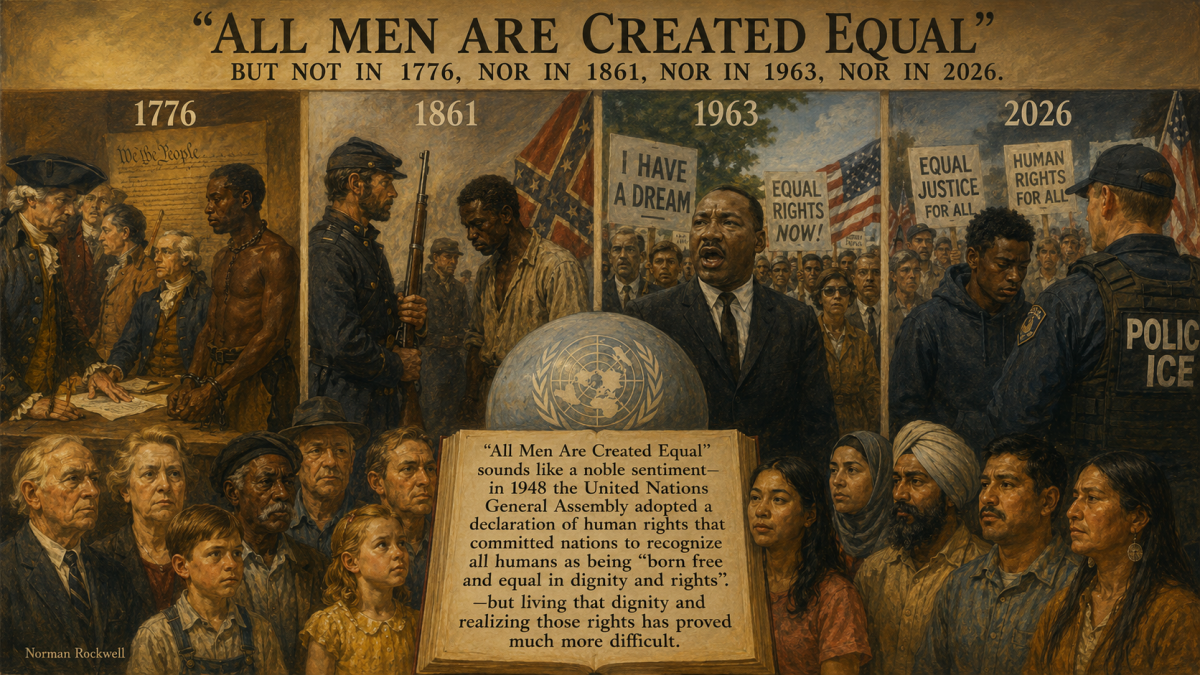
“All Men Are Created Equal” sounds like a noble sentiment, but living that dignity and realizing those rights has proved much more difficult.
“All Men Are Created Equal”? Hypocrisy or Hope Series
Our Declaration of Independence states that “all men are created equal.” But in the USA in 1776, not all men were considered such. Nor were they in 1787—the year our Constitution was ratified. Now, 250 years after 1776, a credible claim can still be made that all men are NOT created—or treated—equally.
Besides the fact that women were not treated as equals until the 20th century—and despite being given the vote in 1919 that “equality” is still debatable—not even all men, especially Black and Red ones, were treated as equals ever in our history.
In regard to African Americans, consider, for example, that it was not until the Voting Rights Act of 1965 was passed that most adult Blacks in Mississippi and Alabama got to vote—from 1964 to 1969, the "percentage of black registered voters increased almost tenfold in Mississippi and more than threefold in Alabama."
Related stories
This was because it took until the mid 1960s to overcome the effects of more than a half-century of Southern segregation—and it can be argued that those effects were not even fully overcome then, especially now when Trumpian White racism attempts to reassert itself.
In 1940 the South, where 77 percent of Blacks still lived, was still plagued by segregation, including segregated schools, churches, housing, restaurants, bars, hospitals, barber shops, public transportation, and restrooms. The Supreme Court ruled segregation legal in 1896, and did not reverse its decision until 1954. In addition, other African-American rights were often denied, including the right to vote.
Mainly because Franklin Roosevelt was unwilling to alienate too many southern White voters by attacking racist evils, he “never went out of his way to work especially hard for African Americans.”
In addition post-Civil-War Blacks faced many other evils, including the Ku Klux Klan (KKK) and lynchings. After the Northern-imposed Reconstruction Era ended along with the presidency of the KKK-suppressing President Ulysses Grant, Southern terrorism, briefly contained, roared back. Between 1877 and 1950, over 5000 “racial terror lynchings” occurred, overwhelmingly in the South. Meanwhile, in 1915, the KKK was reborn and flourished until the mid-1920s, when its U. S. membership totaled 4-5 million. In Indiana alone in 1925, over a quarter of native-born, white males belonged to the Klan. According to historian Thomas R. Pegram, “the bedrock of the 1920s Klan movement remained its commitment to the continuation of native-born white Protestant hegemony in American culture and governance.”
The six states that LBJ’s opponent, Barry Goldwater, carried in 1964 were all, except for his home state of Arizona, in the Deep South. In 1972 and 1984, the Republicans Richard Nixon and Ronald Reagan did even better in the South, winning all of the southern states (and in each election, 49 states in all). The continuing dominance of Republicans in that region was once again demonstrated by Donald Trump in 2016 and 2024, when he carried all the former Confederate states except Virginia.
The views of many Southern Whites—especially older male non-college graduates in small towns and rural areas—are shared by many males with similar backgrounds in other parts of our country. In 2016 writer George Saunders wrote that many Trump supporters suffered from what he called “usurpation anxiety syndrome,” which he defined as “the feeling that one is, or is about to be, scooped, overrun, or taken advantage of by some Other with questionable intentions.”
That “Other” might be anyone benefiting from Affirmative Action, which many male Whites believed disadvantaged them. Their view was contrary to that expressed by President Lyndon Johnson in 1965, who sought “not just equality as a right and a theory, but equality as a fact and as a result.” Many white males, however, resisted his “compensatory” view of equality.
Thus, when Donald Trump competed for the presidency in 2016, their decades-long resistance found its champion. By then, 65 percent of Whites without college degrees “believed that America’s culture and way of life had changed for the worse since the 1950s.” Yet, few of them admitted that the position of Blacks was far worse—or if grudgingly half acknowledging it, might say it was their own fault. But whatever the causes, on average Blacks died younger, had less education, earned less, and were more likely to be unemployed, harassed by police, and incarcerated.
Another minority mistreated in U. S. history were Native Americans, and by many of our highest ranking presidents, including Washington, Jefferson, and Lincoln. Although the Indian Citizenship Act of 1924 was passed by Congress in 1924 and admitted Native Americans born in the U.S. to full U.S. citizenship, they were often prevented from participating in elections “because the Constitution left it up to the states to decide who has the right to vote. And Native Americans suffered from some of the same mechanisms and strategies that kept African Americans from exercising the right to vote” prior to 1964.
Among high-ranking presidents only Franklin Roosevelt receives high marks from historians. Douglas Brinkley, for example, states that “no other president had ever helped Native Americans prosper with the heartfelt conviction of FDR. The New Deal encouraged Indian self-rule, the restoration of tribal government, and the resuscitation of native culture and religion.
Nevertheless, Native Americans still suffer from centuries of abuse. One recent study of COVID effects pointed out that “compared with Black, Latino, and white Americans — Native Americans generally have a higher prevalence of socioeconomic and health-related COVID-19 risk factors.” And that “for centuries, Native Americans have experienced poverty, food insecurity, and poor housing conditions. Access to quality health care remains a challenge for those living on and off reservations.”
The latest people to be treated unequally are most immigrants. In early 2025, the late Pope Francis remarked that Trump’s plan to mass deport undocumented immigrants was a “disgrace.” About the only immigrants or refugees that President Trump has much sympathy for are White ones. He has stated, “Why do we want people from Haiti [and Africa] here? Why do we want these people from all these shithole countries here?” And in 2026 his administration announced “plansto admit up to 10,000 more white South African refugees into the United States in the coming months, arguing that their status as Afrikaners has left them open to discrimination and persecution at home.”
“All Men Are Created Equal” sounds like a noble sentiment—in 1948 the United Nations General Assembly adopted a declaration of human rights that committed nations to recognize all humans as being “born free and equal in dignity and rights”—but living that dignity and realizing those rights has proved much more difficult.
Comments

Powered by RoundtableAn AI/DeFi-powered Enterprise Media Operating System. Learn more at Roundtable.io.© Roundtable 2026. By using this site you agree to the Terms of Use and Privacy Policy