


Mar 21, 2026 6:04 PM
Updated Mar 21, 2026 9:19 PM
Originalism is right-wing casuistry that hallows hypocrisy while living constitutionalism disingenuously camouflages “presentism,” the judging of past actions and morality by current standards.
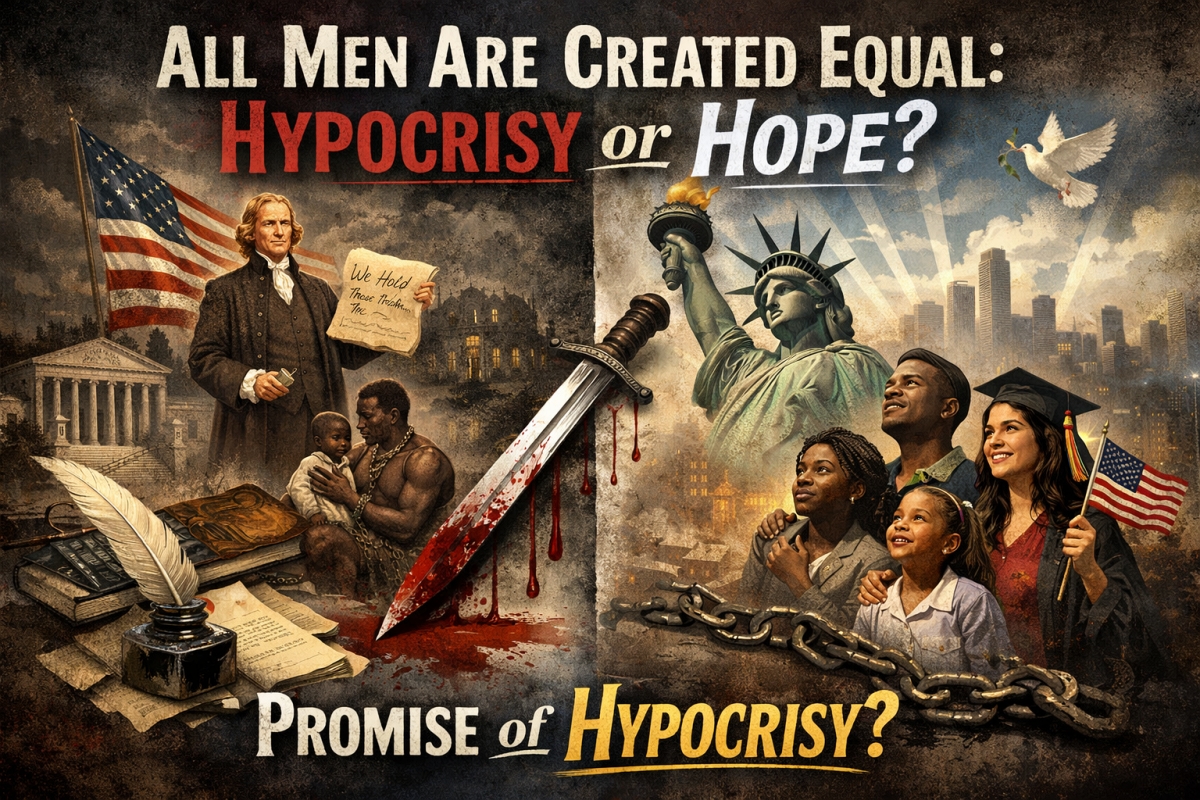
“All Men Are Created Equal”? Hypocrisy or Hope Series
No question can be answered correctly until it is framed correctly. Do we catechize Thomas Jefferson’s five-word phrase within a paradigm of cynical and spurious “originalism” (as the Supreme Court’s super-majority does) or through the lens of “living constitutionalism,” originalism’s purportedly pragmatic antithesis? Originalists interpret revolutionary rhetoric according to what they arbitrarily declare to be the meaning of the words at the time they were written; living constitutionalists interpret revolutionary rhetoric according to what they arbitrarily declare to be the meaning of the words now.
Both camps behave as though their rationales are self-evident. They are not. Originalism is right-wing casuistry, precisely the kind of smug sophistry at which originalism’s chief prophet—the MVP of smug—the late Justice Antonin Scalia excelled. Originalism hallows hypocrisy. It evokes a golden age that never was. And it has a subversive, sinister undertow, implying that those doing the interpreting are oracles, gatekeepers to secret knowledge.
Yet living constitutionalism disingenuously camouflages “presentism”—the judging of past behavior and morality by current standards, i.e., calling Shakespeare a misogynist because of his portrayal of Kate, an anti-Semite because of his portrayal of Shylock, a racist because of his portrayal of Othello. At best a defect in reasoning, presentism is at worst a well-disguised—and equally smug—hypocrisy. It combines moral grandstanding with defamation—Shakespeare was a woman-hating, anti-Semitic, racist—from which the defamed can’t defend themselves. Magans call this moral grandstanding virtue signaling, ignoring that when they do it they too are virtue signaling. Our ideas and attitudes are always and inescapably (because, largely, unconsciously) a reflection of our educations, lives, and times.
Related stories
Hypocrisy or hope?
It’s good to put Jefferson’s momentous phrase in context: a felt need among the founding fathers to defend and promote their radical, treasonous, and—given the aura of divine right in which kings cloaked themselves—blasphemous upending of a long-unquestioned world order:
We hold these truths to be self-evident,
that all men are created equal, that they
are endowed by their Creator with certain
unalienable Rights, that among these are
Life, Liberty and the pursuit of Happiness.
What did the slave-owning-and-impregnating founding father—he sired 6-7 children with his slave/mistress, the quadroon Sally Hemings—mean by all? How encompassing was the “us” in Jefferson’s US? How wide was his lasso? (“Jefferson’s Lasso” echoes “Zeno’s Paradoxes,” ”Occam’s Razor,” “Seward’s Folly,” “Schrödinger's Cat,” and “Rubik’s Cube.”) Despite his inspirational and aspirational oratory, Jefferson owned approximately 600 slaves during his lifetime. Deeply indebted, he failed to manumit (free) the vast majority of them; he is known to have freed ten, including only two of his children. So it’s safe to conclude that his lasso’s loop wasn’t all that wide, its circumference severely circumscribed. Clearly the founding fathers were not above hypocrisy.
When enumerating a citizen’s basic rights, Jefferson wrote all men. He didn’t write—although nothing prevented it—allmen and women or all people or all humans are created equal; he wrote men because he meant men. I’ll stipulate to are, but then there’s the passive-voiced created. Created by whom? Jefferson was a Deist, the belief in a creator who made the universe but who does not intervene in its daily affairs. Yet the phrase invokes a creator who does. Remember context: Jefferson and his revolutionary cohort were addressing multiple audiences—each other; their fellow, not-yet-committed countrymen; and other nations that might intervene either to support the British or the revolutionaries. (Bonour, France et merc!). And finally there’s that nebulous equal. In wealth? Intelligence? Opportunity? Power? Rights?
Both hypocrisy and hope are baked into Jefferson’s all men are created equal just as, thirteen years later, in 1789, they are baked into the French Revolution’s catchphrase Liberté, égalité, fraternité. Liberté? For whom? The nobles of the French ancien régime were stripped of their liberté along with their heads. Égalité? For whom? Their révolution'srhétorique nodded to égalité for women but that was never more than rhétorique and rapidly evaporated, no surprise since fraternité—not sororité, not humanité—tells us all we need to know. Another thirteen years later, in 1802, Napoleon—Make France Great Again—reinstated slavery in the French colonies, an act that France is now paying for dearly.
We benefit from and are victimized by our metaphors. For instance, America is often called a melting pot. America is not a melting pot, it is a suspension. Melting pot’s underlying expectation—that we will all soon become alike enough to take basic assumptions for granted—is false. Nevertheless we often behave as though it were true and then head off in wrong directions. Another common metaphor—the pen is mightier than the sword—is debatable at best. Not that one is weaker—both are powerful—but in a real-world duel, I’m choosing the sword, which spills blood, not ink. Metaphoric pens spill torrents of words that choreograph the movements of ignorant armies that clash by night and day. Crossing the metaphoric border from abstract to concrete, those armies wield real swords that liberate torrents of real blood. Deluges of word and blood have been spilt parsing, and then implementing, all men are created equal.
Neither Jefferson nor his cohort nor France’s revolutionaries intended their hypocrisy. Their limited view of who counted was formed and framed by their culture—their upbringing, their education, their learned history, and their metaphors. None of us is free of all that; few of us are consciously hypocrites. Call it “intrinsic hypocrisy.” We are complicated creatures. As were Jefferson and the people of his time, we are blind to our own impostures. Santayana’s platitude notwithstanding, it is those who know history who are most likely to repeat it.
Hypocrisy or hope? Both and neither. Perhaps this series should be titled, “All Men Are Created Equal: Hypocrisy andHope?”
Comments

Powered by RoundtableAn AI/DeFi-powered Enterprise Media Operating System. Learn more at Roundtable.io.© Roundtable 2026. By using this site you agree to the Terms of Use and Privacy Policy