


Feb 28, 2026 8:00 AM
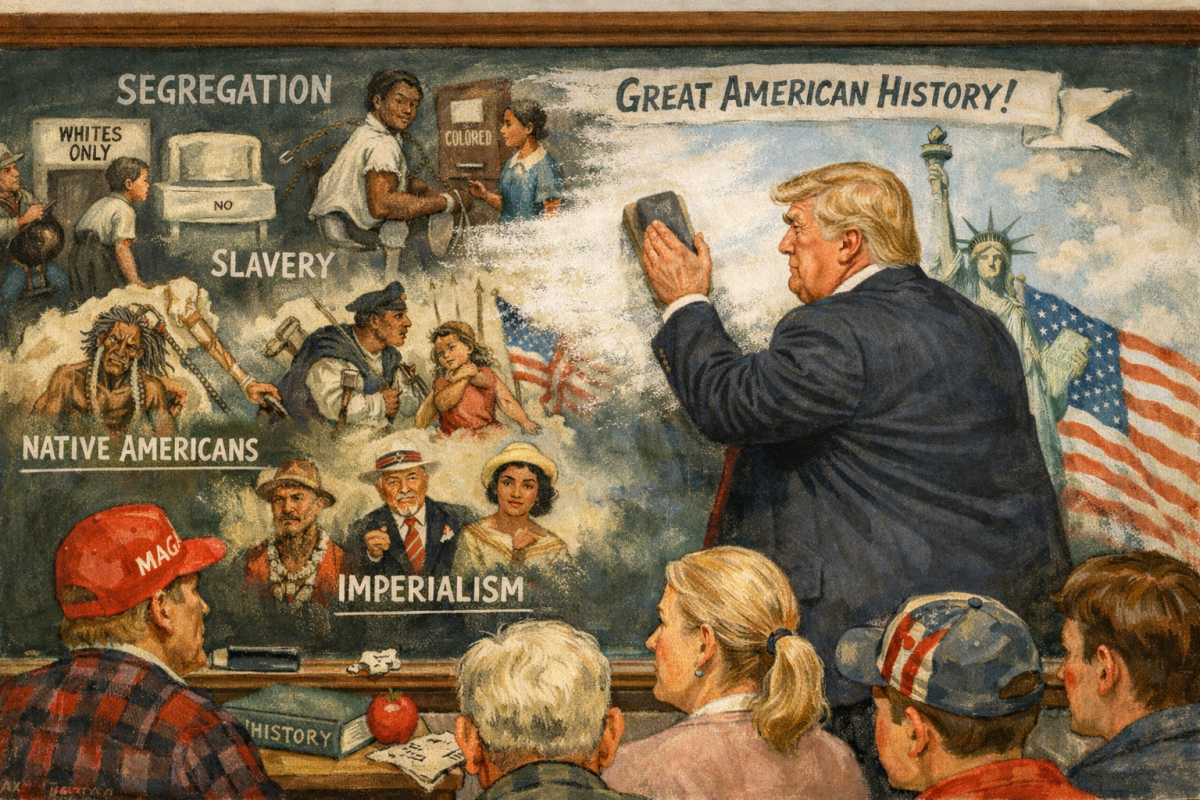
Too many of Trump’s followers—and Trump himself—do not wish to acknowledge the full sweep of the bad parts of U.S. history—slavery, segregation, the treatment of Native Americans and women, and imperialism in areas like Latin America, Hawaii, and the Philippines.
This article is part of the series that addresses the question whether it was hypocrisy or hope when 250 years ago we stated in our Declaration of Independence that “All Men Are Created Equal.” Hypocrisy because more than half of the declaration signers were slaveholders. Plus, how about women, Native Americans, and the unpropertied? But also hopeful because sometime in the future those groups might (and would) be given the vote.
Now, however, during Donald Trump’s second presidential term, he is using various stratagems to limit the impact of those who might oppose him, so once again the question arises, “Are all men (and women) equal—equal in the weight of their vote?” Among Trump’s maneuvers is falsifying history so that it seems to support better his skewed undemocratic views.
Toward the end of President Trump’s first term, my "Trump’s Comments on History: Starting Down a Stalinist Road"appeared on the History News Network (HNN). It indicated that in 2020 Trump said, “Our mission is to defend the legacy of America’s founding, the virtue of America’s heroes, and the nobility of the American character. . . . We want our sons and daughters to know that they are the citizens of the most exceptional nation in the history of the world.” He went on specifically to criticize The New York Times’ 1619 Project: “This project rewrites American history to teach our children that we were founded on the principle of oppression, not freedom.” Thus, in depicting history from the year that the first documented enslaved Africans arrived in the U. S. (in Virginia) until the present, some historians (according to Trump) have depicted our history wrongly.
Yet, despite “starting down a Stalinist road” of downplaying any national historical defects, I also indicated that Trump “has not gone as far as Stalin,” and that “how much farther he might go will depend largely on American voters.” These words were written before the 2020 election in which Trump was defeated, but the 2024 presidential contest gave him another chance, and he was elected to a second term—and another opportunity to continue down the “Stalinist road.”
Related stories
And down that road he continued to go. In an executive order of March 2025, he blasted history that undermined “the remarkable achievements of the United States by casting its founding principles and historical milestones in a negative light . . . Rather than fostering unity and a deeper understanding of our shared past, the widespread effort to rewrite history deepens societal divides and fosters a sense of national shame, disregarding the progress America has made and the ideals that continue to inspire millions around the globe.”
But, as I pointed out in my 2020 HNN piece, Trump fails to understand the main purpose of history. It is not praising “remarkable achievements” and “fostering unity.” It is truth-seeking. “Tell the truth” should be as central to the historian’s mission, as “First, do no harm” is to doctors and nurses. But Trump has become renowned, as Republican Senator Jeff Flake said in early 2018, for battering and abusing “objective, empirical, evidence-based truth...more...than any other [president] in the history of our country.” Thus, covering over negative aspects of our history, whether in museums, schools, national parks, other public sites, or publications, has become commonplace activity for the Trump administration.
The most recent news concerning a Trump attempt to erase negative historical news was a mid-February-2026-judicial ruling restoring displays that the Trump government had taken down in Philadelphia from a house where Washington had stayed. The displays referred to the “nine nine enslaved people Washington kept there while he was president.” The judge, appointed by President George W. Bush, stated that “each person who visits the President’s House and does not learn of the realities of founding-era slavery, receives a false account of this country’s history.”
To Trump’s attempts to falsify U.S. history, to show only its positive side and buttress up his own popularity, there has been plenty of additional opposition, coming from both historians and the larger media world. The noted historian Joseph Ellis in his The Great Contradiction: The Tragic Side of the American Founding (2025) wrote of “two unquestionably horrific tragedies...the failure to end slavery, and the failure to avoid Indian removal.” On the HNN site, historian Bruce Dearstyne compared Trump’s skewing of history to that of Calvin Coolidge, our Republican president of the mid-1920s who earlier had also sought “to roll back most of the expansion of equality in the course of our history since 1776.”
In the more general media world, Ken Burns’ PBS serial presentation of “The American Revolution” certainly dealt with both slavery and our Founding Fathers’ treatment of Native Americans. As did the November 2025 issue of The Atlantic, which was entitled “The Unfinished Revolution.”
Over at Mother Jones, another left-leaning magazine, its March-April 2026 issue carried a piece called “Trump’s War on History.” It pointed out that “American history offers a medium through which Trump can wage the all-encompassing cultural, political, and legal battles animating his administration...American history is being subordinated to Trump’s cult of personality. The president’s face is suddenly everywhere...The semiquincentennial is just one part of the commander in chief’s broader campaign to harness the mechanisms of the federal government to enforce his preferred version of the nation’s history and culture.”
The Mother Jones article went on to provide numerous examples. Trump took “control of the Kennedy Center”; “railed against ‘OUT OF CONTROL’ museums that he insists are too focused on ‘how bad Slavery was’”; “extracted significant concessions over what top universities teach”; “altered or removed scores of exhibits at parks and historic sites on topics including slavery, Native Americans, climate change, and even fossils”; and also leveraged “federal dollars to stop local librarians and educators from sharing content” unliked by the Trump administration.
It concluded that “under the pretense of stamping out ‘woke’ ideas and promoting patriotism, the White House is attempting to mandate uncritical acceptance of its own take on the American story, one that celebrates the martial feats of mostly white men and an imagined religious and ideological conformity that minimizes the fights, tribulations, and dissenters who have defined the country. It’s an effort that flies in the face of American ideals—and reality.”
In 2017, early in Trump’s first term, New York Times conservative columnist Ross Douthat pointed out that Trump’s victory partly represented an attempt by “white-male-Protestant-European protagonists” to “restore their story to pre-eminence.” They preferred the melting-pot concept of U.S. history to the idea of multiculturalism. And they saw themselves as in the Christian tradition, and “more as settlers than as immigrants, identifying with the Pilgrims and the Founders, with Lewis and Clark and Davy Crockett.” Douthat realized that their “story” had its defects and “maybe no unifying story is really possible...but any leader who wants to bury Trumpism...would need to reach for one—for a story about who we are and were, not just what we’re not, that the people who still believe in yesterday’s American story can recognize as their own.”
The problem with Douthat’s approach is that too many of Trump’s followers—and Trump himself—do not wish to acknowledge the full sweep of the bad parts of U. S. history—slavery, segregation, the treatment of Native Americans and women, and imperialism in areas like Latin America, Hawaii, and the Philippines.
In 2019, still during Trump’s first term, my “Do We Want the America of Frederick Douglass or Donald Trump?” appeared on HNN. It contrasted the views of the two men in the title and asked, “Which kind of America do we want? A ‘composite nation,’ as Douglass advocated, one that takes pride in its ethnic and religious diversity and sets an example for other countries who are fearful of immigrants? Or an America afraid of immigrants, especially if not lily white, Christian ones, as Trump and many of his followers desire?” Now, seven years later, that choice still confronts us. And so too does how we view our history, simplistically and blocking out all that is unpleasant—or truthfully, warts and all.
Comments

Powered by RoundtableAn AI/DeFi-powered Enterprise Media Operating System. Learn more at Roundtable.io.© Roundtable 2026. By using this site you agree to the Terms of Use and Privacy Policy