


Apr 20, 2026 6:32 PM
Updated Apr 20, 2026 6:41 PM
Trump has put himself in charge of a "Freedom 250" celebration which an apparently large number of scholars are criticizing as a glorification of himself and a whitewash of American history.
Trump has put himself in charge of a "Freedom 250" celebration which an apparently large number of scholars are criticizing as a glorification of himself and a whitewash of American history. More Videos
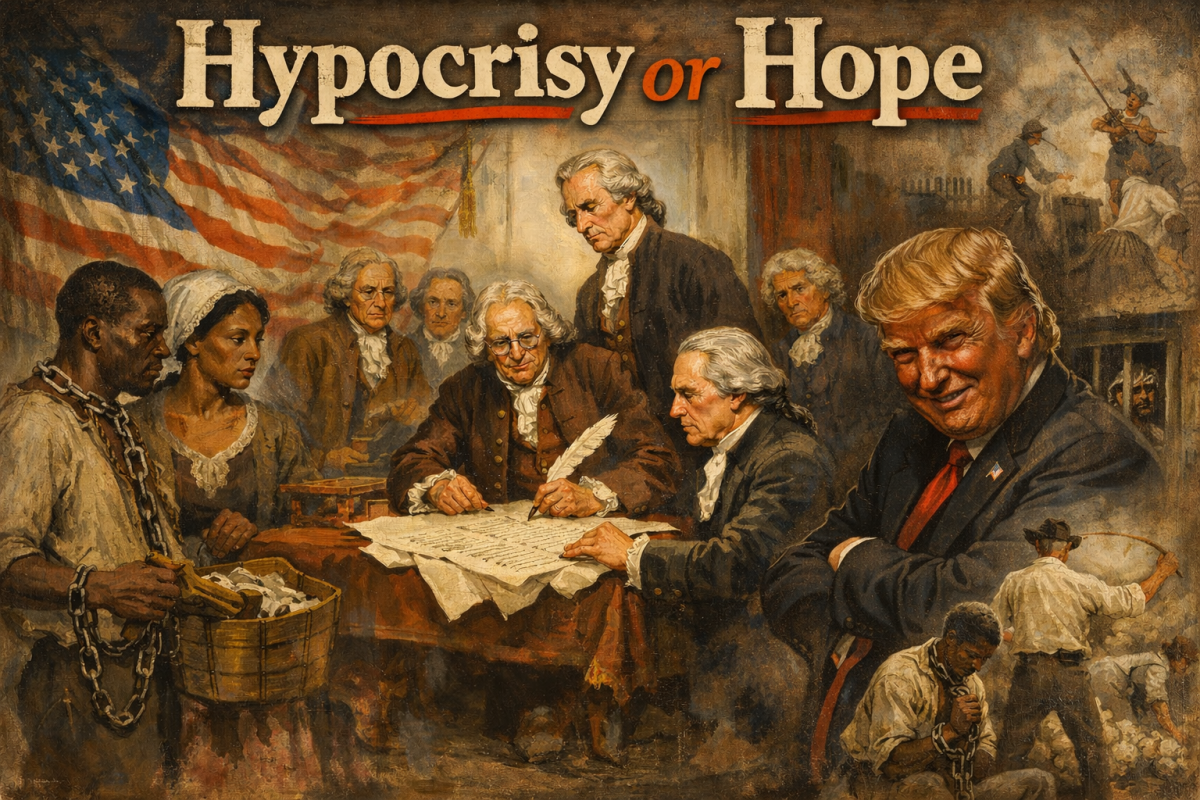
“All Men Are Created Equal”? Hypocrisy or Hope Series
In his book, A People’s History of the United States, historian Howard Zinn described the American Revolution as a “kind of revolution.”
Yet many, maybe most, other historians say the American Revolution truly was revolutionary. Typical of that group is Bernard Bailyn, whom Zinn quoted: “The destruction of privilege and the creation of a political system that demanded of its leaders the responsible and humane use of power were [the founders’]...highest aspirations.”
Zinn countered that the founders “did not want a balance, except one which kept things as they were, a balance among the dominant forces at that time. They certainly did not want an equal balance between slaves and masters, propertyless and property holders, Indians and white.”
Related stories
Bailyn also wrote that, "Everyone knew the basic prescription for a wise and just government. It was so to balance the contending powers in society that no one power could overwhelm the others and, unchecked, destroy the liberties that belonged to all. The problem was how to arrange the institutions of government so that the balance could be achieved."
Zinn added that “as many as half the people were not even considered by the Founding Fathers as among Bailyn’s ‘contending powers’ in the Declaration of Independence, they were absent in the Constitution, they were invisible in the new political democracy. They were the women of early America.”
No doubt Zinn and Bailyn, both dead, would be appalled at President Donald Trump’s planned Happy 250th Birthday USA bash, which is earning less than rave reviews from scholars and pundits. More on that in a minute.
Anyway, the Second Continental Congress ratified the Declaration of Independence in Philadelphia on July 4, 1776. Ultimately, 56 delegates signed the document. All were white male property owners; reportedly as many as 41 were slaveholders.
"We hold these truths to be self-evident, that all men are created equal, that they are endowed by their Creator with certain unalienable Rights, that among these are Life, Liberty and the pursuit of Happiness," is the Declaration’s most famous sentence. I memorized it in junior high school.
Those lofty words rang hollow to women, free and enslaved Blacks and native Americans. The Declaration didn’t call for the abolition of slavery, nor for women, free Blacks and indigenous peoples to be equal to whites politically or socially.
Virginian Thomas Jefferson, the document’s main author, wanted it to include a passage condemning the African slave trade. But it was stricken out when slaveholding Southern delegates objected.
(Jefferson might be characterized as the anti-slavery slaveholder. He believed slavery was immoral, yet he possessed hundreds of slaves and evidently fathered several children with Sally Hemings, one of his slaves. Like almost all whites of his time, he believed Blacks were inferior to whites.)
Slavery was legal in all 13 colonies during the Revolutionary War (though by 1804, slavery had been abolished in the northern states.) The hypocrisy of fighting for “freedom” from British “tyranny” is—or should be obvious—to 21st century Americans. At the onset of armed conflict between Mother Britain and her querulous American children, the famous English essayist and dictionary author Samuel Johnson asked, “How is it that we hear the loudest yelps for liberty among the drivers of Negroes?”
At any rate, Zinn doubted that the statement “all men are created equal” was not meant to denigrate women. “It was just that women were beyond consideration as worthy of inclusion. They were politically invisible.” So was everyone else, except white men who possessed money and power.
Zinn concluded that “the reality behind the words of the Declaration of Independence (issued in the same year as Adam Smith’s capitalist manifesto, The Wealth of Nations) was that a rising class of important people needed to enlist on their side enough Americans to defeat England, without disturbing too much the relations of wealth and power that had developed over 150 years of colonial history. Indeed, 69 percent of the signers of the Declaration of Independence had held colonial office under England.”
The Revolutionary War started with the battles of Lexington and Concord, Massachusetts, in 1775 and ended in American victory with the Treaty of Paris of 1783. From 1781 to 1789, the United States operated under the Articles of Confederation, a weak central government under which all states were equal. In 1787, delegates from every state except Georgia met in Philadelphia to strengthen the articles. They ended up drafting a constitution that abolished the Articles and created a federal government that established the supremacy of the central government over the states.
Most historians and other scholars notably praise the Constitution, which took effect in 1789, for its diffusion of power among executive, legislative and judicial branches of the federal government and for extending to the states a good deal of power to run their own affairs. But Zinn argues that the document was anything but democratic.
The delegates rejected Alexander Hamilton’s antidemocratic proposal for a constitution that established a president and Senate chosen for life. But Zinn pointed out that their finished product didn't “provide for popular elections, except in the case of the House of Representatives, where the qualifications were set by the state legislatures (which required property-holding for voting in almost all states), and excluded women, Indians, slaves.”
Also under the constitution, state legislatures would elect U.S. senators, not coincidentally, also white men of property. Presidents would appoint Supreme Court justices and lower federal judges to lifetime terms.
By 1788 all 13 states had ratified the constitution, several only after demanding a Bill of Rights, which was added to the national charter in 1791 as the first ten amendments.
Zinn wrote that in the infant United States, “the problem of democracy” wasn’t just the constitutional curbs on voting. “It lay deeper…in the division of society into rich and poor. For if some people had great wealth and great influence; if they had the land, had the money, the newspapers, the church, the educational system—how could voting, however broad, cut into such power? There was still another problem: wasn’t it the nature of representative government, even when most broadly based, to be conservative, to prevent tumultuous change?”
When something revolves, that which is on top, goes to the bottom and the bottom goes to the top. A wealth of historical evidence supports Zinn’s argument that the American Revolution was a “kind of revolution.” It was not “an instance of revolving” because that the old colonial elite, for the most part, remained the elite after independence.
As our semiquincentennial approaches, the White House is occupied by a president, a 2024 survey of 154 scholars said was the worst POTUS ever. Trump has put himself in charge of a "Freedom 250" celebration which an apparently large number of scholars are criticizing as a glorification of himself and a whitewash of American history. The president is engaged in “a total revision, a total rewrite, of history,” said Murray State University historian Brian Clardy. “It is not at all surprising that he wants to recast the historical narrative and pretend that bad things like slavery never happened. John Adams, who was there in 1776, said ‘Facts are stubborn things.'”
“Trump is now embarking on a crusade to MAGAfy the American past, via a hostile takeover of the federal government’s commemoration of the 250th anniversary of the...Declaration of Independence,” wrote Tony Aguilar Rosenthal in The Nation.
Trump wants his celebration to include the construction of an “Arch of Independence, which would resemble Paris’ Arc de Triomphe. The monument is already being mocked as “The Arch of Trump.” “Historically, triumphal arches – the bigger the better – have been catnip to despots of all stripes,” wrote The Guardian’s Catherine Slessor. “Hitler confected one with his pet architect, Albert Speer, for his postwar vision of Berlin as a welthauptstadt or world capital. At a colossal 328 feet it would have dwarfed the Arc de Trump and the Arc de Triomphe.”
It’s not certain the arch will be built. Some Vietnam War veterans and a retired architectural historian are suing in federal court to stop the project. “The plaintiffs, represented by Public Citizen Litigation Group, call the proposed plan a ‘vanity project’ that would disrupt one of Washington's most symbolically charged sightlines between the Lincoln Memorial and Arlington House, a view designed to evoke national unity after the Civil War,” wrote National Public Radio’s Windsor Johnston.
In another Guardian story, Jonathan Tait wrote that soon after Trump was elected in 2016, historian Douglas Brinkley recalled he was stunned when the president-elect "who has mused about having his name carved on Mount Rushmore alongside the nation’s most celebrated presidents – told him he had never read a book about Abraham Lincoln. He was thinking about what he would do for his inaugural address, and he said he knew nothing about past history,” Brinkley told a webinar organized by the Carnegie Endowment for International Peace."
Confessed Brinkley: “It startled me, because when you talk to politicians, they even make up books. They pretend they read a lot. He just kind of shrugged it off and told me that he was a visual guy. That translated as his sense of history in a true sense began with John F Kennedy."
Tait quoted historian and presidential biographer Jonathan Alter: “[Trump]…is not now and never has been a student of history, but is basically a restorationist.” Such a politician practices “the politics of nostalgia,” according to Alter.
Alter said that Trump is "ignorant of economic history, he’s ignorant of political history. And his idea for the 250 is to use it as a way to celebrate him.”
Clardy said it is vital that historians counteract Trump’s whitewashing of American history by providing citizens a factual account of our nation's past.. Tait also wrote that historian Heather Cox Richardson “is producing a series of 90-second videos called Journey to American Democracy she hopes will eventually be watched in school classrooms.”
Said Cox Richardson: "We are looking at the different ways in which our always multicultural society constructed a nation, and that is a story of extraordinary triumph, but also of missteps and tragedy. The idea that we had a perfect past that needs to be recovered is an ideology in service to an authoritarian strongman, and one of the things you see with the rise of a strongman is the attempt to destroy real history.
“But if you look around the United States now, you see that the ability to affect culture is slipping away from the president’s hands. The more he talks about it being this sanitized work of a few ideologically pure white leaders in the past, the more other people will speak up and say, ‘Well, no, not really.’”
Clardy agrees. “How do you combat big lies? With bigger truths.”
Comments

Powered by RoundtableAn AI/DeFi-powered Enterprise Media Operating System. Learn more at Roundtable.io.© Roundtable 2026. By using this site you agree to the Terms of Use and Privacy Policy