
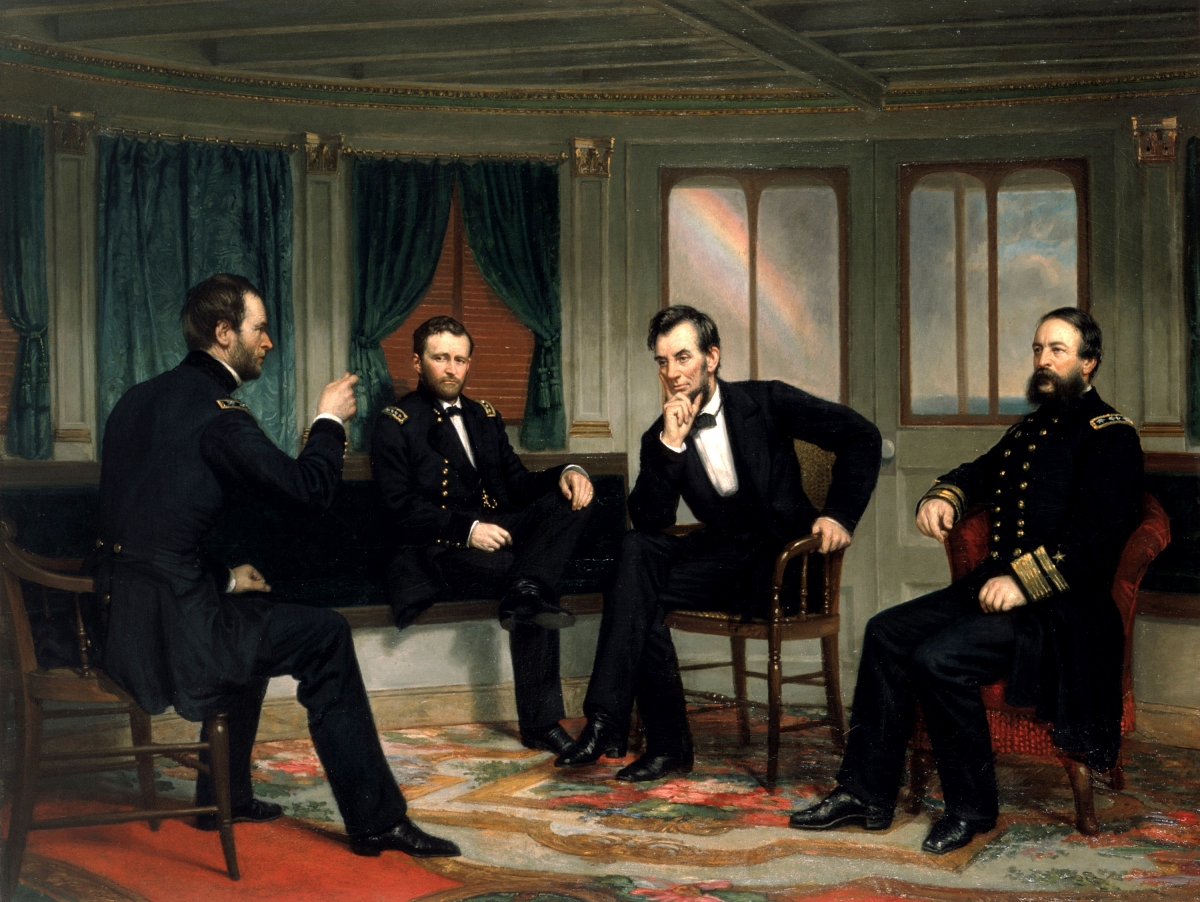
By George Peter Alexander Healy - The White House Historical Association , Public Domain,


Feb 10, 2026 6:13 PM
Updated Feb 11, 2026 6:57 PM
If democracy is a relationship rather than an abstraction, the American body politic can be understood as a fractured partnership—one that demands reckoning, honesty, and sustained attention to restore trust and function.
Author’s Note: This essay reflects on the enduring challenges of sustaining the American body politic, especially in moments of disappointment and fracture. Written for the 250th anniversary of the Declaration of Independence, it considers how people might reckon with unmet promises and rebuild trust, emphasizing that democracy, like any relationship, requires attention, honesty, and sustained care.
“If America isn’t breaking your heart, you don’t love her enough.”
—Sign held at the No Kings rally, New York City, October 2025
America is heartbroken—not in the fleeting sense of disappointment, but in the more profound rupture that follows a breach of trust. It continues to believe in the promise of the union it upholds, even as that union repeatedly fails to uphold its promises in return. Institutions strain under contradiction, social contracts fray, and the people experience a persistent sense of betrayal: of being abandoned, neglected, or taken for granted by the very structures to which they remain loyal. The polity, like a long-term partner, no longer appears faithful to the ideals that once inspired devotion. And yet it remains present and capable of repair, if it can confront its failures honestly and summon the sustained attention that reciprocity requires.
The metaphor of a relationship therapy session provides a framework for understanding civic disengagement, moral exhaustion, and ambivalence. If the polity is imagined as the relational partner, the people occupy the role of the one who feels unseen and unheard; communication has slowed, attention has drifted, and trust has eroded through cumulative neglect. In this framing, the breakup is not merely rhetorical. It is a structural failure of reciprocity, accountability, and care, reverberating through every organ of the social body and weakening the connective tissue that sustains collective life.
Related stories

Denial is the first stage of this breakdown. The body politic persuades itself that tradition alone can substitute for maintenance, that inherited forms remain sufficient despite contemporary neglect. Electoral rituals, bureaucratic procedures, and partisan narratives become talismans against discomfort, shielding the system from recognizing loss. Inequality is minimized as inevitable; polarization is dismissed as cyclical; entire constituencies—working-class communities, economically vulnerable populations, historically marginalized groups—fade into background noise. Denial comforts by postponing responsibility, but it is also dangerous. Circulatory pathways of empathy constrict, feedback mechanisms fail, and the system strains under pressures it refuses to acknowledge.
Guilt follows, arriving gradually, like an organ reawakening from prolonged atrophy. Recognition of complicity surfaces through memories of decades marked by inattentive governance, symbolic gestures substituted for material repair, and moral language used to mask structural neglect. Resources flowed toward cultural signaling, procedural compliance, and elite reassurance, while large portions of the social body endured chronic underinvestment. Guilt functions as an inflammatory response: it signals injury and demands attention. Yet when unmanaged, it metastasizes into paralysis, producing cycles of self-flagellation, performative outrage, or abrupt overcorrection that destabilize rather than repair.
Reckoning emerges when avoidance becomes unsustainable. The polity confronts its failures with greater clarity, interrogating the performance of its legislative, executive, and judicial organs and tracing the pathways through which neglect became normalized. Accountability at this stage is functional rather than theatrical, oriented toward recalibration rather than punishment. Therapy, in this sense, is neither scolding nor sentiment. It is disciplined reflection paired with actionable strategy—a guided process of diagnosis and repair that requires honesty, patience, and a reallocation of attention toward regions of the social body that have long been deprived of it.

Rebuilding, when it begins, is fragile and uneven. Trust does not return through declarations alone; it must be restored through consistent communication and policies that align moral intention with material consequence. Emotional labor—the work of listening, responding, and correcting course—cannot be unilateral. It must be reciprocated if recovery is to endure. This phase demands humility and endurance, along with the recognition that the polity cannot sustain itself through devotion to abstraction. Care must be directed toward the living organism as it exists, even when progress is slow and outcomes remain imperfect.
Social media complicates this therapeutic process by accelerating and amplifying emotional feedback. Every post, like, or share becomes diagnostic; minor gestures are magnified into evidence of systemic failure or redemption. Ordinary signals—tweets, memes, images—trigger disproportionate responses, reinforcing cycles of grief, anger, and fleeting hope. Networks of commentators, activists, and civic organizations function simultaneously as mirrors and critics, shaping perception even when their counsel is partial or flawed. Any attempt to heal the body politic must account for these systems, now integral to the circulation of attention, judgment, and empathy.
Grief, in this context, is both physiological and moral. Memory loops replay unresolved failures; stress signals rise; emotional organs overproduce, sending waves through the social nervous system. This turbulence, though destabilizing, is not pathological. It is adaptive. It reflects the slow work of realignment, the rehearsal of accountability, and the recalibration of collective attention. Suppressing grief would entrench denial; acknowledging it creates the conditions for repair.
The stages of grief—denial, guilt, reckoning, rebuilding—map imperfectly but usefully onto civic recovery. Denial isolates; guilt educates; reckoning restructures; rebuilding restores function. Progress is neither linear nor guaranteed, and regression remains inevitable. Still, the therapeutic lens provides patience and strategy, emphasizing that moral renewal cannot be separated from structural reform and that intention without sustained attention is insufficient.
Irony and compassion are indispensable. America must confront imperfection without despair and disappointment without cynicism. Therapy does not promise triumph; it offers clarity and persistence. The patient must learn to see the social body as it is, flaws intact, and continue the work of maintenance despite fatigue. Love, in this sense, is attentive rather than idealizing. Democracy survives not through fantasy but through grounded stewardship.
Ultimately, “the breakup” functions as both metaphor and method. It transforms civic heartbreak into an analytic tool, revealing the mechanics of dysfunction, the costs of neglect, and the pathways toward repair. It insists that attention, humility, responsiveness, and stewardship are not sentimental virtues but infrastructural necessities. A polity that understands this can survive heartbreak and emerge more resilient, capable of sustaining trust after repeated disappointment.
America must learn to love again—not the myth of itself nor the nostalgia of imagined perfection, but the flawed, stubborn organism that persists. Recovery is possible. Circulation can be restored, and the organs of empathy, conscience, and participation strengthened. The work is slow and unglamorous, but it is necessary. Breakups mark endings, but they also clarify what failed and why. Democracy, like intimacy, requires honesty, patience, and stewardship. At this moment of grief, the opportunity remains to rebuild relational capacity—not as a naïve partner, but as a polity equipped with insight, humility, and resolve.
This article is licensed by the author under the Creative Commons Attribution-NonCommercial-ShareAlike 4.0 International License (CC BY-NC-SA 4.0)
Comments

Powered by RoundtableAn AI/DeFi-powered Enterprise Media Operating System. Learn more at Roundtable.io.© Roundtable 2026. By using this site you agree to the Terms of Use and Privacy Policy