
Cagle Cartoons


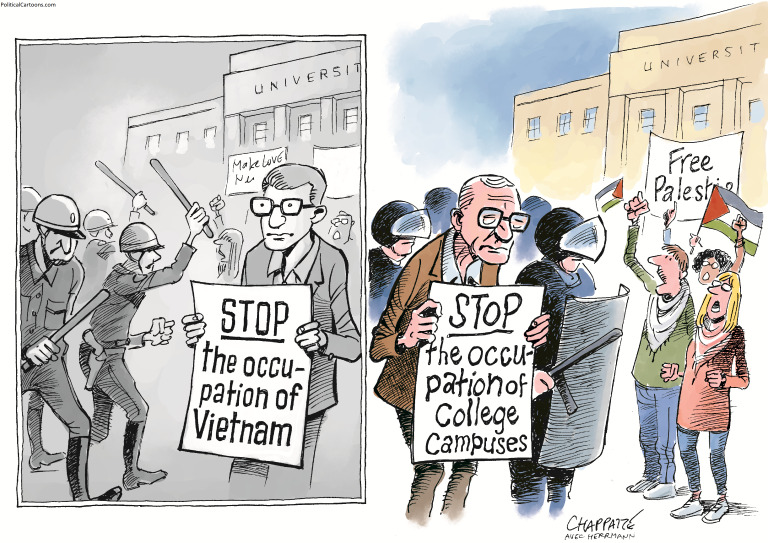
A granddad today, a protestor yesterday
May 23, 2024 4:36 PM
Updated May 24, 2024 4:21 PM
For many college students, the protests over the treatment of Palestinians in Gaza are a political awakening not unlike ours a generation ago.
Watching news of college protests has stirred a strange mixture in me of Sixties pride and 21st century grandfatherly angst. I recently viewed my grandson hitting a single, stealing second, and scoring a run as I sat 500 miles away, thanks to the miracle of Little League live streaming. Our sharp-eyed hitter is not so far, in these precarious times, from young adulthood and facing some of life’s hardest decisions about his career, love, and maybe where he stands in politics and society.
Thoughts about my grandson’s risky future gelled into a sobering present sooner than his next at-bat when a Gen X friend shared his worries that his son, a college freshman, announced his intention to join his campus protest against United States policy on Gaza.
My friend found himself torn between parental fears for his very bright son, who’d previously “never been overtly political,” and his gnawing worries about police confrontation and arrest, potential school suspension, or worse. Tugging at his gut was the recognition that his skateboard-agile offspring was “for the first time, in a true political awakening.”
But, then, he asked the toughest of all questions for any parents eyeing their child’s emergence from hatchling to fledgling at the nest’s edge--"What to say?": “Do I want to suppress that to keep him safe?”
Related stories
My friend’s dilemma also throbbed with memories for me in the tumultuous spring of 1965. Those pains swelled happily down to my swelling soles after trudging 19 miles in thin tennis shoes over the Alabama highway from Selma to Montgomery, and only weeks later ached in my butt after sitting-in till dawn along the cold marble corridors of the University of Minnesota’s administration building, where we protested a sudden tuition jump that was sure to hit low-income students.
Times now do differ from the Sixties, yet so much has been on “repeat” during protests since then, from the United States invasion of Iraq to Black Lives Matter: the marches; the sit-ins; politicians of both parties calling for “order”; dubious outcries against “outside agitators"; the media’s action-news obsession with daily arrest numbers, currently, on 150 college campuses, while barely examining the substance of student demands.
According to NPR’s On the Media, [https://tinyurl.com/4vbc8sjt] (May 10, 2024) despite the public impression of widespread turmoil, just two percent have involved fighting and vandalism, while “the vast majority” of demonstrations have been peaceful. Meanwhile, my friend’s son did join his college protests safely, discovering in the process a new sense of “solidarity” with classmates behind a common cause.
As for our lithe Little Leaguer, I was tickled to watch him dancing and stretching his cool moves off of third base--amazingly, live on screen. I caught myself wondering where he is heading. Was I simply glancing into a rearview mirror where my trepidations appeared closer than they really are? Might our battered world bring a revival of the military draft I also resisted so long ago.
For some time, my grandson’s Gen X mother has brought him to volunteer with her at a Black Life Matters program, packing free meals for low-income families. Still, my apprehensions for him merely moments away from every parent or grandparent’s longest pause, from the weaning moment my mother surely felt when I was 19, nearly 60 years ago.
“Hi, Mom, I’m in Selma, Alabama.”
In late March of 1965, I boarded a bus packed with members of our University of Minnesota group, Students for Integration, headed south. A sophomore, I was sophomoric enough not to mention the trip to anyone in my family. When we got to the now-historic Brown Chapel AME Church in Selma, Ala., we were told there was one payphone in the basement where we could line up with a throng of others from around the country to make a brief, collect call home. Coming from a very progressive family, and I dialed with a tinge of generational pride, as a son and grandson ready to step forward for the cause of justice that dominated family conversation throughout my childhood.
Several Klan thugs were stopped by authorities from their plan to gun us down. Early the next morning, we rode out to join the march to Montgomery along a route lined with soldiers in National Guard for our protection.
On hearing my Mom’s voice accept the charge for the call, I unexpectedly felt my gut tighten. In that uniquely parental clang of alarm and relief, she cried out, “Where are you!? We’ve been asking everyone. No one knew where you were.”
I just blurted out, “Mom, I’m in Selma, Alabama.” I will never forget the wail on the other end of the line, like a screech of microphone feedback I hadn’t thought my mother was capable of emitting — “WHA-A-T!!!” At school in Minnesota, I was on my own and didn’t talk to Mom and Dad except for irregular weekend calls to them in Las Vegas. With that long line of students at my back, I had no time to ask why they were trying to find me mid-week, anyhow. In that moment, she caught my breath.
My mother’s indelible rattle palpitates my eardrum even today. On that afternoon of my youth, I neither understood it, nor forgot. Much later in my life have I realized her cry as umbilical, a mother’s second birthing, this time from the bassinet into your baby’s adulthood. It is the birth pang a mother or father feels in the dissonant moment between fear and tomorrow.
For me, grown, yet still lurching toward maturity, I had suddenly sensed a closeness with my mother that I hadn’t felt before this rushed call from a distant church basement. I grasped then that my loving parents were aware of my every step.
Only decades afterward did I read how, on that night, as many of us stood around the steps of the Brown Chapel, violence lurked in the van, which I could partially see being halted just beyond a crowd. Several Klan thugs were stopped by authorities from their plan to gun us down. Early the next morning, we rode out to join the march to Montgomery along a route lined with soldiers in National Guard for our protection.
That July, I caught a train to Baton Rouge, to volunteer as a civil rights worker with the Congress of Racial Equality in Louisiana. It was only a year after civil rights workers Andrew Goodman, Michael Schwerner and James Cheney were killed in Mississippi. Untrained and clueless, I wasn’t much of a community organizer. But that summer, despite Louisiana’s almost immobilizing swelter, I soaked up the earnest, joyful, if sometimes scary moments, that got me going each day—and would motivate me through the coming years.
Coffee, Donuts and Sit-ins
Scattered amidst this year’s disquieting news-feeds have been accounts of some college administrations engaging constructively with student leaders. I was heartened to learn, for instance, that protesters reached amicable resolutions at several universities, such as Brown, Wesleyan, and particularly San Francisco State.
As KQED public radio reported, “SFSU President Begins Negotiations With Campus Gaza Protesters,” school President Lynn Mahoney sat with 300 students and their eight leaders in an open-air meeting on the campus quad reaching an agreement for further negotiations about divesting of the institution’s investments from military interests in Israel. The discussions in the coming days, including some student protesters who are Jewish, led to initial plans for working together.
Yet, subsequent news reports continued leading with accounts of “campus unrest,” while seldom noting respectful resolutions at other institutions, such as at my alma mater. As I read the Minneapolis Star Tribune’s May 2, 2024, headline, “University of Minnesota says it reaches deal to end pro-Palestinian encampment,” a flood of memories poured over me.
Days before “Finals Week” in 1965, the U of M announced a tuition hike for the coming year. I joined the takeover of the Morrill Hall administration building. It was mere months since UC Berkley’s Free Speech Movement. We Midwesterners were keen on doing something, and the university’s predictable sneakiness offered an excellent cause for outrage; the increase would especially affect students from lower-income families.
Our sleepless, boring night ended with a whimsical touch in the drowsy wee hours before dawn. Word percolated down the dank corridors that, as student leaders continued negotiating with administrators, the university president’s wife had arrived downstairs with a coffee truck and free donuts for protesters. This occurred year’s preceding the creamy phrase “Minnesota nice” was coined. Although most of us scoffed at this as a cynical gesture, a Trojan coffee urn to soften our resolve, I admit that I was tempted in the morning chill. And it sure beat handcuffs.
A Little League Lesson
In 2024, though, the essential teach-in needs to be not only for the young, but very much for the adults supposedly in the room or at the encampments: the lesson of doing no harm and listening with mutual respect. Given the harsh and short-sighted calls for police crackdowns recently by colleges administrators, I wonder how many of those, younger or older, will proceed not merely with the “passionate intensity” that gyred malevolently for the poet William Butler Yeats – there will always be those across the political spectrum who will default to muscle -- but with the deliberative integrity that would harmonize many voices.
Even as police actions spread to campus internationally, there have been nonviolent alternatives. As the New York Times reported on May 11, “Palestinian flags fluttered in the breeze above two neat rows of orange and green tents on Thursday at Cambridge University, where students read, talked and played chess at a small encampment to protest the Gaza war. There were no police officers in sight.” The scene was replicated at all 15 college encampments throughout England.
And who among us Yanks might stiffen an upper lip for good will toward those of opposing views? This granddad was heartened to see the swing for that spirit being live streamed after our boy’s team lost the game I viewed, as their opponents rallied in the last inning with two out. In spite of American “winning-is-everything” sports culture, I was cheered to see both teams line up in two rows and stream past each other with handshakes all around – until they meet again.
A measure of Little League comradery may do our campus politics, and our nation’s future, and the world considerable good.
Comments

Powered by RoundtableAn AI/DeFi-powered Enterprise Media Operating System. Learn more at Roundtable.io.© Roundtable 2026. By using this site you agree to the Terms of Use and Privacy Policy