


May 14, 2026 6:51 PM
Updated May 14, 2026 7:37 PM
A Conversation About Blindness, Identity, and the Possibility of Human Transformation
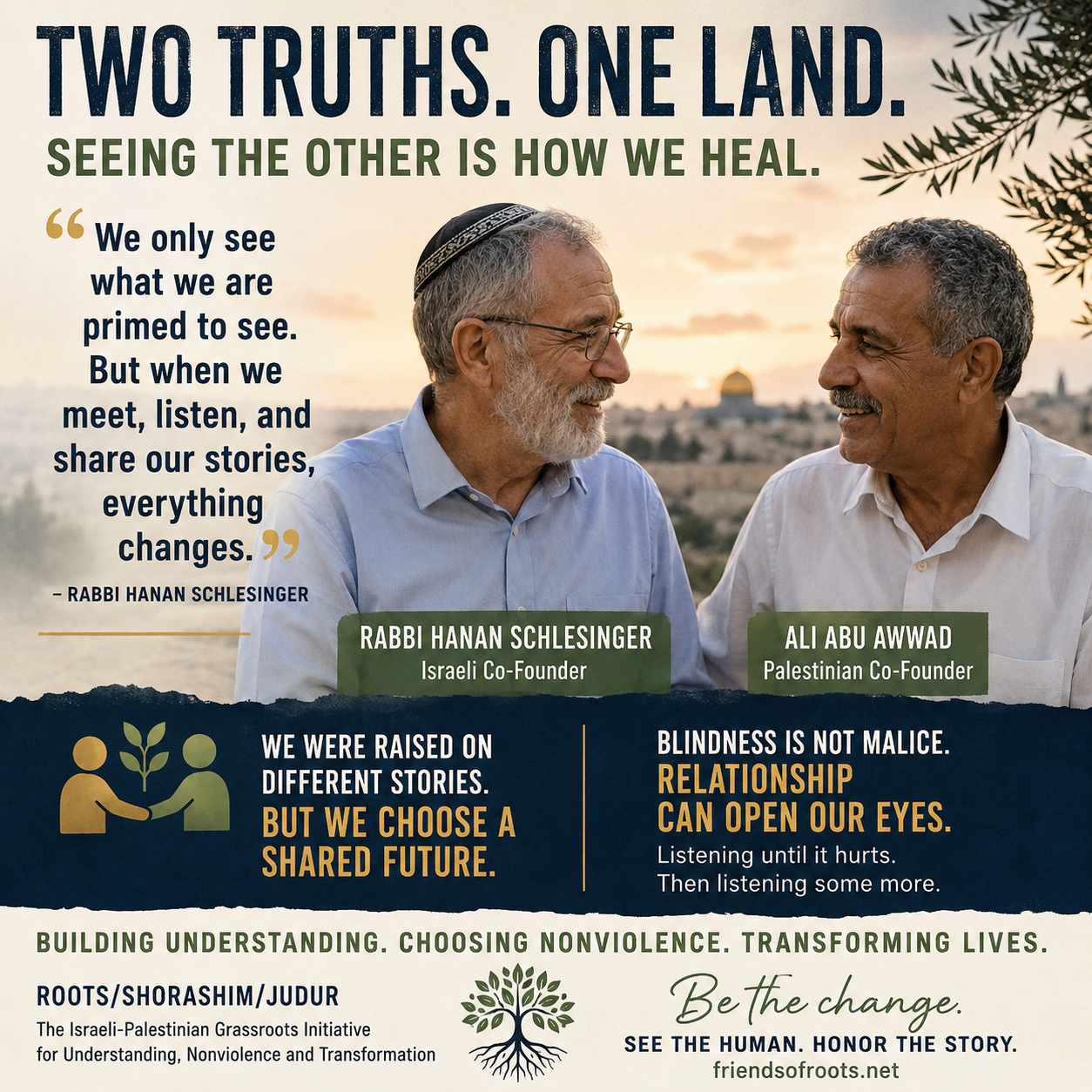
I met Rabbi Hanan Schlesinger a little over a week ago during a presentation about the work of Roots/Shorashim/Judur, the Israeli-Palestinian organization he helped found to foster dialogue, nonviolence, and transformation between Israelis and Palestinians.
What struck me immediately was not just the substance of his presentation, but his storytelling. There was a vulnerability in the way he described his own evolution — from someone who literally did not “see” Palestinians to someone who now devotes his life to helping Israelis and Palestinians encounter one another as fully human.
I knew after hearing him speak that I wanted a deeper conversation.
Then something extraordinary happened.
Related stories
As we talked, I discovered that Hanan and I were born on the exact same day in 1957 — he in Brooklyn, me in the Bronx, just miles apart. We are both New Yorkers by birth. We are both 69 years old this week. Yet despite those shared origins, we grew up with radically different understandings of the world unfolding around us.
That realization became the starting point for a profound discussion about identity, media, race, blindness, history, and what it means to truly see another human being.
“We Only See What We Are Primed to See”
During his presentation, Hanan spoke openly about the fact that for decades he had little relationship with Palestinians and held deeply dismissive assumptions about them. I found myself puzzled.
How could two people born at the same time, in the same city, emerge with such different understandings of what was happening in Palestine and Israel?
I asked him directly whether race and social conditioning might have shaped our perspectives differently.
As a Black girl growing up in America during the Civil Rights Movement, my understanding of oppression and state violence was shaped by what I saw happening to Black Americans. Even as a child in 1967 during the Six-Day War, I instinctively identified with people being dispossessed and marginalized.
Hanan responded with remarkable honesty.
“We only see and hear what we are primed to see and hear,” he told me.
For Jewish Israelis of his generation, the Six-Day War was understood primarily through the lens of existential survival. Israel had been threatened by surrounding Arab nations. The victory felt miraculous. The newly occupied territories — the West Bank, Sinai, and Golan Heights — were viewed almost entirely as security buffers.
What was largely absent, he explained, was any meaningful awareness of the Palestinians living there.
“There was no thinking about them at all,” he said. “There was only the Jewish story.”
The Hubris of Exclusivity
When Hanan immigrated to Israel as a young man, he believed he was fulfilling a sacred historical destiny: returning home after 2,000 years of Jewish exile.
That narrative left little room for anyone else.
Like many Israeli Jews, he said Palestinians existed in the background of the story, almost invisible. Even after moving to the West Bank in the early 1980s, where Palestinians constituted the overwhelming majority of the surrounding population, he never truly encountered them as people.
Then, in 2014, something changed.
He began meeting his Palestinian neighbors.
Not debating them. Not analyzing them politically. Meeting them.
Listening to them.
Hearing their stories.
And slowly, painfully, his worldview began to fracture.
He described realizing that he had lived for decades inside what he called “the hubris of exclusivity” — the belief that only one people’s story truly mattered.
“There are two peoples in this land,” he told me. “Two narratives. Two truths.”
The transformation he describes is not merely political. It is existential.
To recognize the legitimacy of another people’s experience meant reexamining his own identity, his assumptions, and even his understanding of morality itself.
Blindness Is Not Always Malice
One of the most important moments in our conversation came when we discussed the nature of blindness itself.
There is a temptation — especially among those who have experienced oppression — to assume that people who uphold unjust systems are doing so consciously and intentionally.
But Hanan pushed back on that assumption.
He insists that most people are not deliberately refusing to see the humanity of others. Rather, they are shaped by deeply embedded narratives and social conditioning that structure perception itself.
“It’s not willful,” he told me. “It’s the nature of the human mind. You don’t see the other.”
That insight resonated deeply with me because it mirrors the work I have experienced through Coming to the Table, an organization that brings together descendants of enslaved Africans and descendants of enslavers.
The purpose of that work is not simply intellectual analysis. It is encounter.
Relationship.
Seeing.
Because once people genuinely encounter one another, inherited myths begin to crack.
Listening Until It Hurts
Hanan described the process of transformation as emotionally devastating.
Palestinians told him stories about their lives and their experiences of Israeli occupation. At first, those stories contradicted everything he believed about himself and his country.
But he kept listening.
“You listen until it hurts,” he said. “And then you listen some more.”
What slowly emerged was an awareness that Palestinians across different communities were describing remarkably similar experiences — even though they had never coordinated those stories.
That consistency forced him to confront the possibility that he had been participating in a system whose consequences he had never fully acknowledged.
“I’m living at their expense without knowing it,” he realized.
The recognition triggered what he described as an existential crisis.
Could he fully accept what Palestinians were telling him?
And if he did, what would have to change about his own life?
Media, Consciousness, and Waking Up
As publisher of the LA Progressive, I was especially interested in the role media played in his transformation.
Did his information ecosystem change as his worldview changed?
He said yes.
He began reading different newspapers. Following different voices. Meeting Israeli Jews who had undergone similar awakenings. Engaging with Palestinians not as abstractions, but as human beings.
In other words, his consciousness expanded because his relationships expanded.
That observation feels especially urgent in a moment when terms like “woke” have been weaponized and when entire political movements increasingly depend on narrowing empathy rather than broadening it.
What Hanan describes is not “wokeness” as caricatured by cable news pundits. It is something much older and deeper:
the painful process of becoming more fully human.
Roots: Building Encounters Between Israelis and Palestinians
Hanan’s transformation eventually led him to partner with Palestinian activist Ali Abu Awwad, a leading advocate of nonviolent resistance from the West Bank whose own life experience under occupation shaped his commitment to dialogue and reconciliation. Together, the two men helped build Roots/Shorashim/Judur into a rare grassroots space where Israelis and Palestinians can encounter one another not as enemies or abstractions, but as human beings with histories, grief, and legitimate attachment to the same land. The organization creates spaces where Israelis and Palestinians can meet, hear one another’s stories, and begin dismantling inherited fears and myths.
According to Hanan, thousands have participated in these encounters.
Some emerge profoundly changed.
Others experience deep emotional upheaval as long-held assumptions collapse.
“I’ve had Israelis and Palestinians cry on my shoulder,” he told me, “as they discovered they had lived their whole lives without seeing this additional element of reality.”
The work is not easy. Nor is it linear.
Even within Hanan’s own family, responses to his activism vary widely. One daughter became deeply involved in Israeli-Palestinian dialogue work. Another emotionally withdrew after the trauma of October 7. One son supports his efforts. Another strongly opposes them.
Like many families living through political and moral upheaval, his reflects the fractures of the broader society.
Two Truths in One Heart
Toward the end of our conversation, I asked Hanan what he hopes the next 30 years might bring.
His answer stayed with me.
“I hope there will be equality and brotherhood between Israelis and Palestinians,” he said. “I hope there will be two truths in one heart. Two peoples in one land.”
But he also acknowledged something essential:
peace is not a permanent destination.
Even under the best political conditions, the work of seeing one another must continue every single day.
Brotherhood must be maintained.
Empathy must be practiced.
Reconciliation must be renewed continually.
I found myself wondering aloud whether that ongoing struggle — the constant effort to become more humane — might itself be the purpose of being alive.
Hanan nodded.
“That,” he said, “is the very essence of being fully human.”As our conversation came to an end, I thanked Rabbi Hanan Schlesinger for spending part of our shared birthday with me. In a world increasingly shaped by division, fear, and the refusal to truly see one another, our conversation felt like a gift — not just because of what was said, but because of the honesty, vulnerability, and humanity behind it. It was, in every sense, a wonderful birthday gift.
Learn More About Roots/Shorashim/Judur
Rabbi Hanan Schlesinger can be reached at: [email protected]
Hanan shared the video below for people who want more information about Roots/Shorashim/Judur
Comments

Powered by RoundtableAn AI/DeFi-powered Enterprise Media Operating System. Learn more at Roundtable.io.© Roundtable 2026. By using this site you agree to the Terms of Use and Privacy Policy