


Jan 31, 2026 3:42 AM
The Step‑by‑Step Collapse of Moral Resistance. In 1930, Germans still filled the streets. By 1938, open opposition had vanished.
Why 1930 Matters—and Why 1938 Terrifies
One of the most persistent questions people ask when confronting the Holocaust is deceptively simple: Why didn’t people protest? The answer depends entirely on when you are asking.
Germany in 1930 and Germany in 1938 were not the same country. Treating them as such flattens history—and obscures how authoritarianism actually takes hold.
This distinction matters now, because democracies rarely fall in a single dramatic moment. They erode in stages. Each stage conditions people to accept the next.
1930: A Country Still Loud, Still Fighting
In 1930, Germany was still the Weimar Republic. It was unstable, polarized, economically devastated—but it was not yet a dictatorship.
Related stories
The streets were full of protest.
Workers marched. Trade unions organized. Social Democrats and Communists mobilized against fascism. Liberals warned about political extremism. Anti-Nazi demonstrations were common, and clashes between rival political groups were routine.
But here’s the crucial point: these were not mass protests specifically organized to defend Jews.
Antisemitism was widespread, normalized, and openly expressed across much of the political spectrum. While Nazi rhetoric targeting Jews was growing more extreme, persecution had not yet become formal state policy. For many Germans, the threat felt abstract—another ugly feature of political life rather than a looming catastrophe.
The dominant frame was not “protect Jewish citizens.” It was “save democracy” or “stop fascism.”
That framing failure would prove fatal.
Jewish Germans Were Not Outsiders
Another uncomfortable truth complicates the moral narrative: Jews were deeply embedded in German society.
Roughly 100,000 Jewish men served in the German military during World War I. About 12,000 died. Thousands were decorated for bravery.
These were not marginal figures. They were patriots. Veterans. Professionals. Neighbors.
For many Jewish families, Germany was not just a place of residence—it was home.
That history makes what followed not just persecution, but betrayal.
The Lie That Made Atrocity Possible
After Germany’s defeat in World War I, right-wing nationalists advanced the “stab-in-the-back” myth: the claim that Germany had not lost militarily but had been betrayed internally—by Jews, socialists, and democrats.
It was a lie. But it was politically useful.
Once this myth took hold, Jewish military service stopped counting. Loyalty stopped counting. Citizenship became conditional.
And when loyalty becomes conditional, no credential is ever sufficient.
1938: When Protest Became Impossible
By 1938, the question “Why didn’t people protest?” no longer makes sense.
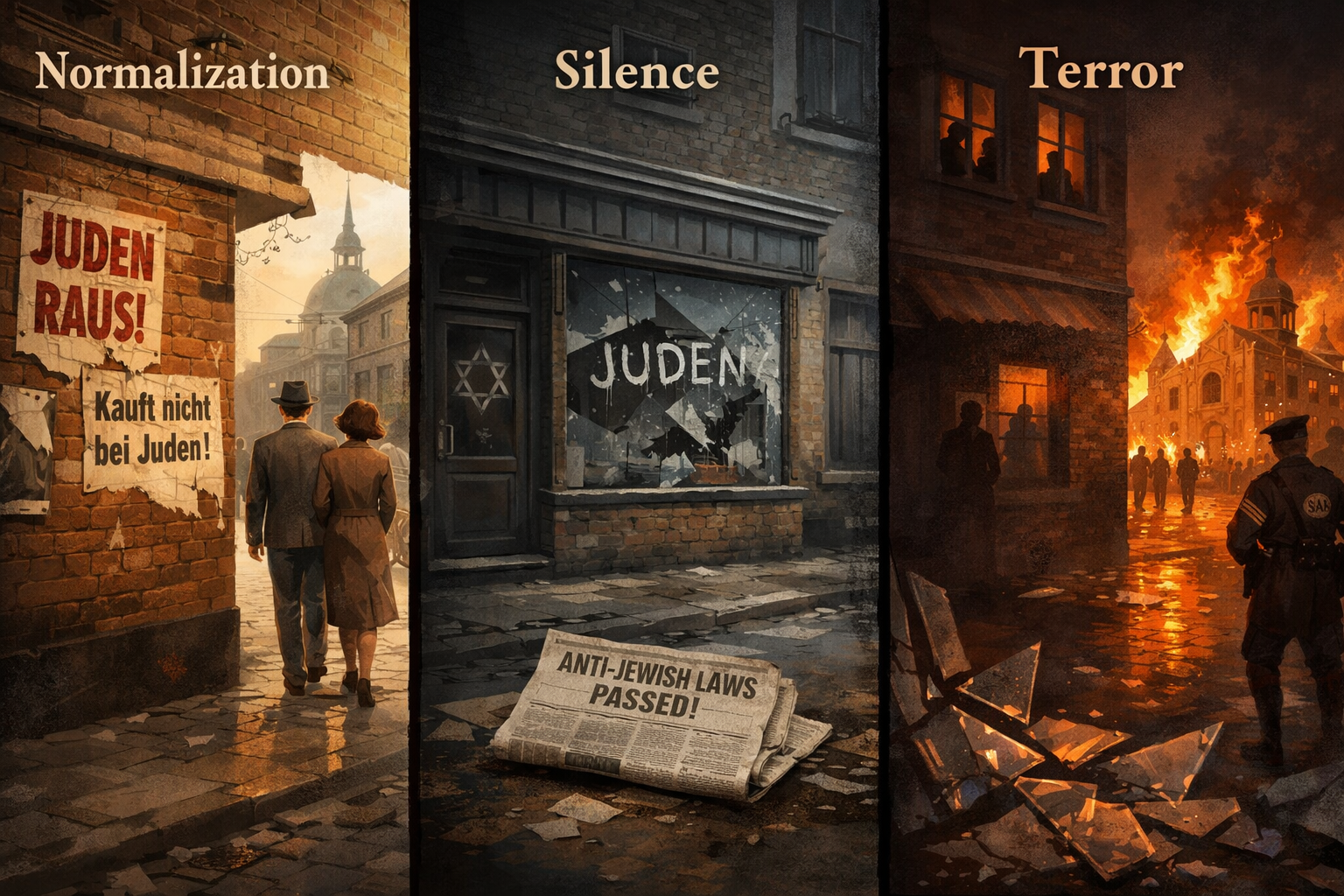
Germany had become a full police state. Opposition parties were banned. Independent media was destroyed. The security apparatus operated without legal restraint. Public dissent was treated as treason.
Then came Kristallnacht.
Synagogues burned across the country. Jewish businesses were smashed. Tens of thousands of Jewish men were arrested and sent to concentration camps. Jews were forced to pay for the destruction done to them.
This violence was public, nationwide, and coordinated.
And there were no mass protests.
Not because people approved—but because the cost of dissent had been made unbearable.
Authoritarian systems do not require universal belief. They require silence.
Historical Sidebar: Service and Shattered Illusions
Jewish Veterans of World War I
Around 100,000 Jewish men fought in Germany’s military during World War I. Thousands were decorated for bravery, and about 12,000 lost their lives on the battlefield. Many of these soldiers believed their service and sacrifice had firmly established their belonging in German society.
Kristallnacht (1938)
Less than two decades later, the Nazi state orchestrated nationwide anti-Jewish violence: synagogues burned, businesses destroyed, mass arrests carried out. Military service records did not protect Jewish veterans from persecution.
The same state that once accepted their loyalty later declared them racial enemies.
The Dangerous Myth of “Why Didn’t They Stop It?”
Asking why ordinary Germans did not rise up in 1938 subtly shifts responsibility away from the system that made resistance suicidal.
The better question is this:
Why was resistance still possible in 1930—and why wasn’t it used to draw a hard moral line around antisemitism then?
The answer is uncomfortable.
Antisemitism was tolerated. Minimized. Treated as rhetorical excess. Jews were expected to endure hostility quietly, while the “real” political battles played out elsewhere.
By the time persecution became unmistakable, the capacity for collective action had already been dismantled.
How Democratic Capacity Collapses - Then and Now
This history is not only about Germany. It is about democratic capacity — the public’s ability to organize, dissent, and set moral limits on power.
Democracy does not fail when terror peaks. It fails earlier, when:
- Targeted groups are rhetorically isolated
- Rights are framed as negotiable
- Institutional guardrails are weakened
- Political violence is normalized
- Citizens treat exclusion as someone else’s problem
By the time repression is visible, the infrastructure of resistance has already been dismantled.
The story of Germany between 1930 and 1938 is not mysterious. It is procedural.
Democratic breakdown is a process of conditioning. People adapt to each new boundary crossed — until no boundary remains.
Democracy does not die because people fail to protest at the end.
It dies because they fail to recognize when the end has already begun.
Further Reading: How Democracies Slide into Authoritarianism
- The Coming of the Third Reich — Richard J. Evans The most accessible and authoritative account of how Germany moved from democracy to dictatorship.
- They Thought They Were Free — Milton Mayer Interviews with ordinary Germans explaining how they gradually adapted to Nazism.
- Hitler’s Willing Executioners — Daniel Goldhagen Controversial but important examination of antisemitism’s depth in German society.
- The Wages of Destruction — Adam Tooze Shows how economic crisis and state planning drove Nazi expansion and repression.
Comments

Powered by RoundtableAn AI/DeFi-powered Enterprise Media Operating System. Learn more at Roundtable.io.© Roundtable 2026. By using this site you agree to the Terms of Use and Privacy Policy