



Sep 9, 2019 9:27 AM
Updated Feb 10, 2022 10:09 PM
Valerie Vande Panne: Street papers can support everyone in a community by providing a deeper and more meaningful understanding of our shared spaces, especially in cities.
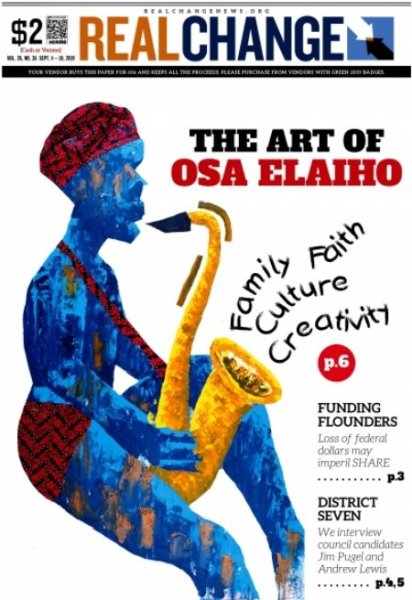
Street papers unite to serve communities around the world.
Boston has Spare Change. Seattle has Real Change. Oklahoma City has the Curbside Chronicle.
London has The Big Issue. Lisbon has Cais. São Paulo has Ocas".
What all of these have in common is that they are all considered street newspapers: Local newspapers that support those with very low incomes or who are experiencing homelessness by providing no-barriers access to make legitimate money with dignity.
Related stories
Around the world, these papers are a part of the International Network of Street Papers, or INSP.
You may have seen these papers in your own city, and you may have even purchased one from a vendor. Vendors often consider these papers to be vital to their survival, like Michael Thistle in Boston, who sold Spare Change throughout his battles with both homelessness and throat cancer.
“It saved my life,” Thistle told Next City. Selling the newspaper “made me viable while I had the cancer.”
The papers all generally follow the same model, in that a vendor can receive a few papers for free, and then pays a certain amount—say, 50 cents—per copy. They sell the papers on the street for $2 each, plus, perhaps, tips.
Street papers can support everyone in a community by providing a deeper and more meaningful understanding of our shared spaces, especially in cities.
In this way, the vendor is accessing a meaningful way to make a living and gaining a sense of dignity and self-respect while cultivating community ties. The person purchasing the paper is supporting someone in a low-income, or possibly homeless, situation, and gets not only the quality reporting the street newspapers offer, but also the opportunity to interact with someone low-income in a safe, meaningful, community-level way that breaks down barriers between people of middle and upper classes and people experiencing homelessness.
Street papers, therefore, can support everyone in a community by providing a deeper and more meaningful understanding of our shared spaces, especially in cities.
Twenty-five years ago, the folks at The Big Issue in the UK started the International Network of Street Papers, primarily in Europe. Two years later, the North American Street Newspaper Association started in the U.S. By 2013, the two networks joined forces to become the world’s only global network of street newspapers, covering six continents.
The main service of INSP is generating, gathering and collating content, which is then shared across their network. The group works with over 100 volunteer translators, in different language combinations, to translate the different articles and make sure they are accessible throughout their network, as not all street papers have professional journalists or can afford to pay them. It’s a way for street papers to access high-quality content to republish in their own publications.
INSP also connects papers and people with one another, coming up with ways for members to share practices with one another, linking people up and sharing best practices.
Based in Glasgow, a city known for its strong support system for social enterprise, INSP supports over 100 street papers in 35 countries around the world, from Hong Kong to Oklahoma City; Serbia to Taiwan; Cape Town to Cologne; and Albuquerque to Athens. Through this network, over 20,000 vendors are supported, and the papers reach over 4.5 million readers in 26 different languages.
“It’s cool to work across so many different countries and cultures and learn about different social issues in different cultures,” says Zoe Greenfield, operations manager at INSP.
Funded by membership fees based on organizational revenue, INSP is also funded by grants, the Scottish government and the Glasgow city council.
The biggest challenges, says Greenfield, are external to the network and often felt around the world, including the political and economic aftermath of the last global recession, which had a big impact on homelessness. The political shift to the far right has had a big impact on street papers as well, including discrimination against the marginalization of groups.
Other common challenges include policies that criminalize the behaviors associated with poverty and homelessness, including people being penalized for handing out food or sleeping in certain places.
Mainstream, corporate media outlets that are disconnected from these issues are also problematic.
INSP’s network of papers is grappling with these social and economic issues by generating their own coverage, as well as political action—something Real Change in Seattle has inspired tangible success with by not only preventing the construction of a new jail, but replacing the politicians who promoted it.
On a more street level, perhaps unsurprisingly, is the unique challenge of maintaining human interaction, between people, in an increasingly siloed and cashless society. “We need to maintain the human interaction,” says Greenfield. “We’ve seen a lot of street papers looking at how to do that.”
Street papers, says Greenfield, are rising to the challenge. The results have seen the implementation of app-oriented payment systems people can use to purchase papers from vendors on the street.
Perhaps most surprising is that even while payments become virtual, and while local papers and alt-weeklies fold nationwide, street papers keep going, harkening back to the days even before home delivery to the time when people bought papers from a vendor on the street corner.
Israel Bayer, director of the North American Bureau of the INSP, says street papers are “going back to the roots of an unjust world and selling papers on the corner.” It seems there is a yearning for that.
The North American Bureau, also known as INSP-North America, was created to bring North American INSP members together and to share information specific to North America, such as dealing with the border wall.
In North America, there are 23 street papers in the U.S., three in Canada and one in Mexico City, and all are INSP members.
INSP-North America is creating a regional network that is a part of the international movement, yet in the same time zone as the other regional street papers (more or less). There’s the added bonus of being more culturally aware of the political and social dynamics happening on the ground. The regional group is able to offer technical assistance by supporting street papers to build capacity, to work with papers on business plans and fundraising strategies.
“We’re laying a foundation for what’s to come,” says Bayer. “Some street papers have a staff of 20 people, while some are just one person.”
INSP-North America, he says, is trying to raise all boats, “thinking bigger and broader, so that will include a lot more joint projects between street papers, [and the] ability to take some of the excellent voices from the street and elevate them into a national dialogue.”
On a nitty-gritty level, “We’re working on developing a vendor training video for all street paper vendors,” explains Bayer, in addition to “Designs for templates for tabloids and magazines to provide professional, clean layout.”
The benefits of the international network, says Bayer, are that “regardless of where we are geographically, we’re dealing with homelessness and extreme poverty. We all have a publication that offers people on the streets a dignified income to improve their quality of life through [the] sale of tabloids and magazines. Regardless of political or social environment, we have the same core: We offer those in extreme poverty a source of income. People can work towards having a home or maintaining a home.”
“From a functional place, that’s where we come together,” says Bayer. “Socially, we live in a global world. Many of the issues that are happening on our continent—immigration, climate change, homelessness—are all common factors that all of our communities are dealing with.” Indigenous issues, says Bayer, are also a priority.
“All of our street paper countries are doing social justice work, investigative reporting, and are working with people in a world in migration,” says Bayer.
“Readers only apply these issues to their own communities, but most of the world is in migration now. These themes are themes that bind all of our papers together.”
Bayer points out that in the United States, “We’ve disinvested from housing for four decades, and the result is mass homelessness. Housing is a public infrastructure, no different from roads, police, and fire [fighters].”
Having the network of INSP is incredibly supportive as publications in cities around the world deal with issues of poverty and housing. Together, the movement is stronger than they would be facing these issues alone.

Learn more at insp.ngo.
Valerie Vande Panne
Independent Media Institute
Valerie Vande Panne is a writing fellow and chief correspondent at Local Peace Economy, a project of the Independent Media Institute. She is an independent journalist whose work has appeared in Columbia Journalism Review, In These Times, Politico, and many other publications.
This article was produced by Local Peace Economy, a project of the Independent Media Institute.
Comments

Powered by RoundtableAn AI/DeFi-powered Enterprise Media Operating System. Learn more at Roundtable.io.© Roundtable 2026. By using this site you agree to the Terms of Use and Privacy Policy