


May 12, 2023 2:00 PM
The extent of grief’s reach among American society has often gone underestimated, despite good-faith efforts to measure it.
Today, the US declared the end of the COVID-19 emergency. There has been and will be no public celebrations or grand pronouncements of “mission accomplished.” Instead, the declaration draws to quiet close various pandemic programs and policies. But for millions of Americans who continue to struggle with the effects of COVID loss, the announcement ushers in an unwelcome beginning, a confusing new phase of mourning that asks, “If it’s officially over, am I no longer allowed to grieve?”
Their experiences tell us that the undercurrent of grief left in the pandemic’s wake is anything but gone. Part of the disconnect lies with how narrowly we’ve defined who gets to mourn and for how long—something each of us (artist, writer, and academic) have encountered over the past three years working with the COVID bereaved.
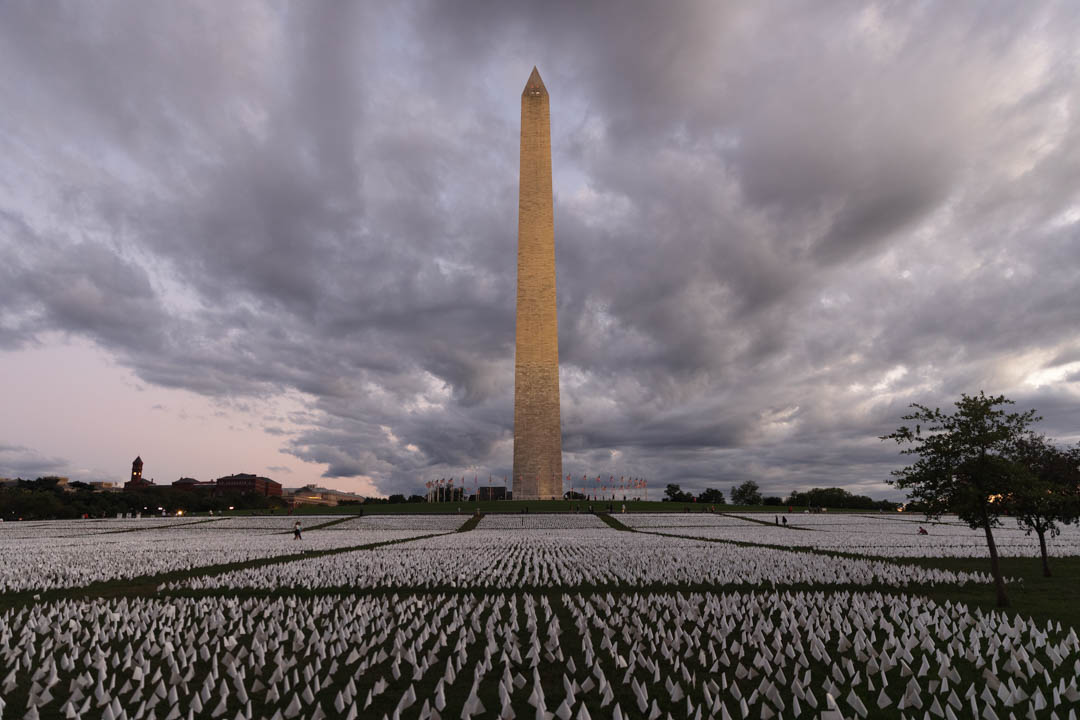
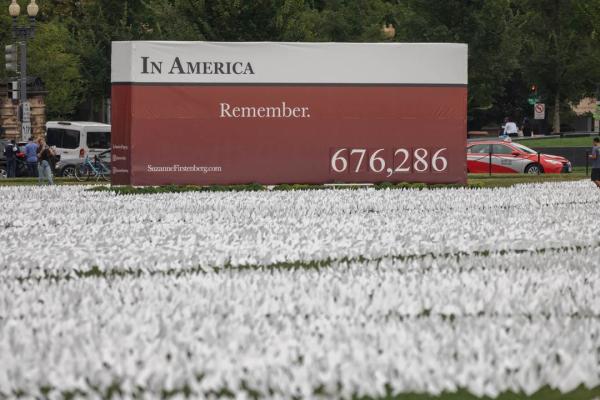
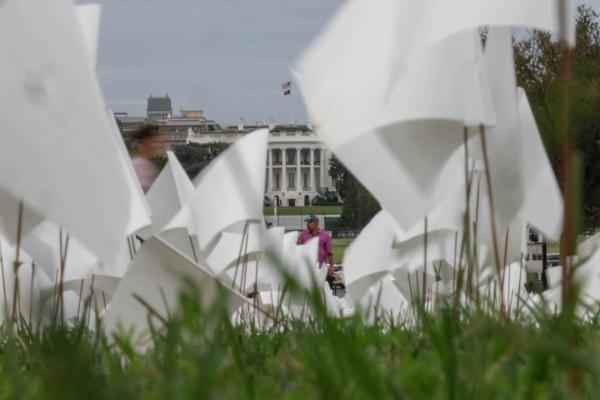
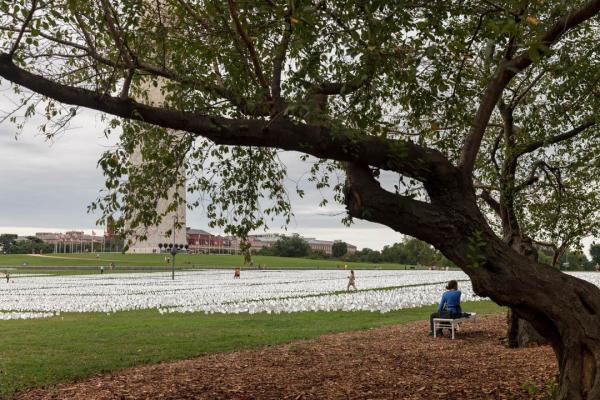
Suzanne’s public art installation In America: Remember on the National Mall made space for anyone – close kin or total stranger – to dedicate a flag to someone who died of the virus in the United States. The 20,000 inscriptions bear witness to the myriad relationships of mourning caused by the pandemic. Martha’s website WhoWeLost.org offers a “sheltering” space for anyone who wishes to write a story of remembrance, whether about pandemic death or recollections of a life lived.
Sarah and her research team have attended dozens of in-person and virtual memorials, and spoken with hundreds of bereaved and those who support them. We’ve seen firsthand the ripple effects of loss throughout families, friendships, communities, and our society as a whole.
Related stories
The extent of grief’s reach among American society, however, has often gone underestimated, despite good-faith efforts to measure it. For example, early in the pandemic a study came out positing that for every one death there are nine family members affected. While acknowledging the potential pitfalls of too limited a rubric of kinship, the authors defined those relatives as grandparent, parent, sibling, spouse, or child. The “COVID-19 bereavement multiplier” quickly gained traction, its ratio quoted widely by policy makers and in media coverage.
Such quantifications have shaped the public’s expectations about who counts as a bereaved. But dropped from the equation are other categories of mourners, especially those who cared for the dying and the dead – healthcare workers, including ICU nurses and doctors, nursing home and long-term care facilities staff, funeral home staff, clergy members, and so on. Then there are friends, neighbors, teachers, and coworkers. In short, if you think you don’t know someone who is still grappling with pandemic grief, think again.
When the “bereavement multiplier” study was published in July 2020, the researchers hypothesized about a projected 190,000 COVID deaths in the United States, a number which now seems tragically quaint. And its prominence in news cycles made sense, for everything was about numbers then – case counts, empty ICU beds, available ventilators, pulse oximeter data, how many seconds to wash our hands, how many inches it took for a sneeze to escape a mask and infect an entire choir. Counting counted.
But now, as we near 1.2 million deaths in the U.S., we look less at numbers, or not at all. Public health departments have largely stopped counting cases, forcing even the Johns Hopkins COVID-19 Dashboard to cease updates due to lack of incoming data. We hear little about vaccination or positivity rates.
Perhaps, then, it is time to reevaluate how we look at pandemic grief and re-examine its origins rather than solely investigating the genesis of the virus itself.
Perhaps rather than referencing a contextually outdated bereavement multiplier, we might look at the ways in which the politicization of the virus and its attendant disinformation still influence how and who we grieve.
Right now, on the back end of the WhoWeLost.org website, there are dozens and dozens of unpublished stories, written by people who feel unable to share their grief publicly but still ache to express it. They send reminiscences with notes attached, explaining that they fear expulsion from their families, trolls on social media, and sometimes just simple disinterest with a command to “move on.” They ask that the stories be “held” until such time when they might be more comfortable sharing. The word “held” is potent because these mourners are also asking to be embraced and have their grief recognized without questions about comorbidities and political affiliations.
A common hashtag used by the Covid-bereaved who don’t avoid social media is #notjustanumber. It gained prominence early in the pandemic and its popularity persists. Maybe it’s time we take the hashtag literally. As we jettison the numbers, the quantifiers that have helped epidemiologists but not necessarily grievers, we can look at the grief as part of a continuum that deserves attention, care, and above all patience. We can extend a declaration of empathy to those who lost and continue to mourn – no expiration date needed.
Comments

Powered by RoundtableAn AI/DeFi-powered Enterprise Media Operating System. Learn more at Roundtable.io.© Roundtable 2026. By using this site you agree to the Terms of Use and Privacy Policy