


Luigi Mangione and Mainstream Media
Dec 16, 2024 7:33 PM
Updated Dec 17, 2024 7:19 PM
The shooting of the UnitedHealthcare CEO executive has received nonstop media coverage. So why don't we know more about America's healthcare problems
A few years ago, my daughter went on her first trip to Paris. As she deboarded the plane, she slipped, twisted her ankle, and ended up in a Paris hospital emergency room. Fortunately, her ankle wasn’t broken, but she had a pretty bad sprain that put her on crutches for her entire spring break. My daughter was a college freshman at the time and still covered on my healthcare insurance plan.
When she reached me with her "safe arrival call," I was relieved that she was okay and surprised that the accident didn't cost us a dime. They didn't even ask for her medical insurance. I think she told me that they laughed when she offered it. Her being covered by my healthcare plan was irrelevant in Paris. In fact, it would have cost me more if the accident had occurred in her home town, Los Angeles, because of my co-pay.
Our healthcare system is broken. That's no longer debateable, even in mainstream corporate media, but what they generally don't talk about is how American people came to accept for-profit private healthcare insurance as a norm. In some communities, its even seen as a status symbol—a point of pride to have a job that provides this "perk." It is a gatekeeper to the medical care gauntlet where insured patients/consumers aren't always sure of the costs they are incurring when they seek medical care, and, on the other hand, those who are not covered ignore healthcare maintenance and only go to the emergency room when they are in dire need.
I’ve been a supporter of universal healthcare for decades. I so wish the masses in this country would demand more because odds are we'll never have what other countries take for granted, the kind of care my daughter received in Paris, until we, the people, demand it.
Related stories
In all other developed countries, when someone seeks medical attention, the notion that they could be turned away for lack of payment or insurance or, if the medical care is provided, could cause them to go bankrupt is unthinkable. The fact that so many Americans are tied to jobs they hate for fear of losing healthcare insurance coverage for themselves or their dependents is foreign to most people living in other developed countries. In the U.S., this kind of healthcare manipulation and exploitation is normalized—so normal that most Americans know no other way of living. They accept what the rest of the developed world won’t tolerate.
Why do we accept this—and what would it take for Americans to stand up and demand what the rest of the developed world takes for granted? Does mainstream corporate media have a role in this?
The story I told of my daughter's experience at a Paris hospital is but one experience that informed me of this: Americans are being fleeced. My decades-long experience publishing the LA Progressive has shed light on how the media, especially mainstream corporate media, helps to prepare the public to be compliant and easily fleeceable.
According to the Journal of Social and Political Psychology, a range of empirical studies have found that mainstream corporate media plays a role in shaping public debate and public opinion and helping to construct the kind of public beliefs that either lead to social change or maintain the status quo.
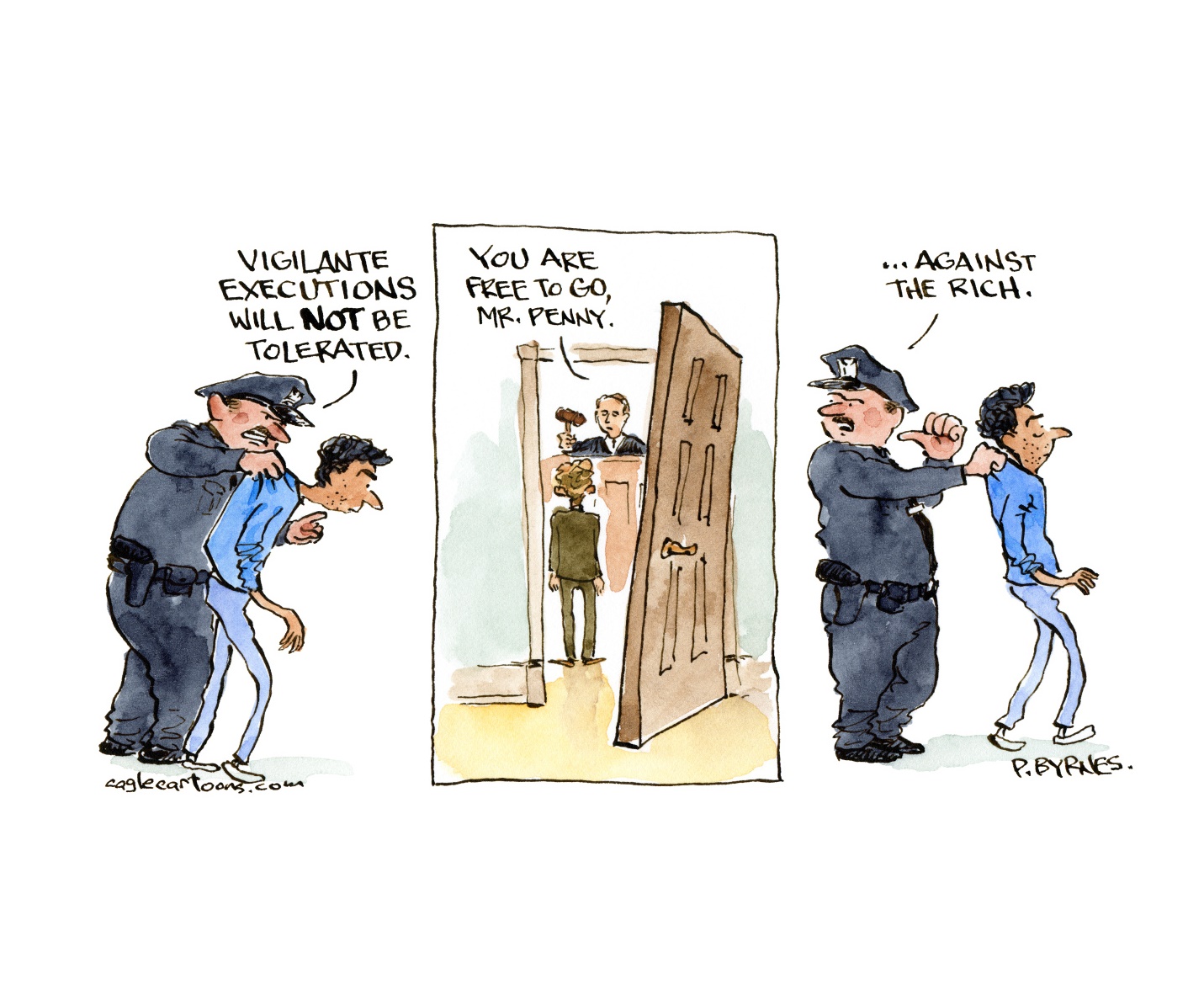
When one considers the coverage mainstream corporate media has served up since the shooting of the UnitedHealthcare CEO, it doesn’t take much imagination to see that it is carefully following an agenda—one that does not spur the public to question why we receive such shabby treatment when all other comparable nations take care of their people. Given the terrible state of healthcare access in the United States, the UnitedHealthcare tragedy provides a window of opportunity to engage and inform the public on this issue. But its unlikely corporate mainstream media will do that. It isn't in their interest to provide news coverage that leads to the kinds of questions that wake up the sleeping giant.
Americans are accused of having a short attention span. I don't know if that is true, but I will acknowledge that because more people are focusing their attention on healthcare insurance since the shooting, now would be a good time for mainstream corporate media to also focus on the extreme disparities in healthcare and offer possible solutions. For example, compared to the rest of Western society, America has high medical standards, but large swaths of its people don't have access to them.
Since the shooting of the UnitedHealthcare executive, viral stories on social media submitted by insured people who have had healthcare claims denied and the devastating impact those denials have had on their lives shed light on the brokenness of the system and could have given mainstream corporate media an opportunity to offer investigative in-depth reporting, explaining why our system is so broken—but they didn't follow that path.
The UnitedHealtcare story gave corporate mainstream media a lot of options. They could have taken any number of directions; for example, the handgun (or at least parts of the handgun) believed to be used in the killing was made with a 3D printer. Or the fact that the death of the UnitedHealthcare CEO is just one death among the estimated 50,000 deaths that will be caused by firearms in the United States this year alone.
To be more specific, mainstream corporate media could have provided any number of in-depth investigative pieces that could have informed the public on ways to improve our healthcare system, but instead, for the most part, their stories have focused almost exclusively on Luigi Mangione, ad nauseum. So much so that one wonders the purpose of this coverage. Is it in the public's interest to learn everything there is to know about Luigi Mangione? Or is this kind of coverage a type of slight of hand that leads people to believe they are doing their civic duty to stay informed but instead are being distracted and entertained?
What is, "Deny, Defend, Depose"? It is a phrase often used to describe tactics employed by insurance companies, particularly when dealing with claims, where they might "deny" a legitimate claim, "defend" their decision against legal challenges, and potentially "depose" witnesses to support their position. Insurance industry executive, Wendall Potter, tried to warn us a decade ago.
Bill Moyers was the kind of journalist who knew how to inform. As I watched some of the coverage being served up as "journalism," I thought of Bill Moyers. Here is one of his interviews on healthcare insurance that was recorded several years ago. Wendall Potter, a former healthcare insurance executive, spills the beans about for-profit healthcare. It's as true today as it was when it was recorded.
Comments

Powered by RoundtableAn AI/DeFi-powered Enterprise Media Operating System. Learn more at Roundtable.io.© Roundtable 2026. By using this site you agree to the Terms of Use and Privacy Policy