


Apr 29, 2017 5:55 PM
Updated Feb 10, 2022 10:26 PM
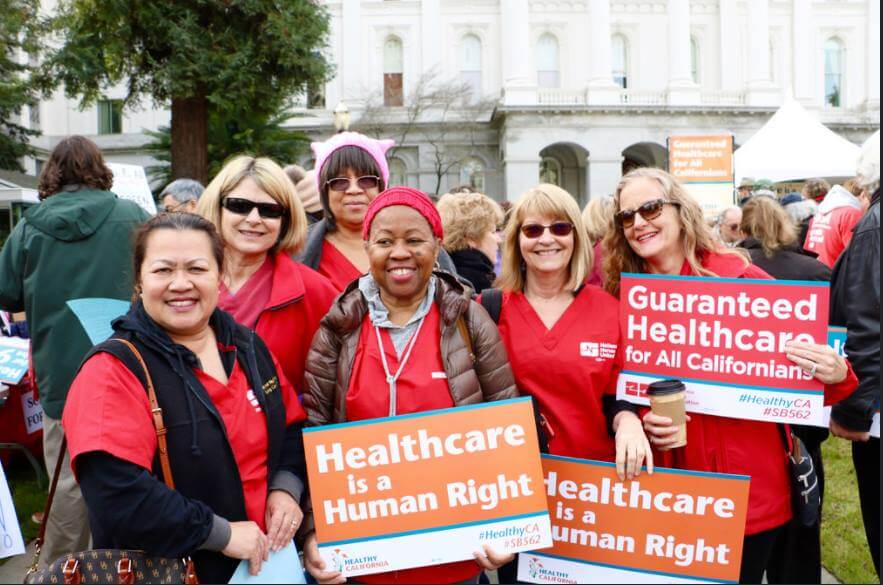
If adopted, the Golden State's newly introduced single-payer healthcare insurance legislation, The Healthy California Act (SB-562), would save an estimated $344 billion over ten years.
California faces a classic anomaly.
If adopted, the Golden State's newly introduced single-payer healthcare insurance legislation, The Healthy California Act (SB-562), would save an estimated $344 billion over ten years, according to a 2005 study. It could save the state even more, given that the new "Medicare for All" styled measure would empower a single state agency to negotiate prices for medical care, hospitalizations and pharmaceuticals.
Yet, the principal obstacle to this cost-saving legislation, according to Gov. Jerry Brown, lies in the need to locate the funds necessary to implement a California single-payer system.
At the federal level, a single-payer system would save an estimated $1.8 trillion per decade while benefiting 95% of U.S. households by slashing administrative wastes associated with the private insurance industry ($476 billion/year) and by reducing pharmaceutical prices to European levels ($116 billion/year).
Related stories
If adopted, the Golden State's newly introduced single-payer healthcare insurance legislation, The Healthy California Act (SB-562), would save an estimated $344 billion over ten years
Funding for a federal single-payer system could be relatively simple and straight-forward. Congress can reduce military spending and replace premiums and co-pays with a graduated income tax. This could be augmented by a steep excise tax on the super rich, especially the top 1/10 of one percent, who now own as much wealth as the bottom 90%.
The task of funding a state-run single-payer system, however, is anything but straightforward or simple.
Although, like the federal government, California can replace premiums and co-pays with payroll taxes, lawmakers are faced with the fact that private funding accounts for only 29% of California's $367 billion annual healthcare expenditures. A major portion of the public funds now used to pay for healthcare in California comes from the federal government. This includes $71.4 billion in federal Medicare funding and another $62.9 billion as the federal government's share of "Medi-Cal" --- the name California uses for its Medicaid program.
The authors of SB-562, CA Democratic State Senators Ricardo Lara and Toni Atkins, seek to tap those federal funds by directing a newly created Healthy California Board "to seek all necessary waivers, approval, and agreements to allow various existing federal health care payments to be paid to the Healthy California program."
This would leave the decision on whether to approve waivers for how the state uses its federal Medicaid funding in the hostile hands of the Trump administration—an unfortunate circumstance that can, in no small measure, be attributed to what then House Speaker Nancy Pelosi (D-CA) and the Democratic leadership of the U.S. House of Representatives did in the Fall of 2009.
Single-Payer: the only genuine reform
In the wake of a failed Republican attempt to "repeal and replace" the Affordable Care Act ("ACA", or "ObamaCare")—an effort that would have left "52 million people" uninsured over the next 10 years—it is easy to lose sight of the severe deficiencies that remain embedded within the ACA.
Certainly the ACA reflects a significant improvement over the previous "free market" system where, each year, according to a Harvard study, 45,000 Americans died simply because they couldn't afford health insurance. That would be 45,000 in addition to the uncounted numbers of Americans who died when insurance companies simply refused to authorize vital, life-saving medical procedures. Such refusals were far easier for them to do prior to a number of ObamaCare regulations.
Thanks to the ACA, there has been a significant reduction in the number of uninsured Americans. The number has plummeted from 47 million in 2009 to 28.5 million in 2016, according to the Kaiser Family Foundation.
If 47 million uninsured Americans resulted in 45,000 deaths in 2009, simple but ghastly arithmetic suggests that more than 27,000 of the 28.5 million still-uninsured Americans died in 2016 simply because they still cannot afford insurance.
The ACA, of course, is not entirely responsible for the unacceptable number of Americans who remain without insurance. Many lack any form of healthcare because Republican governors in 19 states refused to accept the ACA's federally-funded expansion of Medicaid.
In 2010, after the Democratic leadership eliminated the "public option" as an alternative to the ACA's private health insurance market, former CIGNA executive-turned-whistleblower Wendell Potter derided the legislation as "The Insurance Industry Profit Protection and Enhancement Act."
The accuracy of that assessment may be measured by the fact that U.S. and California tax dollars fund 71% of California's massive $367 billion annual healthcare bill, an enormous portion of which goes into the pockets of the private health insurance industry. Nationally, under the ACA, by 2025, the U.S. government will have forked-over $1.2 trillion in taxpayer-funded subsidies to the profit-driven healthcare insurance industry.
Americans pay more, receive much less.
U.S. per capita healthcare expenditures in 2013 ($8,713) nearly tripled the per capita expenditures in the United Kingdom ($3,235), which has had a much beloved, government-run national healthcare system since 1948. Yet, according to a 2014 Commonwealth Fund study, the U.S. healthcare deliver system ranked dead last amongst eleven industrial nations in terms of "quality, efficiency, access to care, and healthy lives."
Indeed, citing its own Health-Care Efficiency Index, Bloomberg reported that the U.S. healthcare system is one of the world's "least-efficient," coming in 50th out of the 55 countries measured in 2014. The Commonwealth Fund study ranked the U.K. at number one.
Quiet death of the Kucinich Amendment
Single-payer systems do not always arrive first at the national level. In 1962, Saskatchewan became the first governmental entity in North American to adopt a single-payer healthcare system. Over the next ten years, single-payer spread to every province in Canada.
If single-payer could work in a rural province like Saskatchewan, which was somehow able to find the funding, then surely California—whose $2.46 trillion GDP makes it the world's 6th largest economy—can come up with the funds needed to pay for a single-payer system, especially if that included federal funding.
For a brief period during the Summer and early Fall of 2009, it looked as if the door was open for the U.S. to follow the Canadian model. In July of that year, the House Labor and Education Committee voted 27 - 19 to approve an amendment offered by then Rep. Dennis Kucinich (D-OH) to the pending reform bill that would have expressly authorized states to adopt their own single-payer systems. The amendment would have established an element of federalism—an expression of Congressional intent to allow states to go the single-payer route—that would have likely prohibited subsequent administrations from arbitrarily refusing to issue waivers for single-payer state use of funds from programs like Medicare and Medicaid.
Unfortunately, at the end of October that year, the state-run single-payer doorway was slammed shut when the Pelosi-lead House leadership, with little fanfare or mention in the mainstream media, killed the Kucinich amendment by eliminating it from their version of the health insurance reform bill.
It is not entirely clear what impact a retention of the Kucinich amendment in the final version of the ACA would have had on the GOP's ongoing opposition to ObamaCare. What we do know is that the final version of the ACA failed to garner a single Republican "yes" vote. By way of sharp contrast, during the Summer of 2009, perhaps because of its appeal to federalism, thirteen Republicans then serving on the House Labor and Education Committee voted to approve the Kucinich amendment.
Thus, it came to pass that it was the Pelosi-led Democratic House Leadership, and not the GOP, that erected what may now prove to be the principal obstacle to single-payer healthcare in California.

Ernest A. Canning
Comments

Powered by RoundtableAn AI/DeFi-powered Enterprise Media Operating System. Learn more at Roundtable.io.© Roundtable 2026. By using this site you agree to the Terms of Use and Privacy Policy