


Jun 27, 2017 9:58 PM
Updated Feb 10, 2022 11:12 PM
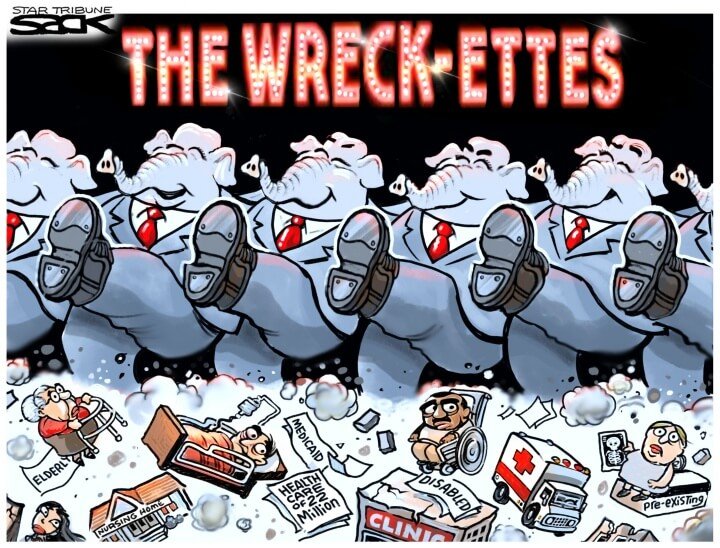
Despite big dollars from big ideological donors, those few Republican Senators see that too many of the votes needed for reelection are vulnerable to being locked out of the doctor's office without mortgaging the family homestead.
On Tuesday morning, Republican vote counts were changing hour-by-hour on Mitch McConnell's drafted-in-secret health care bill, following the CBO rating on Monday of the bill. Amidst the facts, hyperbole, rhetoric, and reality that 22 million additional Americans could lose access to seeing a doctor, there are plenty of astonishments. One is, McConnell can't keep some GOP Senators aboard because the bill doesn't go far enough in eliminating the Affordable Care Act, root and branch, and he's still trying to placate them by making a bill filled with meanness even meaner.
On Monday, McConnell sought to win those malcontents, those champions of "you're not entitled to it unless you personally pay for it with your own money," by making changes. The most visible of those is a new provision to "encourage" Americans to maintain a financial relationship with the for-profit insurance industry as a priority more important than rent or food. It would fulfill the long-standing GOP promise to eliminate Obamacare’s individual mandate, but establish its own punitive penalty on anyone whose finances force them into a lapse in continuous health-care coverage. The new McConnell provision would impose a six-month waiting period before new insurance could go into effect for anyone who had a break in coverage lasting 63 days or longer in the prior year. It would take effect beginning in 2019.
That was designed to win over the four hardest of the hard-boiled Republican Senators -- Rand Paul of Kentucky, Ted Cruz of Texas, Mike Lee of Utah, and Ron Johnson of Wisconsin. Each has expressed intransigence and refusal to vote for anything less than "a full repeal of Obamacare."
In an exercise of utter foolishness, Democrats seem to think those four votes are therefore out of play. We caution that all four are potentially in their party's plus column through deal making from GOP leadership or from the White House, anything that can be portrayed as "killing Obamacare."
Related stories
Meanwhile, ideology and numbers are booted about, to the continuing -- and perhaps utter -- alienation of plenty of people who are not particularly political.
Imagine any of many scenarios that would find you -- any of us who isn't rich -- negotiating the narrow parameters of reinstating your health insurance after "something happened." Something, anything, that had prevented you from making the obscene monthly premium payments of your health insurance, in which, under the new GOP plan, you are wholly on your own. Maybe it was an auto accident that required you to prioritize repairing your car because you must have it to get to work. Maybe it was a sick child whose copayments for point-of-service delivery of care were so high that you had to forego those crushing payments for your own coverage. Maybe the air conditioner went out and the elderly parent who lives with you would die in the heat unless you fixed it.
Point is, everyday strains that would cost you this year's hope for a summer vacation will instead cost you half a year with no health care coverage. And we all know how insurance works: you'll be paying the pirates each of those six months for something you don't get, because the coverage doesn't take effect until the seventh consecutive month that you pay them. You'll be able to go to the doctor then, 183 days after you start paying them, unless something else happens and you lose five months of payments, with no benefit at all, because you can't pay the sixth month. Then the clock starts over, as does the need to send money for something you can't yet use until you've been paying for it for six months.
We're about to say that other numbers matter, too. But none more than those. So, we can get to the Congressional Budget Office (CBO) report rating the Senate GOP health care bill, which has plenty of numbers. Or we can emphasize that six months.
Until recent days, Democrats have been embarrassingly inadequate in presenting scenarios like the ones above. That kind of thing kept them from connecting in 2016, and it's still a problem when someone can't speak at Berkeley because they are "politically incorrect" and kitchen table issues -- how most people relate to things -- aren't being cited to connect with things that actually matter.
It matters when a razor-thin vote is about to be taken and a handful of supposed Republican moderates (if there is any such thing anymore) will decide this. They are the ones who can be reached by arguments of what affects and effects the folks at home, where the 2018 votes are needed if you want to remain in the Senate.
Sen. Dean Heller (R, Nevada) said on Friday he will oppose the bill "in its current form" largely because it makes cuts to Medicaid and de-funds subsidies for individual insurance coverage. Sen. Susan Collins (R, Maine) and Bill Cassidy (R, Louisiana), on their rounds of the Sabbath gasbag shows, said they "can’t say yet" how they’ll vote, as each voiced reservations about McConnell’s speedy deadline for a vote before the Fourth of July break.
Those three, and others, are already facing constituent pressures from the folks at home. No matter how Republican someone is, that doesn't prevent an individual realization -- regardless of eight years of endorsing lockstep rhetoric -- that one's own financial situation will deprive them of a doctor under the GOP plan. In turn, those Senators are torn between a party managing victory under a President who can strand them on a desert island with a tweet, and constituents that send mixed messages of liking their new president and ever-present readiness to blame Congress, not him, when they don't like an outcome.
Despite big dollars from big ideological donors, those few Republican Senators see that too many of the votes needed for reelection are vulnerable to being locked out of the doctor's office without mortgaging the family homestead.
So, forget all the punditry from MSNBC that says the bill is on life support, or the punditry from Fox that says it will pass unless it is betrayed, or the punditry on CNN that says the Russians did it even if CNN just had to fire three of their people for saying so without any evidence. It all comes down to only a handful of GOP Senators who may vote against their party's "repeal and replace" bill and deprive Vice President Mike Pence, voting to break a tie as the presiding officer of the Senate, of being the 51st vote to pass it. Because, despite big dollars from big ideological donors, those few Republican Senators see that too many of the votes needed for reelection are vulnerable to being locked out of the doctor's office without mortgaging the family homestead.
Of course, all elected Republicans are being slammed with the tack the Democrats are taking: the reality that the bill -- in both its House and Senate forms -- is a transfer of wealth, away from helping those with medical needs, to a wealthy class who will use the money for whatever self-indulgent whims it wishes.
But that's really what the Democrats celebrate as the argument that makes them "morally right," and it's parroted as much to keep their progressive factions aboard with the neoliberals as it is an honest tenet. Whether or not that gives any partisan reader heartburn, there is a larger point here: moral superiority really only hits home in the heartland if it's presented as religion or in personal terms. The folks there are tired of Democrats playing Plato on a hill. About everything. Women hate it when it sounds like mansplaining. Men hate it when it comes from Rachel Maddow. Everybody hates it when it's morally superior Demsplaining.
And an awful lot of what hasn't worked for the Democrats is caught up in that image of the pontificating party that doesn't relate to ordinary folks. Had the Democratic Party subjected itself to a badly needed autopsy after the 2016 losses (plural) continued the losses of 2010, 2012 (losses then everywhere but the Presidential level), and 2014, that fact would now be regarded as central. But the Clintonite neoliberals blocked it, and went with the scapegoating game of distraction and obfuscation in a (so far) successful, if delusional, scheme to retain power.
What's really useful is to humanize the CBO's numbers -- not simply that the Senate bill keeps intact almost all of the House’s tax cuts for the ultra wealthy. But that the biggest losers would be people who make 351 percent of the federal poverty level -- a little over $42,000 for an individual -- who would go from paying a maximum 9.7 percent of their income in premiums to paying a sky's-the-limit, whatever-the-market-will-bear monthly fee, with no cap at all. While the Senate GOP bill provides far more assistance to the poor and near-poor than the House GOP bill, the Senate plan still cuts the hell out of Obamacare's subsidies and becomes more devastating over time, as it imposes longer-term austerity on health spending by government on behalf of even its most needy citizens. The bill's "extra help" for states and the insurance exchanges, over time, would "phase out," and cuts to Medicaid and to insurance protections would "phase in." And it isn't hard to incite ire when you can quote that tax cuts for the rich are immediate, paid for by your decreasing access to the doctor "phasing in."
It's disingenuous for Democrats to talk about "death panels" in an effort to throw Republican rhetoric of 2009 back in their faces. But it isn't deep-weeds wonky to cite the realities in terms people can grasp. Like the fact that the GOP bill makes things a lot worse over time. For example, in 2025, the Senate bill would go even farther than the House in imposing an absolute cap on federal Medicaid funds by using the consumer price index, rather than a measure of medical inflation that tends to rise more quickly. Cite that alongside the fact that half of all births in the US are now paid for with Medicaid funds, and you have a shocker.
On the subject of shockers, it's time we transcend the fight over an Obamacare system that is, at essence, a full employment act for the for-profit insurance industry, vs. a Republican free market free-for-all that is free for nobody and rations health care delivery solely on the basis of wealth.
It is simply obscene that someone, somewhere, who has absolutely nothing to do with determining what is medically the most appropriate care or treatment for any particular individual patient, must make a profit. And that they must collect their profits before any parameters are even established for what latitude of allowable options are made available to the doctor or the patient.
The present system is predicated on profit-making and profit-taking, and the GOP proposals are an effort to retrench that to an extreme. So isn't it time we asked ourselves whether there aren't enough other ways for investors to make a profit in our society without life and death and living in suffering? Can't easing human suffering be the only goal that matters, instead of an arena where the seats are too expensive, and financial gladiators joust over second yachts, condos at Vail, and third vacation homes?
If we are not willing to change the fundamental equation to remove monetary profits and require rewards for investor capitalism from health care delivery, we are choosing to accept that human beings in the United States of America will be relegated to living with pain and suffering and the likelihood of addiction to prescription drugs instead of curative treatment. We will be accepting that we are willing to abandon part of our creativity and productivity because we kick people to the curb and deprive them a place in the work force when they become sick or injured.
We can read endlessly of health care executives who finance harems of young women, some with children they have fathered. Or who establish private compounds in Florida, where they import giraffes and African antelopes to roam, so they can watch them out their windows and brag to their fellow multi-millionaire health exec guests. Or who simply live ostentatious, privileged lifestyles while their companies deny patient claims for needed care.
We can grouse and even feel righteous outrage, and let it all come down to a fight for propping-up Obamacare and its guarantee of subsidizing a system to enrich the insurance companies, or the GOP desire to remove the constraints from the insurance companies so they can maraud across the landscape and cherry pick those who they will cover most profitably. Or we can do what the rest of the industrialized world does, and divorce capitalism from the idea of health care as a right of citizenship.
I said that the obscenity of all this makes it time for something shocking. Here it is. This'll sound smarmy-sarcastic. It's not intended that way. I am being, quite literally, deadly serious.
Americans are the only ones in the industrialized world who live in constant suffering from treatable medical conditions, because the needed treatments are "out of plan," or require astronomical "co-pays," or are, for various reasons that inevitably are due to our uniquely for-profit health delivery "system," unprofitable for the moneyed interests who must profit if anything is to be delivered.
Amendments are now being introduced in the US Senate to the GOP health care bill. We'd like to offer one, and it doesn't matter whether a Democrat or a Republican introduces it. Because none should be as important as this one.
It's time we organize a full-court press for federally-guaranteed universal Physician-Assisted Suicide.
I am, as I said, deadly serious. And it's time we were open and honest about all this. Because, quite simply, if everyone who is living with a painful, debilitating condition that should be treatable but for which treatment is "unavailable," can finally be told:
"You cannot afford the treatments (or astronomically expensive prescription drugs, or the surgical procedures) that would make you whole again, productive again, able to function competitively in the work force again, able to feel a sense of fulfillment and wholeness again; and you will, as the result of not being wealthy, live your live with declining functionality; downward-spiraling debility, and ever-increasing pain."
Then how many among us would welcome a way out?
There is a very real "death panel" and, while what it is differs with circumstances, it is ever present in the health care debate. Right now, it takes the form of decisions made by those who lack access to the resources needed to qualify applicants for subsidies and MediCal. Soon, it may become an office of sharp-pencil accountants (or their robotic A.I. replacements) that determine who will be allowed to access health delivery at a profit to their insurance company. In the end, the death panel manifests in a simple question -- whether we are honest about who can live with the comfort and care of the best that medicine, in all its techno-pharmacological-surgical-therapeutic wonderfulness can be made to provide, and who must live in painful debilitation due solely to their economic circumstances.
If a profit-driven paradigm is to determine health delivery, the most humane thing we can do is offer patients who are not being served a way to opt-out.

Larry Wines
Comments

Powered by RoundtableAn AI/DeFi-powered Enterprise Media Operating System. Learn more at Roundtable.io.© Roundtable 2026. By using this site you agree to the Terms of Use and Privacy Policy