
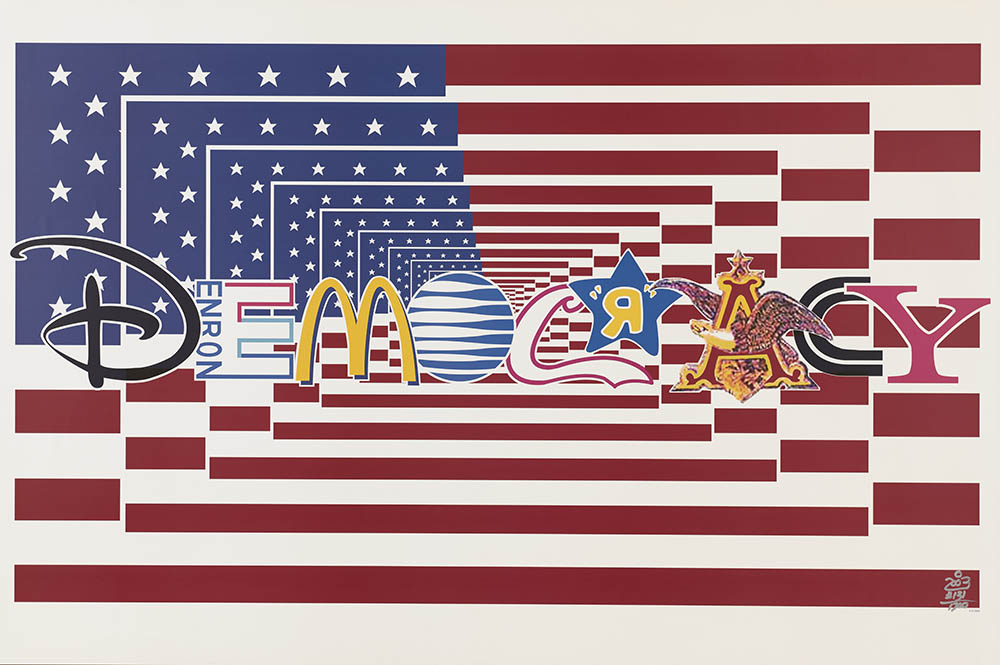
"O" Offset, 2002 Venice, CA 18432


Jul 2, 2025 5:37 PM
Updated Jul 11, 2025 7:58 PM
Subvertisements features and interprets the appropriation of commercial advertisements in protest posters. The posters provoke strong responses, anger, agreement, amusement.
From the moment someone hung a sign out in front of their shop or tavern, symbols—lettering or images—have been used to identify a business and distinguish its product or service from competitors. I imagine the use of symbols initially appeared in communities where people weren’t literate and evolved from there. According to 1000logos.net, Stella Artois, a Belgian beer now owned by Anheuser Busch, was founded in 1366 by Den Hoorn brewery along with one of the first (might we say, Western?) logos. A horn, referencing the name of the company (translated as “The Horn”) was used to associate the beer with the manufacturer, which we must assume had a strong, well-regarded reputation. The Stella logo has gone through many iterations, but interestingly enough the current logo retains the symbol of a horn. Symbols are powerful!

Although these logos were initially used for identification purposes, marketers of the 1950s and 60s realized that they had a potential for much more. Along with a promotional campaign, logos make a product instantly recognizable and build associations with the brand’s corporate values. The idea was to build brand loyalty across products. The elements of the logo such as font, color, quality of line and symbol are carefully chosen to communicate specific corporate standards. The look and symbols of a logo might communicate tradition and stability or quality product, where another choice might communicate playfulness or innovation. Symbols related to nature and/or the color green might be used to communicate a company’s commitment to using natural ingredients or sustainability. Similarly, the color red is frequently associated with left-wing political parties and movements. We all inherently understand how logos work when the kids in the car notice the iconic golden arches and plead for a Happy Meal.
Well, all that carefully planned image-making can be turned against itself when artists remix, parody and reference well-known logos to create social commentary art. And, that is the subject matter of the Center for the Study of Political Graphics’ (CSPG) current exhibition, Subvertisements: Using Ads & Logos for Protest & Solidarity. This exhibition is on display at Mercado La Paloma in downtown Los Angeles through July 11. Selective images and annotation are also available on their website. Both on-site and virtual annotations are available in Spanish and English and Spanish.
Subvertisements features and interprets the appropriation of commercial advertisements in protest posters. The posters provoke strong responses, anger, agreement, amusement. Or they allow us to acknowledge a connection between two ideas. The more familiar the advertising campaign and logo, the more likely it is to be parodied, defaced, appropriated or altered. As a viewer, I observe in myself the stronger the corporate logo the more powerful the political message. Some posters promote real boycotts against real products, such as Gallo Wine or Nestlé. Others are fake ads about real issues such as the Vietnam War, genetically modified food or acid rain. Corporate logos are used to make anti-corporate statements about globalization, consumerism or worker exploitation. For example,
Related stories
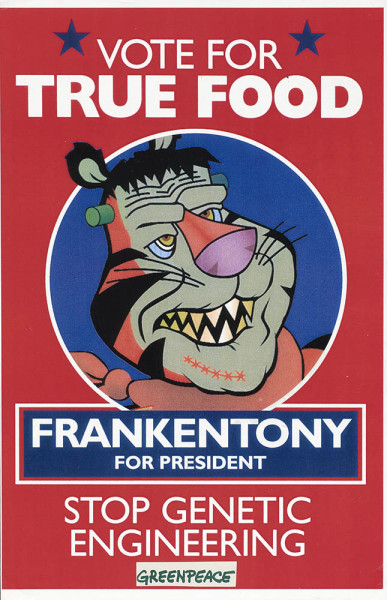
- Green Peace transformed Tony the Tiger, mascot for Frosted Flakes, into “Frankentony” to oppose genetically modified food.
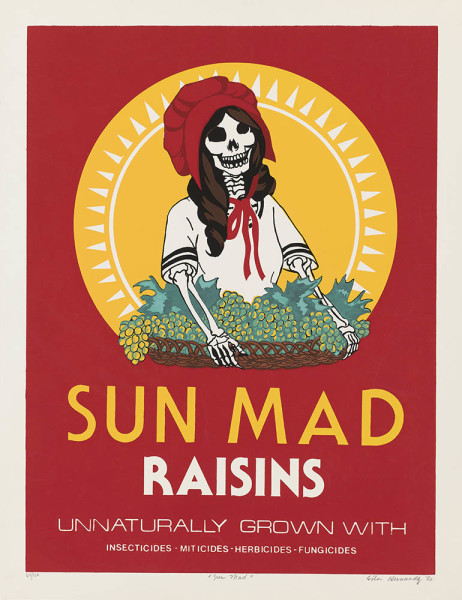
- In 1982 Ester Hernandez altered Sun-Maid raisins’ smiling female mascot into a skeleton, protesting insecticides and herbicides. And 26 years later, she redesigned her earlier poster into Sun Raid, protesting deportations.
- The Marlboro Man was one of the most successful tobacco advertising campaigns worldwide and was used from 1954 to 1999. In 1983 it was used by ACT UP/NY to draw attention to the AIDS crisis and lack of adequate health insurance in the U.S. In 1991 it was featured on an anti-smoking poster, with the masculine cowboy instead depicted as a skeleton, an image of death. (In fact, five actors, and possibly more, who modeled the Marlboro Man died from smoking-related disease.)
The exhibition, featured on the interior walls of the La Paloma food court is grouped into nine different sections: People Over Profits; Corporate Media; Real Products, Real Protest; Health Care Not Wealth Care; Big Banks; Anti-War; Pollution, Climate Change & Environmental Justice; and Olympic Protests. You can enjoy the visual impact of these posters or choose to go deeper by reading the didactics. Instead of wall labels, CSPG provides pages of annotation in English and Spanish hanging on nearby wall hooks. To best digest, I encourage you to see the complete on-site exhibition and feel their impact, enjoy some great food and then, when you have time and focus, return to the website to absorb the extensive annotation. It’s a wonderful history lesson.
This exhibition was designed to travel to diverse grassroots and community-based organizations which do not have UV filtered lighting or the security necessary to protect these fragile vintage posters. To create an exhibition appropriate to these conditions, all the posters are high-quality digital reproductions laminated between two pieces of plastic.
Mercado La Paloma, located in a predominantly working-class and Latinx community, is an acclaimed food court and community center that is visited by between 1,000 and 2,000 people a day. The indoor court features several stores including an alterations shop and a variety of food cafes including a one-star Michelin restaurant. CSPG has been partnering and placing posters on the walls of La Paloma for more than a decade. Readers may recall our last visit there, for a “rogue’s gallery of presidential satire.”
The Center for the Study of Political Graphics is an activist, educational and research archive with more than 90,000 human rights and protest posters from the 19th century to the present. Through this and other traveling exhibitions, CSPG is using the power of art to inform, inspire and incite people to action.
The CSPG exhibition, Subvertisements, was just extended through July 29.
Comments

Powered by RoundtableAn AI/DeFi-powered Enterprise Media Operating System. Learn more at Roundtable.io.© Roundtable 2026. By using this site you agree to the Terms of Use and Privacy Policy