
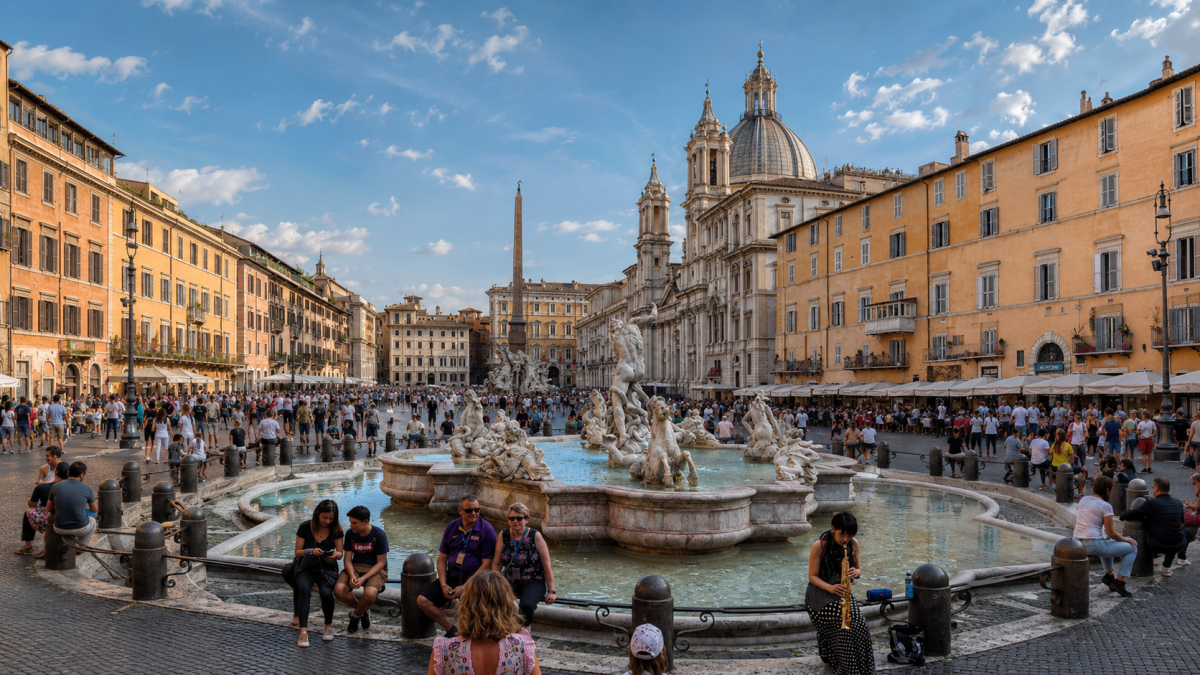
Photo of Rome by Victor Malyushev on Unsplash


Jun 22, 2026 6:20 PM
From a protest against McDonald’s in Rome to a global movement spanning more than 160 countries, Petrini showed that protecting food, farmers, culture, and the planet is inseparable from the struggle for justice.
The founder of Slow Food movement, Carlo Petrini, died last May 21. His lifework reminds us of the perils we now face. The planet and environment have never been more fragile nor endangered – we broke the planet. The world is in an unprecedented, global food crisis; with multiple famines occurring in Gaza and Sudan, and near-famine conditions in Mali, South Sudan, Yemen and Haiti.The food industry has been swamped and subsumed by the corporate-industrial sector, and its companion advertising agencies’ relentless bombardment promoting the worst of the worst. Pope Leo’s recent encyclical, Magnifica Humanitas (Magnificent Humanity) serves as a sequential follow up to Pope Francis’ 2015 encyclical Laudato Si (On Care for Our Common Home), whose focus is on ecology, environmental vision, and climate preservation. Petrini and Pope Francis were friends, and Pope Leo has continued with these concerns.
Petrini’s impetus for creating the Slow Food movement came from the placement of a McDonalds on the Piazza di Spagna in Rome in 1986, where his favorite coffee shop once stood. He responded by organizing a protest, and giving away servings of wholesome, savory food to passersby. Petrini and his friends stood outside the new Rome McDonald’s and gave away servings of penne pasta. He did this to call out, and show up the toxicity of McDonald’s food and culture, which is a global marketing behemoth and a wolf tree, to smaller, more nutritious food enterprises. It’s a fair to say that McDonalds doesn’t serve real food, but rather empty calories high in sodium and other chemicals, which offer NO positive nutrition. That point was graphically illustrated by the late Morgan Spurlock in his 2004 film, Super Size Me; in which he essentially donated his body to medical science by eating ONLY McDonalds “food” for 30 days. That led to a massive weight gain, dramatic cholesterol elevation, liver dysfunction similar to that of an alcoholic, and psychological depression.
“Good, clean and fair,” is the motto of the Slow Food movement, coined by Petrini – a distillation of concepts to promote good food (seasonal and tasty); a clean environment (environmentally and animal welfare-friendly), and fair (to farmers, producers, cooks and food workers.) Petrini’s Slow Food movement inspired many cooks and chefs to rethink their approach to growing, gathering and preparing food; including noted Berkeley food writer Prof. Michael Pollan, and Chef Alice Waters, who is considered the queen of the Slow Food Movement in the US. Prof. Pollan published a tribute to Petrini in 2003, in which he described the Slow Food movement as, “the best way to defend the planet’s cultural and biological diversity is to enjoy it at the table, slowly.” He characterized the beginning of the movement’s resistance to McDonalds saying, “Petrini organized a group of like-minded activist-cum-sybarites to simply celebrate all those qualities that McDonald’s’ inexorable drive toward the homogenization of world taste threatens: the staunchly local, the irreplaceably unique, the leisurely and communal. His (so-very-Italian) idea was to launch a political movement conceived under the signs of pleasure and irony: Dionysus meets Dario Fo.”
Carlo Petrini was a left-wing journalist, who promoted wholesome, nutritious food in a way that bridged cultures and geographies of various culinary traditions and customs. Petrini’s organization, foundedon July 26, 1986 at the Piazza de Espanaevent, was at first known as “Arcigola.” The name cleverly combined ARCI, a popular Italian left-wing recreational association, and gola, Italian for “throat” or gluttony.It then became Slow Food Italy, and culminated with the Slow Food Manifesto. on December 9, 1989. More than twenty nations signed onto it in Paris, and Petrini served as its president until 2022. Portions of the Manifesto echo passages from Alvin Toffler’s 1970 Future Shock. The Manifesto concludes:
Related stories
Real culture is here to be found. First of all, we can begin by cultivating taste, rather than impoverishing it, by stimulating progress, by encouraging international exchange programs, by endorsing worthwhile projects, by advocating historical food culture and by defending old-fashioned food traditions. Slow Food assures us of a better quality lifestyle. With a snail purposely chosen as its patron and symbol, it is an idea and a way of life that needs much sure but steady support.
In 2004, Petrini founded the University of Gastronomic Sciences in Pollenzo, Italy, which was “the first academic institution to offer an interdisciplinary approach to food studies.” This elevated the place of food as an academic endeavor, leading the Italian government to create the world’s first Bachelor’s Degree Program in Gastronomic Sciences, in 2017. Petrini led the Slow Food Movement with a group of friends in the 1980’s to become a global network of environmental and food activists in more than 160 nations. The creation of Terra Madre in 2004 was another major accomplishment, creating a working network of chefs, farmers, fishermen, food crafts people and scholars, which advocated for those marginalized by the corporate-industrial food system.
Petrini had a special friendship with Pope Francis, whose 2015 encyclical, titledLaudito Si (Praise Be to You), advocated for the moral and spiritual obligations of caring for the environment. Petrini’s friendship and alliance with Pope Francis was mutually enriching. The families of both were from the Piedmont area of Italy; Petrini from Bra, and Pope Francis’ paternal grandparents were from Asti province, before they immigrated to Argentina in 1929. On September 7, 2013, the day of Pope Francis’ prayer for peace, Petrini sent the Pope a copy of his book, Terra Madre, which he co-authored with Waters and Pollan; along with a clip of his article on Piedmontese emigration published in La Repubblica. The Pope honored him with a collegial phone call three weeks later, in which they discussed there many areas of common ground, and the Pope’s enthusiasm for Slow Food and Terra Madre.
The sub-title of Pope Francis’ May 24, 2015 Encyclical is “Care for our Common Home,” and tributes his namesake St. Francis of Assisi in Sec 10 saying, “I believe that Saint Francis is the example par excellence of care for the vulnerable and of an integral ecology lived out joyfully and authentically. He is the patron saint of all who study and work in the area of ecology, and . . . He shows us just how inseparable the bond is between concern for nature, justice for the poor, commitment to society, and interior peace.” Other notable sections include:
-Sec. 13: “The urgent challenge to protect our common home includes a concern to bring the whole human family together to seek a sustainable and integral development, , , Here I want to recognize, encourage and thank all those striving in countless ways to guarantee the protection of the home which we share. Particular appreciation is owed to those who tirelessly seek to resolve the tragic effects of environmental degradation on the lives of the world’s poorest.”-Sec. 14: “I urgently appeal, then, for a new dialogue about how we are shaping the future of our planet. We need a conversation which includes everyone, since the environmental challenge we are undergoing, and its human roots, concern and affect us all. . . Obstructionist attitudes, even on the part of believers, can range from denial of the problem to indifference, nonchalant resignation or blind confidence in technical solutions.”-Sec. 18: This echoes the foreshadowing of Toffler’s Future Shock saying, “The continued acceleration of changes affecting humanity and the planet is coupled today with a more intensified pace of life and work which might be called “rapidification”. Although change is part of the working of complex systems, the speed with which human activity has developed contrasts with the naturally slow pace of biological evolution.
The entire document reads as a blueprint for safeguarding the planet with topics such as: Pollution and climate change, including global warming; climate (management) as a common good; and the grave implications for the environment, society and economies. Other topic headings address water, bio-diversity, the decline in quality of human life and social breakdown, and global inequality; as noted in Sec. 48: “The human environment and the natural environment deteriorate together; we cannot adequately combat environmental degradation unless we attend to causes related to human and social degradation. In fact, the deterioration of the environment and of society affects the most vulnerable people on the planet. He adds, “Both everyday experience and scientific research show that the gravest effects of all attacks on the environment are suffered by the poorest”.
Concern for the poor is also articulated in Sec. 25 when he wrote, “Its worst impact will probably be felt by developing countries in coming decades. Many of the poor live in areas particularly affected by phenomena related to warming, and their means of subsistence are largely dependent on natural reserves and eco-systemic services such as agriculture, fishing and forestry.” Pope Francis concluded his encyclical with a prayer for the earth and “a Christian prayer in union with creation.” All the elements that he called out are consistent with the Slow Food-Terra Madre agenda, and illustrate the depth of his alliance with his friend Carlo Petrini.
Pope Leo’s recent encyclical Magnifica Humanitas serves as a timely complementary expression to his predecessor’s encyclical on properly stewarding the earth and its environment. Pope Leo’s warning about the dangers of too much technology, including Large Language Models or “AI,” also harkens back to Toffler’s Future Shock, in which he foreshadowed some of today’s concerns about too much technology overwhelming the human capacity to adapt and cope.
They are in good company with William Shakespeare, whose own “encyclical” about caring for the earth, and the boundaries of “godliness” occurs in Act II Scene 2 of Hamlet, when he says to Rosencrantz and Gildenstern:
I have of late, but wherefore I know not, lost all my mirth, forgone all
custom of exercises, and, indeed, it goes so heavily with my disposition that this goodly frame, the
Earth, seems to me a sterile promontory; this most
excellent canopy, the air, look you, this brave o’erhanging
firmament, this majestical roof, fretted
with golden fire—why, it appeareth nothing to me
but a foul and pestilent congregation of vapors.
What a piece of work is a man, how noble in
reason, how infinite in faculties, in form and moving how express and admirable; in action how like
an angel, in apprehension how like a god: the
beauty of the world, the paragon of animals—and
yet, to me, what is this quintessence of dust?
The Bard’s Renaissance humanism can also be seen in the work of Petrini. The parallel messages of the two papal encyclicals, coupled with Petrini’s untimely passing reminds us of the confluence and connectedness of earth, agriculture, food production, human health, and lamentably . . . politics from local to global. Petrini taught the world, “Good, clean and fair.” It’s also about the deep interconnectedness of agricultural, service, transportation and food labor economies, and fairness to everyone involved including farmers, field workers and food workers.
Comments

Powered by RoundtableAn AI/DeFi-powered Enterprise Media Operating System. Learn more at Roundtable.io.© Roundtable 2026. By using this site you agree to the Terms of Use and Privacy Policy